This week moved work across three layers of the platform at once: the market infrastructure around tokenized agents, the distribution surfaces where those agents get discovered, and the framework code that every Swarms system runs on. The Swarms Screener launched as a native market view for the tokenized agent ecosystem, an integration with GMGN put those same agents in front of one of the largest trading communities on Solana, and AgentHQ opened its waitlist as a new way to run a team of agents.
The connecting theme is legibility. A tokenized agent is a working AI product with a market attached, but that combination only functions if people can see it: what launched, what it does, how its market is behaving, and where to act on it. Two of this week's releases attack that visibility problem from opposite directions, one from inside the platform and one from the trading side.
Underneath the product work, the open-source framework had a heavy engineering week focused on code health. The Agent core lost more than a thousand lines through refactoring and dead-code removal, concurrent execution became more predictable, and a series of fixes landed across the tool system, workflow visualization, and the Agent Orchestration Protocol.
The Swarms Screener Tracks Every Tokenized Agent in Real Time
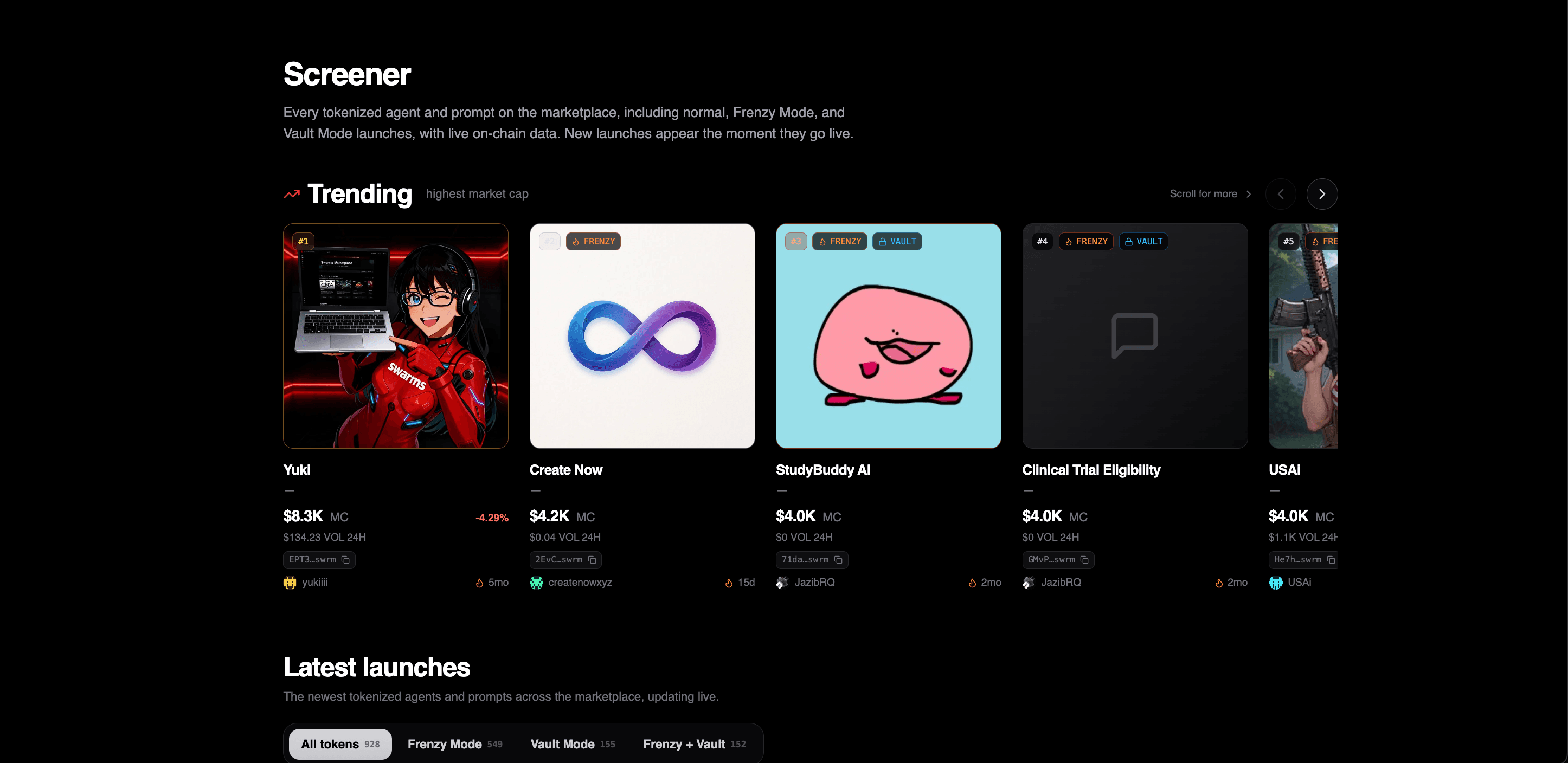
The Swarms Screener is live on the Marketplace as the native market view for the tokenized agent ecosystem. It lists every tokenized agent and prompt on the platform in one page, ranked by market capitalization, with volume and launch activity updating in near real time. Filters narrow the view to agents in Frenzy competitions or agents with Vault Mode enabled, and every row links directly to the agent's listing page. The significance is context. General-purpose market tools show a ticker and a chart; the Screener sits next to the agent's actual description, capabilities, reviews, and creator profile, so evaluating the product and evaluating its market happen in the same place. For creators, it also means a new launch is visible to the whole ecosystem the moment it goes live, without any promotion step.
Learn more
The GMGN Integration Extends Agent Discovery to Traders
Swarms is now integrated with GMGN, one of the most widely used trading platforms on Solana. The integration works in three ways. GMGN's Trenches view can filter for SWRM agents, which surfaces everything launching across the Swarms ecosystem in real time. Any tokenized agent can be found on GMGN by pasting its contract address, which every listing on the Launchpad displays. And each tokenized agent's listing page now carries a Buy on GMGN button that links directly to its GMGN trading view. The technical significance is reach without extra work: every agent published on the Launchpad becomes visible to an active external trading audience automatically, and the fees generated by that additional activity flow back to the agent's creator. The Screener and GMGN complement each other, one providing the Swarms-native view with full agent context and the other the trader-native view with deep market analytics.
Learn more
AgentHQ Opens Its Waitlist
AgentHQ opened its waitlist this week at swarms.ai/agenthq. AgentHQ is a new interface for running a headquarters of AI agents: you hire agents, assign them research and tasks, and manage the operation as a team rather than as a set of disconnected sessions. The early interface presents the operation as an office, with a staff roster, an org chart, and a live feed of what each agent has produced. The design goal is to make multi-agent operation feel like management instead of orchestration code: the questions become who is on the team, what are they working on, and what did they deliver. The waitlist form takes an email address and grants early access as the product rolls out. Signing up now puts developers in the first cohort.
Learn more
The Agent Core Lost Over a Thousand Lines Without Losing Features
The framework's central agent.py dropped from 5,237 lines to 4,084 this week through two structural changes. The autonomous execution path, previously an inline loop handling the max_loops="auto" mode, moved into a dedicated AutonomousAgentLoop component, isolating the most complex control flow in the framework behind a single interface. A separate cleanup removed ten dead methods from the Agent class and moved multi-image input handling down to the model provider layer, cutting 418 further lines. Two dead schema modules were also deleted, and internal ID generation switched to secrets.token_hex. None of this changes the public API. It matters because agent.py is the file every contributor reads first and every feature touches: a smaller, better-factored core reduces review time, shrinks the surface where bugs can hide, and makes the autonomous loop independently testable.
Learn more
Concurrency, Tooling, and Protocol Fixes Across the Framework
A series of correctness fixes landed alongside the refactor. Concurrent multi-agent execution now returns results in input order, so callers can rely on positional correspondence between the agents they passed in and the outputs they get back, and the concurrent dashboard path honors the on_error callback. The Agent Orchestration Protocol received two stability fixes, one stopping its queue lock and persistence loop from blocking indefinitely and one correcting over-broad network-error classification. In the tool system, Pydantic-derived tool schemas are now named after the model class rather than leaking metaclass names into the schema. GraphWorkflow sanitizes workflow names before using them as file paths for visualization output, and arun forwards positional arguments correctly. Four new MCP examples were added to the examples suite with corrections to two stale server entries, keeping the reference material aligned with the current protocol integration.
Learn more
Conclusion
This week connected the two halves of the tokenized agent economy. The Screener made the ecosystem legible from the inside, and the GMGN integration made it legible from the outside, so an agent launched on the platform now reaches both its native audience and an external trading community at the moment it goes live. AgentHQ points at the next interface layer, where operating a team of agents looks like management rather than infrastructure.
The framework work runs in the same direction from below. A smaller Agent core, deterministic concurrent results, and a steadier orchestration protocol are the substrate that every product surface above them depends on. The pattern across the week is consistent: make the system easier to see, easier to reach, and easier to trust.
Resources

![Swarms Weekly Ecosystem Update [August 3 - August 8]: The Auto Agent Builder, the MCP Portal, and a Two-Month Cloud Changelog](/_next/image?url=%2Fecosystem_weekly_update_april3.png&w=3840&q=75)