This week moved on two fronts at once. On the product side, Swarms introduced AgentHQ, an interactive environment for running and observing multi-agent work, and announced the upcoming v15 release of the core framework under the codename Akira. On the platform side, the team published a long-form implementation guide for turning agents into distributable products and opened a new Launchpad competition denominated in USDC.
The common thread is the operator experience. Multi-agent systems are difficult to supervise once they run beyond a single process, and the standard interface for that supervision is still a terminal full of structured logs. AgentHQ replaces that view with a spatial one, where every agent, task assignment, and handoff is visible while it happens. Akira attacks the same problem from underneath, reducing the token cost and execution overhead that make large agent teams expensive to run in the first place.
The remaining work this week concerns distribution. The Builder's Guide documents the full path from an existing agent to a published, priced product on the Marketplace, including several implementation paths for developers who already have code, an API, or an MCP server. The USDC Launch Championship gives that path a concrete deadline and a dollar-denominated market for new launches.
AgentHQ Enters Pre-Beta
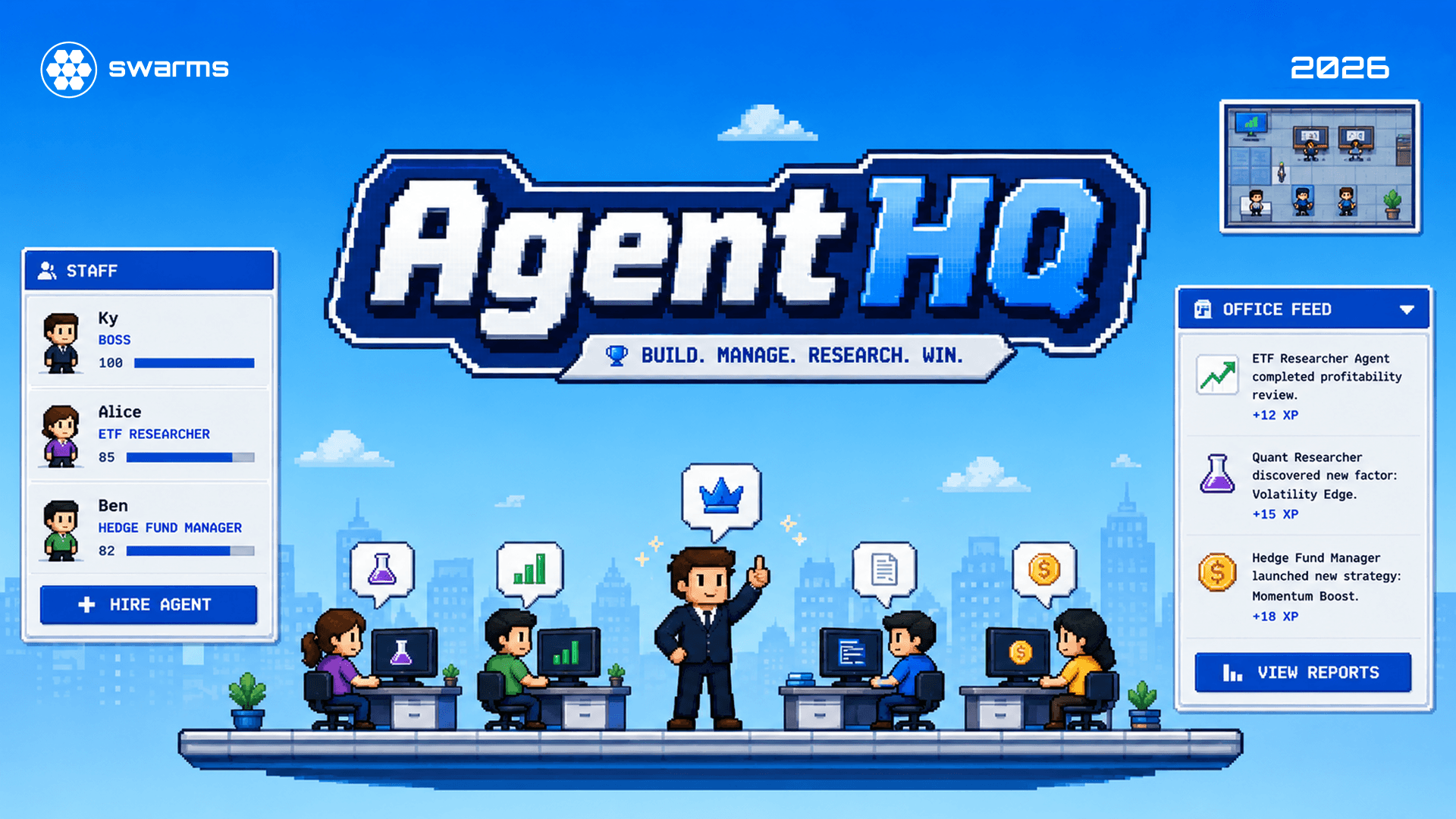
AgentHQ is a new Swarms product that presents multi-agent orchestration as an interactive office rather than a log stream. Developers hire Claude and Codex agents, place them at desks, assign tasks in plain language, and watch execution in real time as agents collaborate, delegate, and hand off results. The design target is observability during a run rather than after it. In a conventional setup, a stalled agent, a duplicated task, or an unexpected tool call surfaces only when the logs are read afterward. AgentHQ makes agent state, current task, and inter-agent communication continuously visible, which shortens the loop between a misbehaving orchestration and the developer noticing. The product is in pre-beta, and access is being granted through a waitlist while the runtime is hardened.
Learn more: swarms.ai/blog/introducing-agenthq
Swarms v15 Akira Announced
Swarms v15, codenamed Akira, was announced this week ahead of its release. Akira is a performance-focused release across the framework, with up to 40 percent lower token usage across multi-agent architectures and lower-level concurrent execution in the runtime. Token consumption is the dominant cost in multi-agent systems, because every additional agent multiplies context, tool schemas, and intermediate output. A 40 percent reduction changes which architectures are economically viable at production scale, particularly wide concurrent workflows and long-running hierarchical swarms. The concurrency work targets the second constraint, moving coordination further down the stack so that agents executing in parallel spend less time waiting on the orchestration layer. The release ships in the coming days, and the newsletter carries the release notification.
Learn more: github.com/kyegomez/swarms
The Builder's Guide to Tokenized AI Agents

The Builder's Guide to Tokenized AI Agents was published this week as a complete implementation reference for publishing agents and prompts as products on Swarms Launchpad. The guide covers which categories of agents suit a distribution model of this kind, the four supported implementation paths (Code, x402, MCP, and Website), GitHub imports for existing repositories, launch configuration options including pricing models and USDC or SOL denominated markets, and the operational modes available at launch time. It walks the full publishing process end to end rather than describing the feature set in the abstract. For developers with an agent already running in production, the practical value is the import path: an existing repository or hosted endpoint becomes a listed product without rewriting the agent itself.
Learn more: swarms.ai/blog/complete-guide-tokenizing-your-agent
The USDC Launch Championship Opens
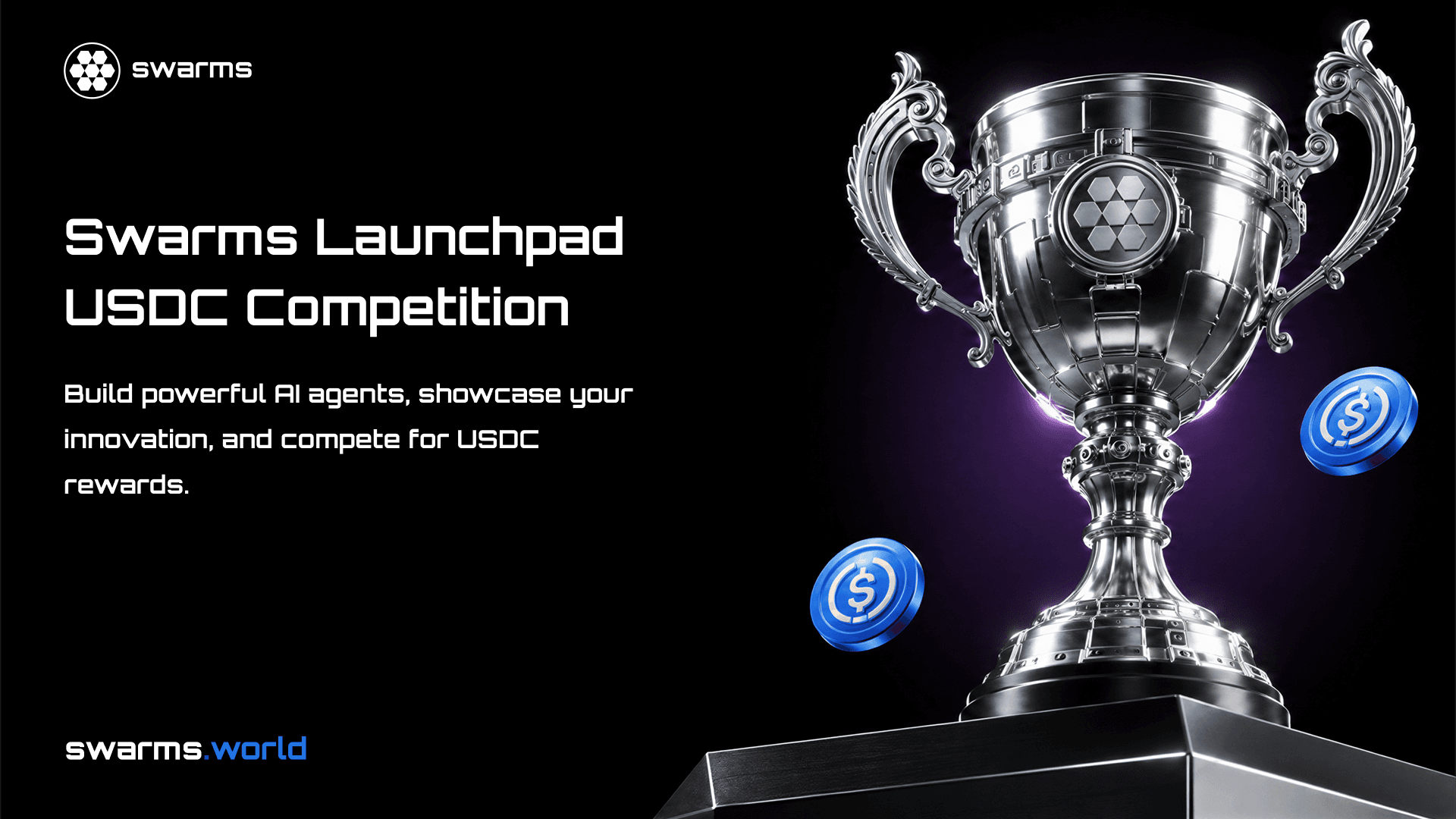
The USDC Launch Championship opened on August 26 and runs through September 2 UTC. Developers who publish an agent or prompt on Swarms Launchpad with USDC selected as the quote currency are entered automatically, and the top three launches by total trading volume share a prize pool of 1,000 USDC, distributed as 500, 350, and 150. The leaderboard updates throughout the competition window. The technical detail worth noting is the quote currency itself. Pricing a launch in USDC gives creators a stable unit of account, so revenue and pricing decisions are not affected by movement in a volatile denominating asset. That makes the economics of a published agent easier to reason about, which matters for developers treating a listing as a product rather than an experiment.
Learn more: swarms.ai/blog/usdc-launch-championship
Swarms Ranks Fourth Among Solana Launchpads
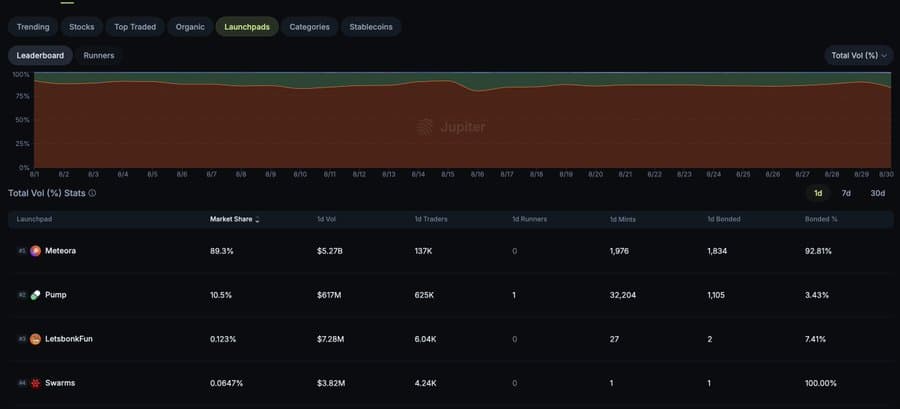
Swarms is now the fourth largest launchpad on Solana by the public Jupiter rankings. The position reflects sustained launch activity on Swarms Launchpad rather than a single event, and it follows the tokenization work shipped over the past several weeks, including configurable pricing, USDC and SOL denominated markets, Vault Mode, and Frenzy Mode. The longer term goal is to make Swarms the home for agent capital markets on Solana, where developers tokenize agents and prompts, publish them, and distribute them to thousands of potential users through a single surface. For developers, the practical consequence is distribution. A launchpad with this level of activity gives a newly published agent an audience on day one, which is the constraint most independent developers hit after the agent itself is working.
Learn more: swarms.world/launch
Ecosystem and Community
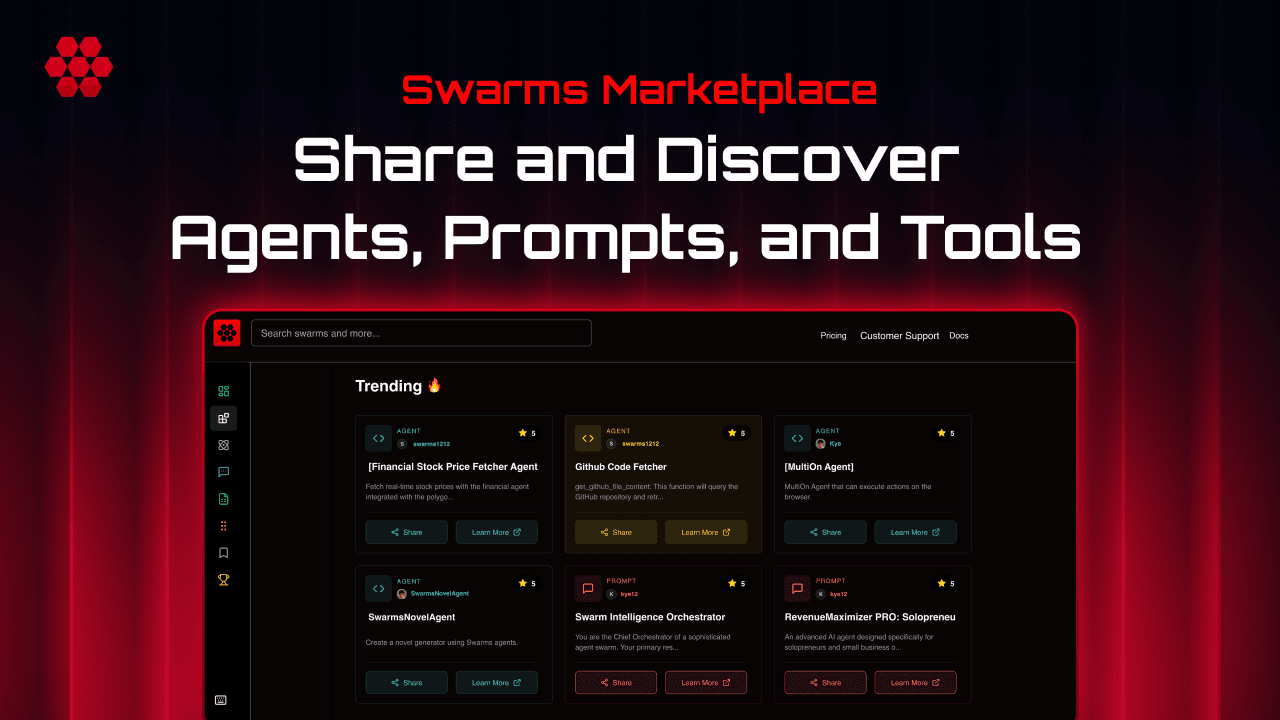
The Marketplace continued to expand alongside the product work, with community launches, prompt publishing, and Launchpad activity running through the week. The Swarms MCP server, released the previous week, remains available at a single hosted endpoint with 23 tools spanning agent execution, multi-agent swarms, batch processing, workflow orchestration, model discovery, and service health, and the MCP Portal on Swarms Cloud remains the entry point for connection setup and diagnostics. Developers building against AgentHQ, Akira, or Launchpad can use the same API key across all three surfaces.
Learn more: swarms.world
Conclusion
The week's releases address different layers of the same problem. Running a multi-agent system in production requires that it be observable while it runs, affordable at scale, and distributable once it works. AgentHQ covers the first, Akira the second, and the Launchpad guide and competition the third.
None of the three is finished. AgentHQ is in pre-beta, Akira ships in the coming days, and the competition closes on September 2 UTC. Developers who want early access to AgentHQ should join the waitlist, and the newsletter carries the Akira release notification when the framework version ships 🦾
Links and Resources

![Swarms Weekly Ecosystem Update [August 24 - August 31]: AgentHQ Pre-Beta, Swarms v15 Akira, and the Builder's Guide to Tokenized Agents](/_next/image?url=%2Fswarms_weekly_end_off_aug.png&w=3840&q=75)