如果你希望多个 AI 智能体协同完成规划、研究、撰写和审核,又不想自己运维承载它们的服务器,那么在 2026 年有三个现实的选项:Swarms API、Amazon Bedrock Agents(现已更名为 Agents Classic)及其继任者 Amazon Bedrock AgentCore,以及 Google 的 Vertex AI Agent Builder 搭配 Agent Development Kit(ADK)。本文在三者上运行同一个三智能体任务,然后比较真正决定平台选型的几个方面:支持的架构、模型目录、流式输出、批处理、定价,以及拿到第一个结果所需的时间。
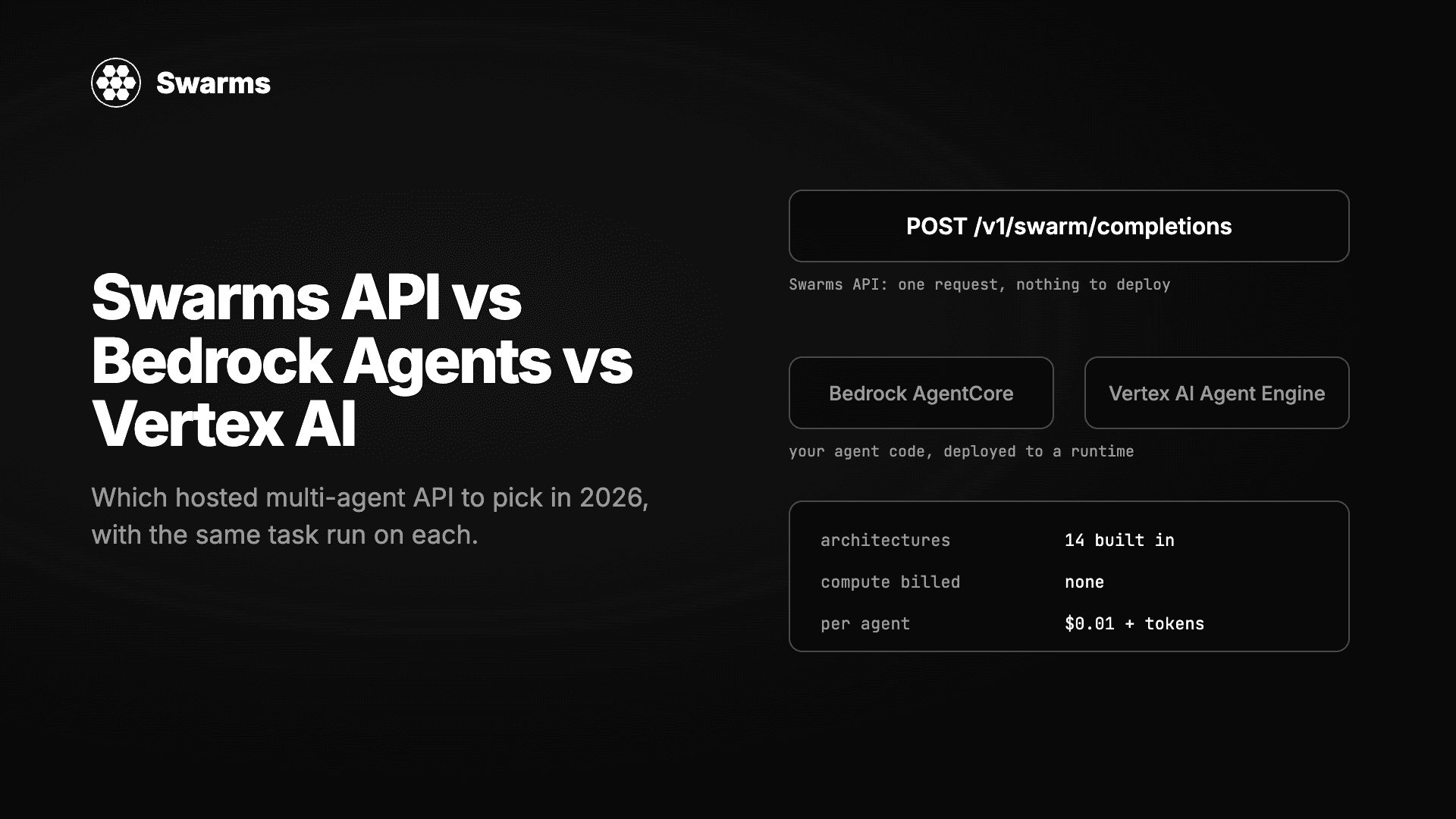
一句话总结:Bedrock 和 Vertex 卖给你的是一个运行时。你编写智能体代码、打包、部署,并在它处理流量时按 vCPU 小时付费。Swarms API 卖给你的是结果。你用一个 JSON 请求体描述智能体和架构,发送一次 HTTP 请求,按智能体数量加模型 token 付费。哪种更合适,取决于你想自己掌控多少编排工作。
我们在三个平台上运行的任务
下面每个示例构建的都是同一条流水线:研究员收集事实,分析师整理结构,撰稿人产出一份竞争简报。任务是一份关于柏林共享电动滑板车市场的简报。任务刻意选得平常,重点是看每个平台运行三个协作智能体需要多少代码和基础设施。
选项一:Swarms API
Swarms API 把多智能体编排暴露为一个端点:POST /v1/swarm/completions。你选择一个 swarm_type,列出智能体及其系统提示词和模型,然后发送任务。没有任何东西需要部署。
curl -X POST https://api.swarms.world/v1/swarm/completions \
  -H "x-api-key: $SWARMS_API_KEY" \
  -H "Content-Type: application/json" \
  -d '{
    "name": "Market Brief Desk",
    "swarm_type": "SequentialWorkflow",
    "task": "Write a competitive brief on the shared electric scooter market in Berlin for an operator considering entry in 2027. Cover market size, three main competitors, regulatory risks and a recommendation. Keep it under 500 words.",
    "agents": [
      {
        "agent_name": "Researcher",
        "system_prompt": "You are a market researcher. List the facts, figures and competitor details relevant to the task as concise bullet points.",
        "model_name": "gpt-5.4-mini",
        "max_loops": 1
      },
      {
        "agent_name": "Analyst",
        "system_prompt": "You are a strategy analyst. Turn the research into structured findings with a recommendation and reasoning.",
        "model_name": "claude-haiku-5-5",
        "max_loops": 1
      },
      {
        "agent_name": "Writer",
        "system_prompt": "You are a business writer. Write the final brief under 500 words with the sections: Market size, Main competitors, Regulatory risks, Recommendation.",
        "model_name": "claude-sonnet-5-5",
        "max_loops": 1
      }
    ],
    "max_loops": 1
  }'
用官方 Python 客户端发起同样的调用:
import os
from swarms_client import SwarmsClient

client = SwarmsClient(api_key=os.environ["SWARMS_API_KEY"])

result = client.swarms.run(
    name="Market Brief Desk",
    swarm_type="SequentialWorkflow",
    task=(
        "Write a competitive brief on the shared electric scooter market in Berlin "
        "for an operator considering entry in 2027. Cover market size, three main "
        "competitors, regulatory risks and a recommendation. Keep it under 500 words."
    ),
    agents=[
        {
            "agent_name": "Researcher",
            "system_prompt": "You are a market researcher. List the facts, figures and competitor details relevant to the task as concise bullet points.",
            "model_name": "gpt-5.4-mini",
            "max_loops": 1,
        },
        {
            "agent_name": "Analyst",
            "system_prompt": "You are a strategy analyst. Turn the research into structured findings with a recommendation and reasoning.",
            "model_name": "claude-haiku-5-5",
            "max_loops": 1,
        },
        {
            "agent_name": "Writer",
            "system_prompt": "You are a business writer. Write the final brief under 500 words with the sections: Market size, Main competitors, Regulatory risks, Recommendation.",
            "model_name": "claude-sonnet-5-5",
            "max_loops": 1,
        },
    ],
    max_loops=1,
)

for step in result["output"]:
    print(f"\n## {step['role']}\n{step['content']}")

print(result["usage"])
我们实际运行这个请求时,22 秒后拿到了响应,其中按顺序包含每个智能体的输出,以及一个 usage 块:
{
  "input_tokens": 5064,
  "output_tokens": 3424,
  "total_tokens": 8488,
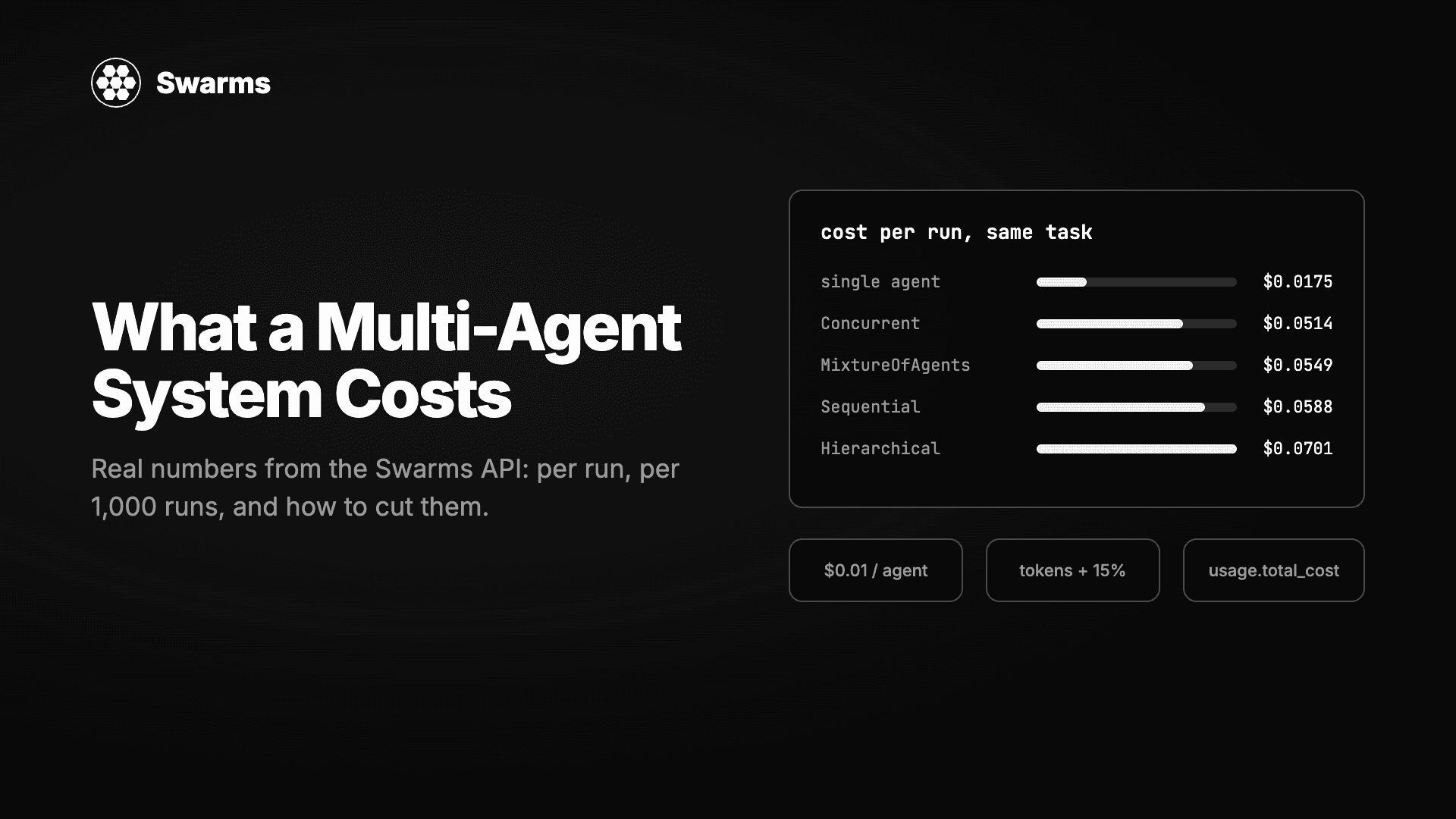
  "total_cost": 0.058763,
  "billing_info": {
    "cost_breakdown": {
      "agent_cost": 0.03,
      "input_token_cost": 0.007076,
      "output_token_cost": 0.021687,
      "num_agents": 3
    }
  }
}
来自两家模型供应商的三个智能体,一次请求,不到六美分,账单在响应里逐项列出。切换架构只需改一个词:把 swarm_type 设为 ConcurrentWorkflow,智能体就并行运行;设为 HierarchicalSwarm,就由一个主管来规划和分派;设为 MajorityVoting,它们就进行投票。
选项二:Amazon Bedrock Agents 与 AgentCore
Amazon 这里有两代产品,而且在 2026 年这个区别很重要。
Bedrock Agents Classic 是最初通过控制台配置的产品:你定义一个带指令、动作组(由 Lambda 支撑的工具)和知识库的智能体,然后用 InvokeAgent 调用它。多智能体协作功能在 2025 年 3 月推出。你把一个智能体指定为主管(supervisor),再把协作者智能体关联到它上面;主管负责规划并把工作路由给协作者。AWS 自己的文档现在写明,Agents Classic 已不再接受新注册,现有用户被引导至 Amazon Bedrock AgentCore。如果你今天才开始,Classic 不是一个选项。
Amazon Bedrock AgentCore 是替代品:一个托管运行时,承载你用任意框架编写的智能体代码,最常见的是开源的 Strands Agents SDK。你会得到 Runtime(无服务器会话)、Gateway(以 MCP 形式提供的工具)、Memory、Identity、Browser、Code Interpreter 和 Observability,每一项都单独计费。多智能体模式存在于你的代码里,而不是平台里。
下面是用 Strands 实现的同一条三智能体流水线。Swarm 类允许智能体之间互相交接;第一个智能体接收任务,当某个智能体回复而不再交接时运行结束。
# agent.py
from bedrock_agentcore.runtime import BedrockAgentCoreApp
from strands import Agent
from strands.multiagent import Swarm

researcher = Agent(
    name="researcher",
    system_prompt="You are a market researcher. Gather facts, figures and competitor details, then hand off to the analyst.",
)
analyst = Agent(
    name="analyst",
    system_prompt="You are a strategy analyst. Structure the research into findings and a recommendation, then hand off to the writer.",
)
writer = Agent(
    name="writer",
    system_prompt="You are a business writer. Write the final brief under 500 words. Do not hand off.",
)

swarm = Swarm(
    [researcher, analyst, writer],
    entry_point=researcher,
    max_handoffs=6,
    max_iterations=6,
    execution_timeout=600.0,
)

app = BedrockAgentCoreApp()


@app.entrypoint
def invoke(payload: dict) -> dict:
    result = swarm(payload["prompt"])
    return {
        "status": str(result.status),
        "path": [node.node_id for node in result.node_history],
        "output": str(result.results[result.node_history[-1].node_id].result),
    }


if __name__ == "__main__":
    app.run()
部署和调用:
pip install bedrock-agentcore strands-agents bedrock-agentcore-starter-toolkit
agentcore configure --entrypoint agent.py
agentcore launch
agentcore invoke '{"prompt": "Write a competitive brief on the shared electric scooter market in Berlin for an operator considering entry in 2027..."}'
你要承担的内容:一个带有运行时 IAM 角色的 AWS 账户,每次代码改动都要走一次部署,走自定义路线时需要 ARM64 容器,以及在 Bedrock 中为每个模型系列申请访问权限。Strands 本身与模型无关(支持 Bedrock、Anthropic、OpenAI、Gemini 和 LiteLLM 等提供方),但 AgentCore 的定价页面明确说明,模型 token 通过 Bedrock 或你的供应商单独计费。
选项三:Vertex AI Agent Builder 与 ADK
Google 的路线是 Agent Development Kit,一个提供 Python、TypeScript、Go、Java 和 Kotlin 版本的开源框架,再加上 Agent Engine,即 Vertex AI 中承载它的托管运行时。ADK 自带的工作流智能体与 Swarms 的架构最为接近:SequentialAgent、ParallelAgent 和 LoopAgent,叶子节点则是 LlmAgent。
# market_brief/agent.py
from google.adk.agents.llm_agent import LlmAgent
from google.adk.agents.sequential_agent import SequentialAgent

researcher = LlmAgent(
    name="Researcher",
    model="gemini-2.5-flash",
    instruction=(
        "You are a market researcher. List the facts, figures and competitor "
        "details relevant to the user's request as concise bullet points."
    ),
    output_key="research",
)

analyst = LlmAgent(
    name="Analyst",
    model="gemini-2.5-flash",
    instruction=(
        "You are a strategy analyst. Using the research below, write structured "
        "findings with a recommendation and reasoning.\n\nResearch:\n{research}"
    ),
    output_key="findings",
)

writer = LlmAgent(
    name="Writer",
    model="gemini-2.5-pro",
    instruction=(
        "You are a business writer. Using the findings below, write the final "
        "brief under 500 words with the sections: Market size, Main competitors, "
        "Regulatory risks, Recommendation.\n\nFindings:\n{findings}"
    ),
)

root_agent = SequentialAgent(
    name="MarketBriefPipeline",
    sub_agents=[researcher, analyst, writer],
    description="Research, analyse and write a competitive market brief.",
)
本地运行与部署:
pip install google-adk
adk run market_brief
adk deploy agent_engine --project $GOOGLE_CLOUD_PROJECT --region us-central1 \
  --staging_bucket gs://$STAGING_BUCKET market_brief
ADK 是一个用起来舒服的框架,用 output_key 对应 {占位符} 在步骤之间传递状态的约定也很清晰。代价与 AWS 同一个形态:一个 Google Cloud 项目、一个暂存存储桶、IAM、每次改动一次部署,以及在模型 token 之外按小时计费的运行时。Gemini 是一等公民;Claude、OpenAI 和 Ollama 模型通过 ADK 的模型集成和 LiteLLM 使用。
并排对比
| Swarms API | Bedrock AgentCore(Strands) | Vertex AI Agent Builder(ADK) |
|---|
| 你需要部署什么 | 不需要,一次 HTTP 请求 | 把你的智能体代码部署到 Runtime | 把你的智能体代码部署到 Agent Engine |
| 多智能体架构 | 内置 14 种:Sequential、Concurrent、Hierarchical、MixtureOfAgents、GroupChat、MajorityVoting、Debate、Council、Router、Rearrange 等 | 你自己编码:Strands Swarm、Graph、智能体即工具 | Sequential、Parallel、Loop 工作流智能体,以及自定义和图工作流 |
| 更换架构 | 改一个字符串 | 改代码,重新部署 | 改代码,重新部署 |
| 模型 | API 提供的任意模型 id:GPT-5.4、Claude Sonnet 5.5、Gemini 2.5、DeepSeek、Kimi 及 OpenRouter 目录,每个智能体可不同 | Bedrock 目录,加上通过 Strands 接入的供应商 SDK | Gemini 优先,其他通过集成和 LiteLLM |
| 流式输出 | 智能体和集群均支持 SSE,并带有每个智能体的归属标记 | 在你的代码和 Runtime 中实现 | 在 ADK 和 Agent Engine 中实现 |
| 批处理 | /v1/swarm/batch/completions 和 /v1/agent/batch/completions(高级版) | 自行构建 | 自行构建 |
| 日志与指标 | API 内置 /v1/swarm/logs、/v1/metrics/summary | 通过 Observability 进入 CloudWatch | Cloud Logging 与 Trace |
| 计算定价 | 无 | 每 vCPU 小时 $0.1276,每 GB 小时 $0.0169(Runtime v2,按用量) | 每 vCPU 小时 $0.0864,每 GB 小时 $0.0090 |
| 编排定价 | 每次请求每个智能体 $0.01,加模型 token 及 15% 服务费 | Gateway 每 1,000 次调用 $0.005,Memory 每 1,000 个事件 $0.25,加模型 token | Sessions 与 Memory Bank 每 1,000 个事件 $0.25,加模型 token |
| 拿到第一个结果 | 几分钟:一个 API 密钥和一次请求 | 几小时:账户、IAM、配置、启动 | 几小时:项目、存储桶、部署 |
定价数据取自 2026 年 11 月 8 日的公开定价页面,变动频繁,建模成本前请先核对。Swarms 的价格来自 GET /v1/models/pricing,它返回每个模型已包含服务费的费率。
各自的优势场景
选择 Swarms API 的情况:产品的核心是多智能体的输出,而不是托管。为产品添加智能体功能的创业公司、想在一个下午试完五种架构的团队、需要一个 HTTP 步骤的无代码工具,以及任何想在一次运行中混用不同供应商模型的人。逐项列出的 usage 块让按客户计费变得直接,付费计划在集群补全上的夜间折扣,可以让错峰调度的批量工作 token 成本减半。
选择 Bedrock AgentCore 的情况:你的其余技术栈已经在 AWS 上,你需要通过 Gateway 暴露工具并用 IAM 限定身份,或者合规团队要求数据留在你的 AWS 账户和 VPC 内。你会写更多代码,也要自己维护部署流水线,但换来的是围绕它的完整 AWS 控制平面。
选择 Vertex AI Agent Builder 的情况:你已经选定 Gemini 和 Google Cloud,你想用 Python 之外的语言使用 ADK 的类型化工作流智能体,或者 Agent Engine 的会话和 Memory Bank 适合你的对话类产品。同样的取舍:更多的掌控权,更多的控制力,更多的搭建工作。
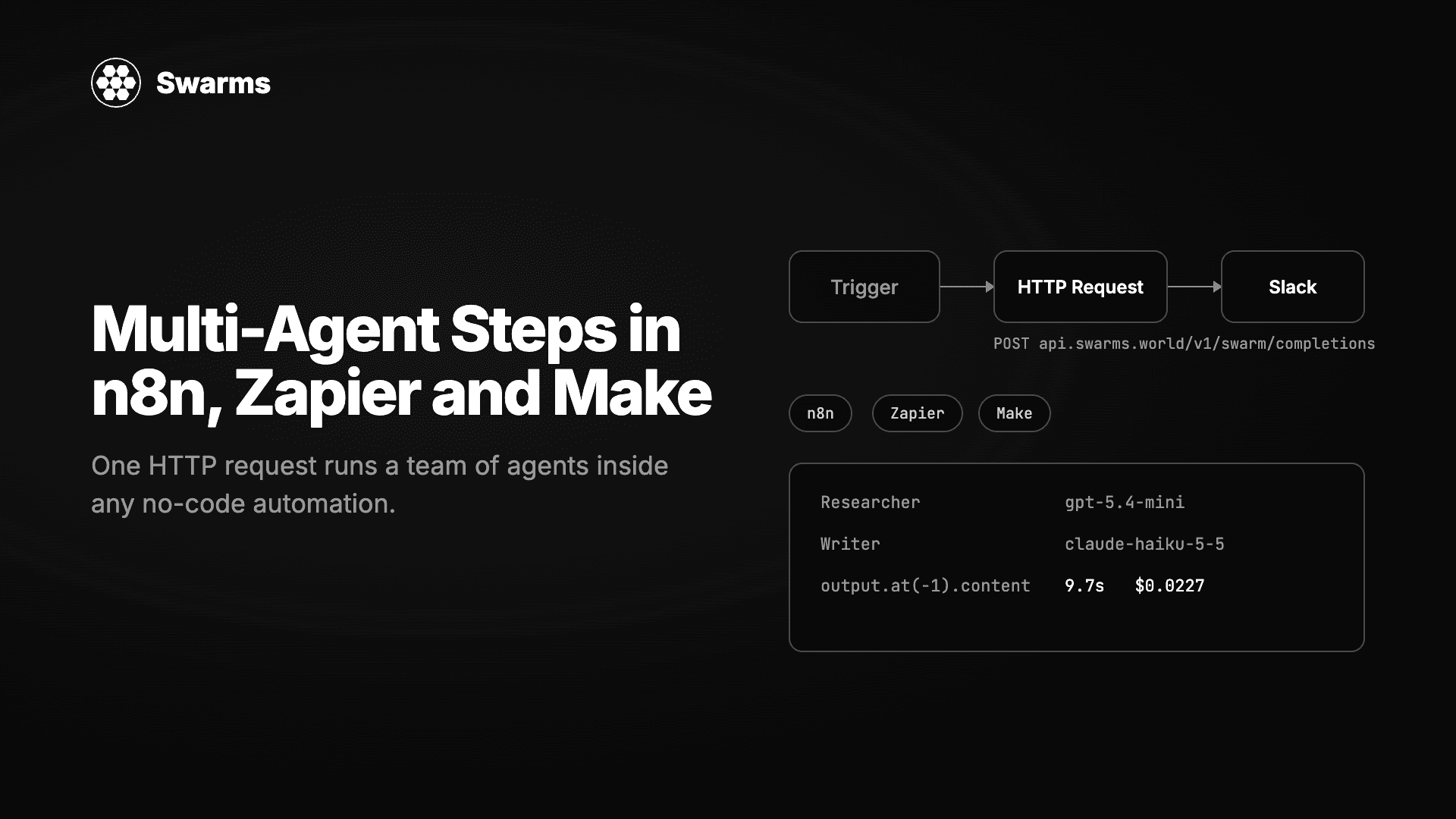
还有一种许多团队最终采用的混合方案。把需要工具或私有数据的智能体代码留在自己手里,在其中调用 Swarms API 来处理纯编排的部分:动作执行前的一次 MajorityVoting 校验、一次 HierarchicalSwarm 研究、对一批文档的 ConcurrentWorkflow 扇出。这个 API 就是一个普通的 HTTP 调用,所以无论放进 Strands 工具、ADK 函数工具还是 Lambda,都同样顺手。
常见问题
Amazon Bedrock Agents 还能用于新项目吗?
Amazon Bedrock Agents 现在是 Amazon Bedrock Agents Classic,AWS 的文档写明已不再接受新注册。现有用户可以继续使用。新项目被引导至 Amazon Bedrock AgentCore,搭配 Strands Agents 等框架。
最接近 Bedrock、又不需要部署代码的替代方案是什么?
Swarms API。它在一个请求体中接收智能体和架构,在托管基础设施上运行,并返回带逐项账单的输出。没有运行时需要部署或扩容。
Swarms API 能在同一个集群里混用 Claude、GPT 和 Gemini 吗?
可以。每个智能体设置自己的 model_name,所以一个集群可以用 claude-sonnet-5-5 撰写、gpt-5.4-mini 研究、deepseek-v4-pro 分析。调用 GET /v1/models/available 获取实时列表和价格。
Swarms API 的定价与 Agent Engine 和 AgentCore 相比如何?
Swarms 每次请求每个智能体收 $0.01,加上模型 token 及 15% 服务费,计算资源不收费。Agent Engine 和 AgentCore 按 vCPU 小时和 GB 小时收取运行时计算费,加上会话或记忆的按事件费用,模型 token 另行计费。对于突发或低流量的工作负载,Swarms 的模式通常更便宜,因为空闲时间不花钱。对于持续高流量的同类调用,请用你自己的 token 数量算一算。
Swarms API 支持多智能体运行的流式输出吗?
支持。在 /v1/swarm/completions 上设置 stream: true,API 会返回 Server-Sent Events。对于 SequentialWorkflow 和 AgentRearrange,每个分块都带有智能体名称,UI 可以显示是哪个智能体在输出。其他集群类型会发送一个包含完整结果的分块。
开始使用
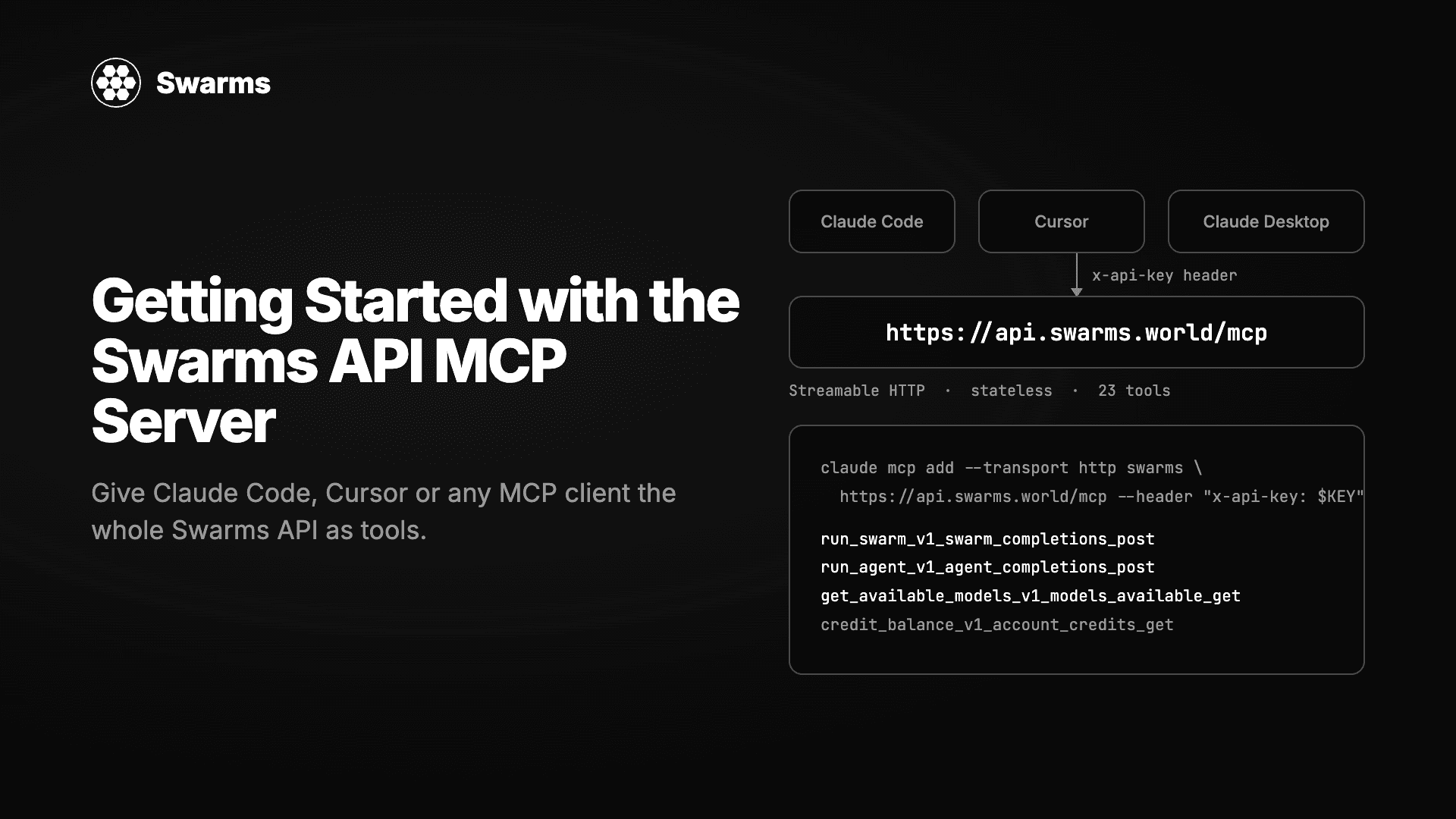
curl -H "x-api-key: $SWARMS_API_KEY" https://api.swarms.world/v1/swarms/available
这个调用会列出 API 今天能运行的每一种架构。在 swarms.world 获取密钥,阅读 Swarms API 文档,并在行业页面查看同样的请求在你所在领域是什么样子。如果你在权衡的是开源框架而不是托管平台,多智能体框架对比涵盖了 LangGraph、CrewAI、AutoGen 和 Swarms。