指南工程
Swarms x TypeSafe:如何在 Swarms 框架和 API 中使用决策模型
Swarms 决策模型完整指南。向 TypeSafe 的 Jev 和 Cloudflare 的 Clef 提出类型化问题并获得校准后的概率,对比和集成多个模型,把它们接入智能体和集群,并通过 Swarms API 或 TypeSafe SDK 调用。
Swarms 团队10 分钟阅读

Swarms 决策模型完整指南。向 TypeSafe 的 Jev 和 Cloudflare 的 Clef 提出类型化问题并获得校准后的概率,对比和集成多个模型,把它们接入智能体和集群,并通过 Swarms API 或 TypeSafe SDK 调用。

一个智能体系统每天做的大部分事情,其实是大量的小决策。这张工单该交给哪个智能体?这条回复可以发布吗?任务完成了吗?这条消息是垃圾信息吗?团队通常再调用一次大模型来回答这些问题:写提示词、生成文本、解析文本,然后祈祷格式不出错。
决策模型直接回答这些问题。你给决策模型一个 state(文本、JSON 对象或列表)和一组类型化的 questions,它在一次请求中为每个可能的答案返回概率。TypeSafe 把这称为 System One 模型:快速、低成本、类型化的判断,与大模型擅长的慢速 System Two 推理互为补充。
Swarms 现在在开源框架和 Swarms API 中都支持决策模型:
jev-latest、jev-preview、jev-1.13.0),每百万输入 token 0.042 美元,输出 token 免费。clef,一个 27B 多模态模型;clef-flash,一个更快的 9B 模型),运行在 Workers AI 上。本指南从第一个问题讲起,一直到路由智能体、审核智能体输出、集成多个决策模型,以及通过 Swarms API 用普通 HTTP 或官方 TypeSafe SDK 调用这一切。下面每段代码在发布前都实际运行过,展示的输出都是真实结果。
一共有三种问题类型,可以在一次请求中自由混用:
| 类型 | 回答什么 | 返回内容 |
|---|---|---|
choice | 这些选项中哪个适用? | choice、每个选项的 probabilities、confidence |
score | 它在一个有序量表上处于什么位置? | score(按概率加权的等级,可以落在两个等级之间)、legend、probabilities、confidence |
noul | 这个是/否陈述成立吗? | noul,0 到 1 之间的概率 |
因为每个答案都带有概率,如何处理不确定性由你决定。置信度 0.98 的选择可以自动化处理,置信度 0.40 的选择可以交给人工或第二个模型。你永远不需要解析自由文本,答案也永远不会是你没有提供的选项。
决策模型支持从 swarms 16.0.1 开始提供:
pip install -U "swarms>=16.0.1"把你要用的服务商密钥加到 .env 文件中,Swarms 会自动读取:
TYPESAFE_API_KEY="your-typesafe-key"        # Jev models
CLOUDFLARE_ACCOUNT_ID="your-account-id"     # Clef models
CLOUDFLARE_AUTH_TOKEN="your-workers-ai-token"
只需要配置你打算调用的服务商的密钥。模型名称决定服务商:以 jev 开头的发往 TypeSafe,以 clef 开头的发往 Cloudflare Workers AI。
DecisionModel 为每种问题类型提供了一个辅助方法。每个辅助方法发送一次请求并返回一个答案:
from swarms import DecisionModel

# Uses TypeSafe's jev-latest and reads TYPESAFE_API_KEY from the environment or .env.
model = DecisionModel()

ticket = "I was charged twice for my March invoice and need one of the charges refunded today."

urgent = model.noul(ticket, "The customer needs this resolved today.")
team = model.choice(
    ticket,
    "Which team should handle this ticket?",
    {
        "billing": "Payments, refunds and invoices",
        "technical": "Bugs, outages and API errors",
        "sales": "Pricing and plan questions",
    },
)
frustration = model.score(
    ticket,
    "How frustrated is the customer?",
    ["Calm", "Frustrated", "Angry"],
)

print(f"Urgent: {urgent:.2f}")
print(f"Team: {team['choice']} (confidence {team['confidence']:.2f})")
print(f"Team probabilities: {team['probabilities']}")
print(f"Frustration: {frustration['score']:.2f} on a 0 to 2 scale")Urgent: 0.96
Team: billing (confidence 1.00)
Team probabilities: {'sales': 0.0, 'billing': 1.0, 'technical': 0.0}
Frustration: 0.87 on a 0 to 2 scale辅助方法很方便,但你最常用的会是 run()。它只发送一次 state,附带任意数量的命名问题,并按你起的名字返回每个答案。这比每个问题单独请求更快也更便宜,因为 state 只处理一次:
from swarms import DecisionModel

model = DecisionModel(model_name="jev-latest")

response = model.run(
    state={
        "subject": "Checkout is down",
        "message": "Checkout has failed for every customer for the last hour. We are losing sales!",
        "customer_plan": "enterprise",
    },
    questions={
        "team": {
            "type": "choice",
            "instructions": "Which team should handle this ticket?",
            "criteria": {
                "billing": "Payments, refunds and invoices",
                "technical": "Bugs, outages and API errors",
                "sales": None,
            },
        },
        "frustration": {
            "type": "score",
            "instructions": "How frustrated is the customer?",
            "criteria": ["Calm", "Frustrated", "Angry"],
        },
        "urgent": {
            "type": "noul",
            "instructions": "Is this request urgent?",
            "criteria": {"true": "Customers are blocked right now"},
        },
    },
)

answers = response["answers"]
print(f"Answered by {response['model']}")
print(f"Team: {answers['team']['choice']} {answers['team']['probabilities']}")
print(f"Frustration: {answers['frustration']['score']:.2f} {answers['frustration']['probabilities']}")
print(f"Urgent: {answers['urgent']['noul']:.2f}")
print(f"Usage: {response['usage']}")
print(f"Cost: ${model.calculate_cost(response['usage'])['total_cost']:.7f}")Answered by jev-1.13.0
Team: technical {'billing': 0.03, 'sales': 0.0, 'technical': 0.97}
Frustration: 1.53 {'0': 0.0, '1': 0.47, '2': 0.53}
Urgent: 0.97
Usage: {'input_tokens': 434, 'output_tokens': 70}
Cost: $0.0000182有几点值得注意:
model 是实际作答的版本。jev-latest 和 jev-preview 是别名,在撰写本文时都指向 jev-1.13.0。choice 的选项可以带描述,也可以用 None 只按名称判断(上面的 "sales": None)。probabilities。get_decision_models() 列出所有决策模型,并从每个已设置密钥的服务商实时获取列表。get_decision_model_prices() 返回它们的价格,单位是每百万 token 的美元。Cloudflare 通过 API 公布价格,因此设置了 Cloudflare 密钥后,Clef 的价格会实时获取:
from swarms import get_decision_model_prices, get_decision_models

prices = get_decision_model_prices()
for name in get_decision_models():
    price = prices.get(name)
    if price:
        print(f"{name:<12} ${price['input']}/1M input, ${price['output']}/1M output")
    else:
print(f"{name:<12} price not published")jev-latest $0.042/1M input, $0.0/1M output
jev-preview $0.042/1M input, $0.0/1M output
jev-1.13.0 $0.042/1M input, $0.0/1M output
clef $0.24/1M input, $0.0/1M output
clef-flash $0.09/1M input, $0.0/1M output每个 DecisionModel 都会累计服务商报告的输入和输出 token,涵盖 run()、arun() 和各个辅助方法:
model = DecisionModel(model_name="jev-latest")
model.run(state, questions)
model.noul(state, "Is this urgent?")

model.usage             # {"input_tokens": ..., "output_tokens": ...} summed over both calls
model.get_price()       # {"input": 0.042, "output": 0.0}, US dollars per million tokens
model.calculate_cost()  # input and output tokens, their cost, and total_cost for everything so far
model.calculate_cost(response["usage"]) # the cost of one responsearun() 是 run() 的异步版本。配合 asyncio.gather 和用于限制并发的信号量,你可以用一个客户端处理一大批请求:
import asyncio

from swarms import DecisionModel

QUESTIONS = {
    "spam": {"type": "noul", "instructions": "This message is spam or a scam."},
    "language": {
        "type": "choice",
        "instructions": "What language is the message written in?",
        "criteria": {"english": None, "spanish": None, "french": None, "other": None},
    },
}

messages = [
    "Congratulations! You won a $500 gift card, click here to claim it.",
    "Hola, ¿pueden ayudarme a cambiar mi contraseña?",
    "Bonjour, ma facture de septembre est incorrecte.",
    "Can someone look at the failing deploy on staging?",
] * 5


async def main():
    model = DecisionModel()
    limit = asyncio.Semaphore(10)

    async def check(message: str) -> dict:
        async with limit:
            response = await model.arun(message, QUESTIONS)
            return response["answers"]

    results = await asyncio.gather(*(check(m) for m in messages))
    spam = sum(r["spam"]["noul"] > 0.5 for r in results)
    print(f"Checked {len(results)} messages, {spam} flagged as spam")
    print(f"First four languages: {[r['language']['choice'] for r in results[:4]]}")
    cost = model.calculate_cost()
    print(f"Total: {cost['input_tokens']} input tokens, ${cost['total_cost']:.6f}")


asyncio.run(main())Checked 20 messages, 5 flagged as spam
First four languages: ['english', 'spanish', 'french', 'english']
Total: 6645 input tokens, $0.000279二十条消息,每条两个问题,总成本不到百分之三美分。
Swarms 以相同方式对待每个决策模型,所以切换模型只需改一个词,同时运行多个模型只需一个循环。本节介绍三种模式:对比模型、集成模型,以及从低成本模型逐级升级到第二意见。
下面的代码把同样的问题发给你有密钥的每个模型,其余的跳过:
from swarms import DecisionModel, get_decision_models

review = "The battery lasts two days, but the strap broke after a week and support never replied."
questions = {
    "sentiment": {
        "type": "choice",
        "instructions": "What is the overall sentiment of this review?",
        "criteria": {"positive": None, "mixed": None, "negative": None},
    },
    "refund_risk": {
        "type": "noul",
        "instructions": "The customer is likely to ask for a refund.",
    },
}

for name in get_decision_models():
    try:
        model = DecisionModel(model_name=name)
    except ValueError as error:
        print(f"{name:<12} skipped: {error}")
        continue

    response = model.run(review, questions)
    answers = response["answers"]
    cost = model.calculate_cost(response["usage"])["total_cost"]
    print(
        f"{name:<12} -> {response['model']:<11} "
        f"sentiment {answers['sentiment']['choice']:<8} "
        f"({answers['sentiment']['confidence']:.2f}) "
        f"refund risk {answers['refund_risk']['noul']:.2f}  ${cost:.7f}"
)jev-latest -> jev-1.13.0 sentiment mixed (0.35) refund risk 0.72 $0.0000139
jev-preview -> jev-1.13.0 sentiment mixed (0.44) refund risk 0.70 $0.0000139
jev-1.13.0 -> jev-1.13.0 sentiment negative (0.25) refund risk 0.69 $0.0000139
clef skipped: Set CLOUDFLARE_ACCOUNT_ID in your environment or .env file.
clef-flash skipped: Set CLOUDFLARE_ACCOUNT_ID in your environment or .env file.这条评价本身就很模糊(电池好、表带坏、客服不回复),答案也体现了这一点:每个别名的情感置信度都在 0.25 到 0.44 之间,并且在“mixed”和“negative”之间意见不一。低置信度本身就是信号。在生产环境中,你不会自动化这个决定,而是把它交给人工或第二个模型。相比之下,退款风险问题在三个别名上都稳定在 0.70 左右。
当一个决定很重要时,可以同时询问不同服务商的模型,并对它们的概率取平均。因为答案是概率分布,取平均是有意义的,而 arun() 让每个模型同时作答:
import asyncio

from swarms import DecisionModel

ENSEMBLE = ["jev-latest", "clef", "clef-flash"]


def build_models(names: list) -> list:
    """
    Create a client for every model whose provider credentials are set.

    Args:
        names: Decision model names to try.

    Returns:
        The clients that could be created.
    """
    models = []
    for name in names:
        try:
            models.append(DecisionModel(model_name=name))
        except ValueError:
            print(f"Skipping {name}: provider credentials are not set.")
    return models


async def ensemble_choice(models: list, state, question: dict) -> dict:
    """
    Ask every model the same choice question at once and average their probabilities.

    Args:
        models: Decision model clients.
        state: Content the question is about.
        question: A choice question.

    Returns:
        The winning option, the averaged probabilities and each model's pick.
    """
    responses = await asyncio.gather(
        *(model.arun(state, {"q": question}) for model in models)
    )
    answers = [response["answers"]["q"] for response in responses]
    options = question["criteria"]
    averaged = {
        option: sum(a["probabilities"][option] for a in answers) / len(answers)
        for option in options
    }
    return {
        "choice": max(averaged, key=averaged.get),
        "probabilities": averaged,
        "votes": {m.model_name: a["choice"] for m, a in zip(models, answers)},
    }


models = build_models(ENSEMBLE)
result = asyncio.run(
    ensemble_choice(
        models,
        state="Our dashboard shows last month's numbers even after a hard refresh.",
        question={
            "type": "choice",
            "instructions": "What kind of problem is this?",
            "criteria": {
                "caching": "Stale data served from a cache",
                "data_pipeline": "Data that was never ingested or computed",
                "user_error": "The user is looking at the wrong view or filter",
            },
        },
    )
)
print(f"Votes: {result['votes']}")
print(f"Ensemble: {result['choice']} {result['probabilities']}")
如果只设置了 TypeSafe 密钥,集成会退化为它能访问的唯一模型:
Skipping clef: provider credentials are not set.
Skipping clef-flash: provider credentials are not set.
Votes: {'jev-latest': 'caching'}
Ensemble: caching {'caching': 0.98, 'data_pipeline': 0.02, 'user_error': 0.0}
加上 Cloudflare 密钥后,同样的代码会对 Jev、Clef 和 Clef Flash 取平均。请混合不同的服务商而不是别名:指向同一版本的两个 Jev 别名大多会给出相同的答案。
大多数输入都很简单。级联先用最便宜的模型回答,只有当第一个模型不确定时才花更多钱。这里先由 Jev 作答,置信度低于 0.75 时再咨询 Clef,两者意见不一致的都标记为需要人工复核:
from swarms import DecisionModel

fast = DecisionModel(model_name="jev-latest")
try:
    second_opinion = DecisionModel(model_name="clef")
except ValueError:
    second_opinion = None


def classify(state, question: dict, min_confidence: float = 0.75) -> dict:
    """
    Answer with the cheapest model, and ask a second model only when the first is unsure.

    Args:
        state: Content to classify.
        question: A choice question.
        min_confidence: Confidence below which the second model is consulted.

    Returns:
        The decision, which model made it, and whether a human should review it.
    """
    answer = fast.run(state, {"q": question})["answers"]["q"]
    if answer["confidence"] >= min_confidence:
        return {"choice": answer["choice"], "decided_by": fast.model_name, "review": False}

    if second_opinion is None:
        return {"choice": answer["choice"], "decided_by": fast.model_name, "review": True}

    second = second_opinion.run(state, {"q": question})["answers"]["q"]
    agree = second["choice"] == answer["choice"]
    return {
        "choice": second["choice"],
        "decided_by": second_opinion.model_name,
        "review": not agree or second["confidence"] < min_confidence,
    }


question = {
    "type": "choice",
    "instructions": "Which policy does this expense break?",
    "criteria": {
        "none": "The expense follows policy",
        "alcohol": "Alcohol paid with company money",
        "personal": "A personal purchase",
        "missing_receipt": "No receipt was attached",
    },
}
for expense in [
    "Team lunch for 6 people, $142, receipt attached.",
    "Dinner with a client, $310 including a bottle of wine, receipt attached.",
    "Uber home after the offsite, receipt lost.",
]:
print(f"{expense}\n -> {classify(expense, question)}")Team lunch for 6 people, $142, receipt attached.
-> {'choice': 'none', 'decided_by': 'jev-latest', 'review': False}
Dinner with a client, $310 including a bottle of wine, receipt attached.
-> {'choice': 'alcohol', 'decided_by': 'jev-latest', 'review': False}
Uber home after the offsite, receipt lost.
-> {'choice': 'missing_receipt', 'decided_by': 'jev-latest', 'review': False}三笔报销都在第一个、也是最便宜的模型上通过了置信度门槛,所以根本没有调用 Clef。在真实的报销队列中,只有模糊的情况才需要为第二意见付费。
决策模型最有用的地方,是作为大模型智能体周围的快速层:由它决定谁来干活、输出是否可以接受、任务何时完成,而智能体负责推理和写作。下面的示例使用标准的 Swarms Agent 和多智能体结构。
智能体自己的 agent_description 字段成为 choice 问题的选项,再用一个 noul 问题过滤掉不该处理的请求:
from swarms import Agent, DecisionModel

agents = [
    Agent(
        agent_name="Billing-Agent",
        agent_description="Refunds, invoices, failed payments and subscription changes.",
        system_prompt="You resolve billing questions clearly and briefly.",
        model_name="gpt-5.4-mini",
        max_loops=1,
        output_type="final",
        print_on=False,
    ),
    Agent(
        agent_name="Technical-Agent",
        agent_description="Bugs, API errors, integrations and outages.",
        system_prompt="You debug technical problems step by step.",
        model_name="gpt-5.4-mini",
        max_loops=1,
        output_type="final",
        print_on=False,
    ),
]
agents_by_name = {agent.agent_name: agent for agent in agents}
router = DecisionModel(model_name="jev-latest")


def route(task: str) -> str:
    """
    Send a task to the best agent, or escalate when the router is unsure.

    Args:
        task: The customer request.

    Returns:
        The agent's reply, or a note saying why no agent ran.
    """
    answers = router.run(
        state=task,
        questions={
            "agent": {
                "type": "choice",
                "instructions": "Which agent should handle this request?",
                "criteria": {a.agent_name: a.agent_description for a in agents},
            },
            "in_scope": {
                "type": "noul",
                "instructions": "A software company's support team should handle this request.",
            },
        },
    )["answers"]

    if answers["in_scope"]["noul"] < 0.5:
        return "Declined: out of scope for support."
    pick = answers["agent"]
    if pick["confidence"] < 0.5:
        return f"Escalated to a human: {pick['probabilities']}"

    print(f"-> {pick['choice']} (confidence {pick['confidence']:.2f})")
    return agents_by_name[pick["choice"]].run(task)


for task in [
    "Our webhook endpoint returns 500 since your API update this morning.",
    "I was charged twice for my March invoice, can you refund one?",
    "Can you write my history essay on the French Revolution?",
]:
    print(f"\nTask: {task}")
print(route(task)[:200])Task: Our webhook endpoint returns 500 since your API update this morning.
-> Technical-Agent (confidence 1.00)
Sorry about that. I can help troubleshoot it.
To narrow this down quickly, please send:
1. The webhook request/response headers and body you're receiving
...
Task: I was charged twice for my March invoice, can you refund one?
-> Billing-Agent (confidence 1.00)
I can help with that, but I can't process refunds directly here.
Please send:
- the invoice number for March
...
Task: Can you write my history essay on the French Revolution?
Declined: out of scope for support.路由决策只需不到一秒,成本只有几百万分之一美元,所以你完全可以把它放在每个请求前面。当路由器的置信度低于 0.5 时,任务会交给人工,而不是交给错误的智能体。
大模型智能体有时会写出不能发布的内容。决策模型可以按你的政策检查每份草稿,检查不通过时让智能体重写:
from swarms import Agent, DecisionModel

writer = Agent(
    agent_name="Copywriter",
    system_prompt=(
        "You are an aggressive growth copywriter. You love bold health "
        "promises and urgency like 'only a few left'. Reply with the headlines only."
    ),
    model_name="gpt-5.4-mini",
    max_loops=1,
    output_type="final",
    print_on=False,
)
gate = DecisionModel(model_name="jev-latest")

GATE_QUESTIONS = {
    "health_claim": {
        "type": "noul",
        "instructions": "The `copy` claims the product cures, treats or prevents a medical condition.",
    },
    "fake_scarcity": {
        "type": "noul",
        "instructions": "The `copy` invents urgency or scarcity, such as 'only 3 left'.",
    },
    "quality": {
        "type": "score",
        "instructions": "How compelling is the `copy` as marketing for the product in the `brief`?",
        "criteria": ["Unusable", "Weak", "Good", "Excellent"],
    },
}


def write_with_gate(brief: str, attempts: int = 3) -> str:
    """
    Draft copy, check it with the decision model, and redraft until it passes.

    Args:
        brief: What the copy should say.
        attempts: Drafts to try before giving up.

    Returns:
        Copy that passed the gate, or the last draft marked for review.
    """
    task = brief
    for attempt in range(1, attempts + 1):
        copy = writer.run(task)
        answers = gate.run(
            state={"brief": brief, "copy": copy}, questions=GATE_QUESTIONS
        )["answers"]
        problems = [
            name
            for name in ("health_claim", "fake_scarcity")
            if answers[name]["noul"] >= 0.5
        ]
        quality = answers["quality"]["score"]
        print(f"Attempt {attempt}: problems {problems or 'none'}, quality {quality:.2f}/3")
        if not problems and quality >= 1.5:
            return copy
        task = (
            f"{brief}\n\nYour last draft was rejected for: "
            f"{', '.join(problems) or 'weak quality'}. Rewrite it.\n\nLast draft:\n{copy}"
        )
    return f"[Needs human review]\n{copy}"


print(
    write_with_gate(
        "Write three launch headlines for FocusFuel, a caffeine and "
        "L-theanine drink for steady focus without the crash."
    )
)Attempt 1: problems none, quality 2.45/3
1. Steady Focus. Zero Crash.
2. Meet FocusFuel: Clean Energy for All-Day Sharpness
3. Caffeine + L-Theanine, Perfectly Balanced for Calm, Locked-In Focus这份草稿第一次就通过了。为了看到审核拦截的效果,下面用同样的问题检查一份故意写坏的草稿和一份合规的草稿:
'FocusFuel cures brain fog in 10 minutes! Only 50 cans left, order now!': health_claim 0.92, fake_scarcity 0.97, quality 0.85
'Steady focus, zero crash: meet FocusFuel.': health_claim 0.03, fake_scarcity 0.01, quality 2.14
坏草稿的健康声明得分为 0.92,虚假稀缺得分为 0.97,会被退回重写。合规草稿的得分分别为 0.03 和 0.01。
Swarms 有许多多智能体架构,SwarmRouter 可以按名称运行其中任何一种。决策模型可以先读懂任务,在运行之前选好架构:
from swarms import Agent, DecisionModel, SwarmRouter

ARCHITECTURES = {
    "SequentialWorkflow": "Steps that build on each other, where each agent needs the previous agent's output.",
    "ConcurrentWorkflow": "Independent perspectives on the same input that can run in parallel.",
    "MajorityVoting": "A single answer to a question with a discrete answer, where agreement reduces error.",
}

agents = [
    Agent(
        agent_name=f"Analyst-{i}",
        system_prompt="You are a concise analyst. Answer in under 80 words.",
        model_name="gpt-5.4-mini",
        max_loops=1,
        output_type="final",
        print_on=False,
    )
    for i in range(3)
]
planner = DecisionModel(model_name="jev-latest")


def run_with_best_architecture(task: str):
    """
    Pick the swarm architecture for a task with a decision model, then run it.

    Args:
        task: The task for the swarm.

    Returns:
        The swarm's output.
    """
    pick = planner.choice(
        task,
        "Which multi-agent architecture fits this task best?",
        ARCHITECTURES,
    )
    print(f"Architecture: {pick['choice']} {pick['probabilities']}")
    router = SwarmRouter(
        agents=agents,
        swarm_type=pick["choice"],
        max_loops=1,
        output_type="final",
    )
    return router.run(task)


output = run_with_best_architecture(
    "Give three independent takes on whether a 10-person startup should adopt Kubernetes: "
    "one on cost, one on hiring and one on reliability."
)
print(str(output)[:400])Architecture: ConcurrentWorkflow {'MajorityVoting': 0.0, 'SequentialWorkflow': 0.0, 'ConcurrentWorkflow': 1.0}
- **Cost:** Usually **no** at 10 people unless you already need multi-service orchestration. Kubernetes adds operational overhead, tooling, and infra complexity that can outweigh savings...任务要求三个相互独立的观点,因此决策模型以 1.0 的概率选择了 ConcurrentWorkflow。
“多个模型”也可以指同时运行多个大模型并保留最好的答案。下面 GPT、Claude 和 Gemini 并发回答同一个问题,然后一次决策模型请求就按准确性和清晰度为三个答案打分:
from swarms import Agent, DecisionModel, run_agents_concurrently

TASK = (
    "Explain the difference between a mutex and a semaphore to a junior "
    "engineer in under 100 words, with one concrete example."
)
CANDIDATES = {
    "A": "gpt-5.4-mini",
    "B": "claude-haiku-4-5-20251001",
    "C": "gemini/gemini-3.5-flash",
}
LEVELS = ["Poor", "Fair", "Good", "Excellent"]
CRITERIA = {
    "accuracy": "How technically accurate is `answers.{label}`?",
    "clarity": "How clear is `answers.{label}` for a junior engineer?",
}

agents = [
    Agent(
        agent_name=label,
        model_name=model_name,
        max_loops=1,
        output_type="final",
        print_on=False,
    )
    for label, model_name in CANDIDATES.items()
]
answers = run_agents_concurrently(
    agents=agents, task=TASK, return_agent_output_dict=True
)

judge = DecisionModel(model_name="jev-latest")
response = judge.run(
    state={"task": TASK, "answers": answers},
    questions={
        f"{name}_{label}": {
            "type": "score",
            "instructions": template.format(label=label),
            "criteria": LEVELS,
        }
        for label in answers
        for name, template in CRITERIA.items()
    },
)

scores = {
    label: sum(response["answers"][f"{name}_{label}"]["score"] for name in CRITERIA) / len(CRITERIA)
    for label in answers
}
for label, score in sorted(scores.items(), key=lambda item: -item[1]):
    print(f"{label} {CANDIDATES[label]:<28} {score:.2f}/3")
best = max(scores, key=scores.get)
print(f"\nBest answer ({CANDIDATES[best]}):\n{answers[best]}")
print(f"\nJudging cost: ${judge.calculate_cost()['total_cost']:.6f}")C gemini/gemini-3.5-flash 2.68/3
A gpt-5.4-mini 2.64/3
B claude-haiku-4-5-20251001 2.57/3
Best answer (gemini/gemini-3.5-flash):
Think of a restaurant:
* A **mutex** is the single bathroom key. Only one person can hold it at a time, and only that person can unlock it (ownership).
* A **semaphore** is a host tracking 10 available tables. As groups sit, the count decreases; as they leave, it increases.
...
Judging cost: $0.000041按两个标准评判三个答案只用了一次请求,成本为 0.000041 美元。用大模型做评委,同样的工作成本会高出几百倍,而且你拿到的是需要解析的文本,而不是分数。
examples/decision_models 目录中有更大、更完整的示例:
guarded_group_chat.py:一个 GroupChat,在每条消息发布前用风险问题检查它,并拦截或标记不安全的消息。system_one_director_swarm.py:一个由决策模型担任主管的 HierarchicalSwarm。它选择下一个工作者,识别工作者是否在重复自己,并在答案完整后停止集群。debate_referee_early_stop.py:一个裁判,每轮为辩论双方打分,并在不再出现新论点时结束辩论。decision_screening_funnel.py:用决策模型筛选 500 份简历,只把入围名单交给大模型。calibrated_ensemble_judge.py:在一致性、速度和成本上对比决策模型评委与大模型评委。如果你不想自己管理服务商密钥,Swarms API 可以用你的 Swarms API 密钥替你运行决策模型,按 token 从你的 Swarms 额度中计费。在 swarms.world/platform/api-keys 获取密钥。
| 路由 | 作用 |
|---|---|
GET /v1/decision-model/models | 可用模型及其服务商和每百万 token 价格 |
POST /v1/decision-model/completions | 针对一个 state 提问。返回答案、作答模型,以及含成本的 token 用量 |
POST /v1/systemone | 同样的功能,但采用 TypeSafe 完全一致的请求和响应格式,因此 TypeSafe SDK 无需修改即可使用 |
curl https://api.swarms.world/v1/decision-model/models \
  -H "x-api-key: $SWARMS_API_KEY"

curl -X POST https://api.swarms.world/v1/decision-model/completions \
  -H "x-api-key: $SWARMS_API_KEY" \
  -H "Content-Type: application/json" \
  -d '{
    "model_name": "jev-latest",
    "state": "Checkout has failed for every customer for the last hour.",
    "questions": {
      "team": {
        "type": "choice",
        "instructions": "Which team should handle this?",
        "criteria": {"billing": "Payments and refunds", "technical": "Bugs and outages"}
      },
      "urgent": {"type": "noul", "instructions": "Is this urgent?"}
    }
  }'
completion 响应包含答案、作答的模型版本,以及带有本次请求成本的 usage 字段:
{
  "job_id": "decision-model-3f9c…",
  "status": "success",
  "model_name": "jev-latest",
  "model": "jev-1.13.0",
  "answers": {
    "team": {"type": "choice", "choice": "technical", "confidence": 0.98, "probabilities": {"technical": 0.99, "billing": 0.01}},
    "urgent": {"type": "noul", "noul": 0.97}
  },
  "usage": {"input_tokens": 421, "output_tokens": 73, "total_tokens": 494, "input_cost": 2.03343e-05, "output_cost": 0.0, "total_cost": 2.03343e-05},
  "timestamp": "2026-10-03T13:47:56.151066+00:00"
}有了模型列表,通过 API 使用多个模型和在框架中一样简单。下面把一条评价发给 API 提供的每个模型,并汇总成本:
import os

import requests

BASE_URL = "https://api.swarms.world"
HEADERS = {"x-api-key": os.environ["SWARMS_API_KEY"]}

models = requests.get(f"{BASE_URL}/v1/decision-model/models", headers=HEADERS).json()["models"]
for m in models:
    print(f"{m['name']:<12} {m['provider']:<10} ${m['input_cost_per_1m']}/1M input")

questions = {
    "sentiment": {
        "type": "choice",
        "instructions": "What is the overall sentiment of this review?",
        "criteria": {"positive": None, "mixed": None, "negative": None},
    },
    "refund_risk": {"type": "noul", "instructions": "The customer is likely to ask for a refund."},
}
review = "The battery lasts two days, but the strap broke after a week and support never replied."

total = 0.0
for m in models:
    result = requests.post(
        f"{BASE_URL}/v1/decision-model/completions",
        headers=HEADERS,
        json={"model_name": m["name"], "state": review, "questions": questions},
    ).json()
    answers = result["answers"]
    total += result["usage"]["total_cost"]
    print(
        f"{m['name']:<12} sentiment {answers['sentiment']['choice']:<8} "
        f"refund risk {answers['refund_risk']['noul']:.2f}"
    )
print(f"Total for {len(models)} models: ${total:.6f}")jev-latest typesafe $0.0483/1M input
jev-preview typesafe $0.0483/1M input
jev-1.13.0 typesafe $0.0483/1M input
jev-latest sentiment mixed refund risk 0.69
jev-preview sentiment mixed refund risk 0.68
jev-1.13.0 sentiment negative refund risk 0.71
Total for 3 models: $0.000048API 配置了哪些服务商,它们的模型就会自动出现在列表中,所以 Clef 可用时,同一个循环也会覆盖它。
POST /v1/systemone 接收和返回的内容与 TypeSafe 自己的 API 完全一致。这意味着官方 TypeSafe SDK 只需更换 base URL 和密钥就能在 Swarms 上运行,现有的 TypeSafe 集成改两行代码就能切换到 Swarms 计费:
pip install typesafe-sdkimport os
from typesafe_sdk import Choice, Noul, Score, TypeSafeClient
client = TypeSafeClient(
api_key=os.environ["SWARMS_API_KEY"],
base_url="https://api.swarms.world",
)
print([model.name for model in client.models.list().models])
result = client.system_one(
state="I was charged twice for my March invoice. This is the second time!",
questions={
"team": Choice(
instructions="Which team should handle this?",
criteria={"billing": None, "technical": None, "sales": None},
),
"frustration": Score(
instructions="How frustrated is the customer?",
criteria=["Calm", "Frustrated", "Angry"],
),
"repeat_issue": Noul(instructions="The customer says this happened before."),
},
model="jev-latest",
)
print(result.choices["team"].choice, result.scores["frustration"].score, result.nouls["repeat_issue"].noul)
print(f"Charged: ${result.raw_http_response.headers['x-swarms-total-cost']}")['jev-latest', 'jev-preview', 'jev-1.13.0']
billing 1.21 0.93
Charged: $1.75812e-05JavaScript SDK 的用法相同:
import { TypeSafeClient, noul } from "@typesafe-ai/sdk";

const client = new TypeSafeClient({
  apiKey: process.env.SWARMS_API_KEY,
  baseURL: "https://api.swarms.world",
});

const { data, response } = await client
  .systemOne({ state: "Site is down", questions: { urgent: noul("Is this urgent?") } })
  .withResponse();

console.log(data.answers.urgent.noul, response.headers.get("x-swarms-total-cost"));
响应体与 TypeSafe 完全一致(model、answers 和 usage 中的 token 数)。扣费金额在 x-swarms-total-cost 响应头中,请求 ID 在 x-typesafe-request-id 中,两个 SDK 都会读取它。
API 也能运行大模型智能体,因此决策模型可以放在 /v1/agent/completions 前面,在不需要智能体时直接跳过:
import os

import requests

BASE_URL = "https://api.swarms.world"
HEADERS = {"x-api-key": os.environ["SWARMS_API_KEY"]}


def handle(message: str) -> None:
    """
    Draft a reply with an LLM agent only when the message needs one.

    Args:
        message: An inbound customer message.
    """
    decision = requests.post(
        f"{BASE_URL}/v1/decision-model/completions",
        headers=HEADERS,
        json={
            "model_name": "jev-latest",
            "state": message,
            "questions": {
                "needs_reply": {
                    "type": "noul",
                    "instructions": "This message asks for help or information and needs a written reply.",
                }
            },
        },
    ).json()
    needs_reply = decision["answers"]["needs_reply"]["noul"]
    print(f"\n{message}\n  needs reply {needs_reply:.2f} (${decision['usage']['total_cost']:.7f})")
    if needs_reply < 0.5:
        print("  -> no agent call")
        return

    agent = requests.post(
        f"{BASE_URL}/v1/agent/completions",
        headers=HEADERS,
        json={
            "agent_config": {
                "agent_name": "Support-Agent",
                "system_prompt": "You write short, friendly support replies.",
                "model_name": "gpt-5.4-mini",
                "max_loops": 1,
            },
            "task": f"Draft a reply to this customer message:\n{message}",
        },
    ).json()
    reply = agent["outputs"][-1]["content"]
    print(f"  -> agent reply (${agent['usage']['total_cost']:.5f}): {reply[:160]}")


for message in [
    "Thanks so much, that fixed it!",
    "How do I export my invoices as CSV?",
    "Out of office until Monday.",
]:
handle(message)Thanks so much, that fixed it!
needs reply 0.05 ($0.0000139)
-> no agent call
How do I export my invoices as CSV?
needs reply 0.97 ($0.0000139)
-> agent reply ($0.00171): Hi! You can usually export invoices as CSV from your billing or invoices page.
Try this:
1. Go to **Billing** or **In
Out of office until Monday.
needs reply 0.05 ($0.0000138)
-> no agent callCSV 问题的智能体调用花费 0.00171 美元,而它前面的决策只花费 0.0000139 美元,便宜一百多倍。只要你的入站流量中有一小部分是感谢信、自动回复和垃圾信息,这道门槛就能成倍收回成本。
message urgent?”,让模型知道该读哪一部分。"technical": "Bugs, outages and API errors" 这样的 criteria 描述能告诉模型每个选项涵盖什么。只有当名称本身足够清楚时才用 None。true 和 false 标准界定边界情况。probabilities 会告诉你是哪一种。| 模型 | 服务商 | 框架,使用你自己的密钥(每百万输入 token) | Swarms API,使用 Swarms 额度(每百万输入 token) |
|---|---|---|---|
jev-latest、jev-preview、jev-1.13.0 | TypeSafe | $0.042 | $0.0483 |
clef | Cloudflare | $0.24 | $0.276 |
clef-flash | Cloudflare | $0.09 | $0.1035 |
所有模型的输出 token 都免费。框架价格由服务商从你自己的账户扣费。API 价格从你的 Swarms 额度扣除,GET /v1/decision-model/models 始终返回当前费率。
pip install -U "swarms>=16.0.1" 安装框架,并从决策模型示例开始。在你的下一个智能体前面放一个决策模型,让大模型把 token 花在真正需要它的工作上。
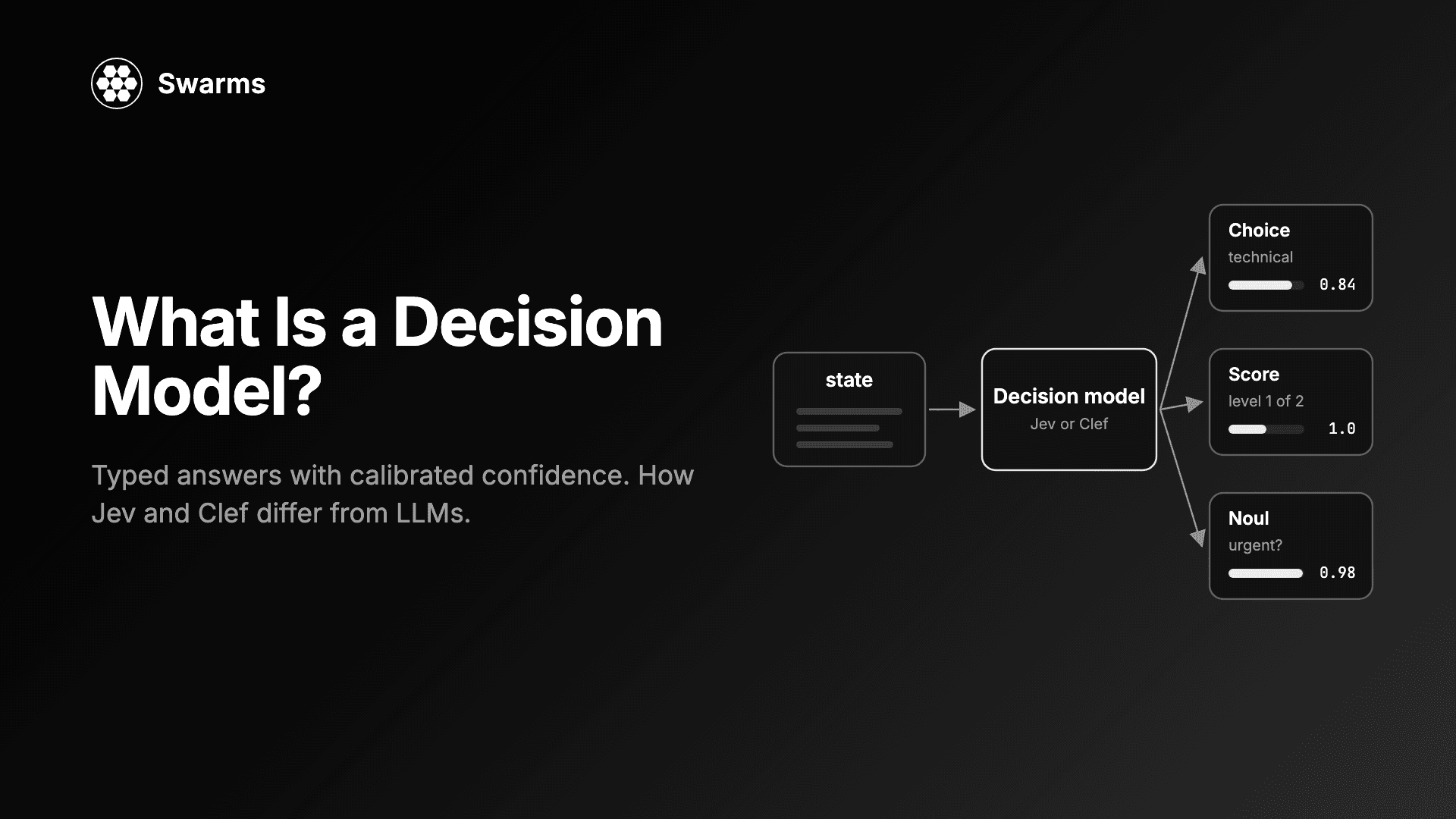
什么是决策模型?TypeSafe Jev 与 Cloudflare Clef 如何用经过校准的置信度回答带类型的问题,而不是生成文本,以及如何在 Swarms 中使用它们。
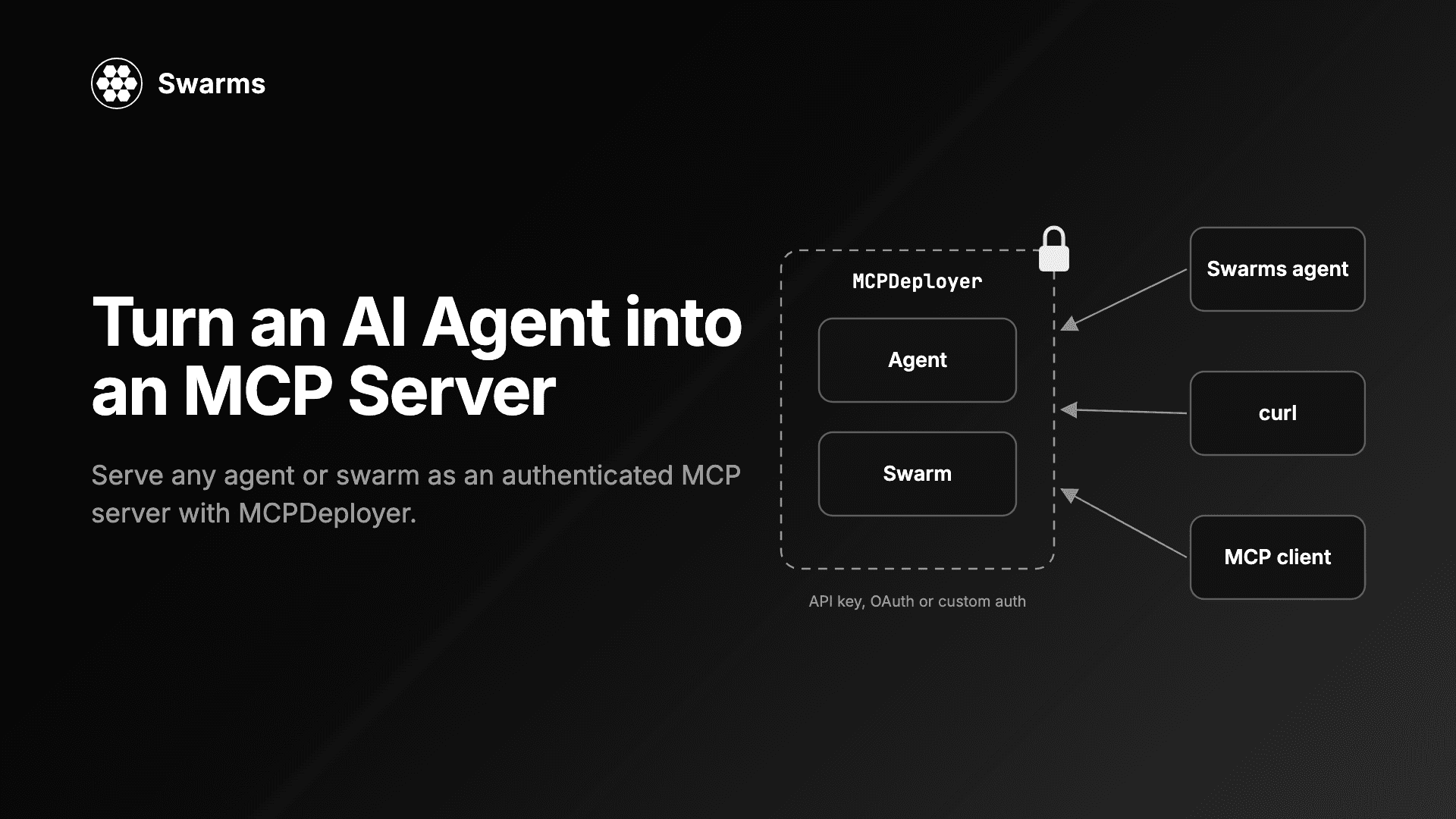
用 Swarms MCPDeployer 在 Python 中把 AI 智能体变成 MCP 服务器:API key、自定义认证、token 校验器、把 swarm 作为工具,以及一个调用它的客户端智能体。
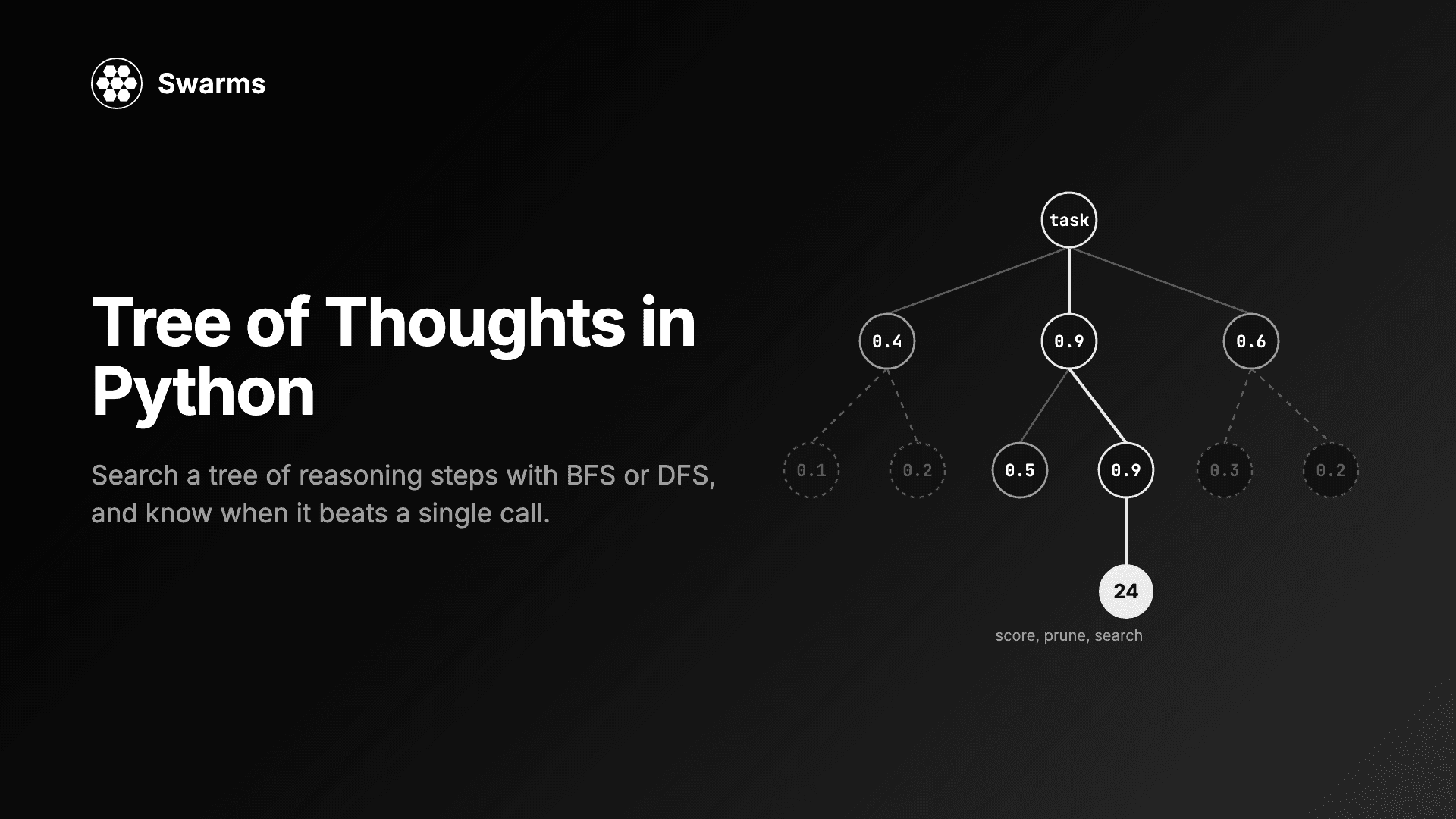
用 Swarms 在 Python 中实现 tree of thoughts:求解 24 点游戏,对比 BFS 与 DFS、propose 与 sample、value 与 vote,控制成本,并查看真实的调用次数。