指南工程
用多智能体集群构建你自己的深度研究 API
一个规划者、多个并行联网搜索的智能体、一个综合者和一个核查事实的批评者,在 Swarms API 上用大约 100 行 Python 串联起来,并通过 FastAPI 暴露为 HTTP 端点。真实输出、真实费用,以及一条在写任何代码之前就能试用研究智能体的 cURL 命令。
Kye Gomez12 分钟阅读

一个规划者、多个并行联网搜索的智能体、一个综合者和一个核查事实的批评者,在 Swarms API 上用大约 100 行 Python 串联起来,并通过 FastAPI 暴露为 HTTP 端点。真实输出、真实费用,以及一条在写任何代码之前就能试用研究智能体的 cURL 命令。
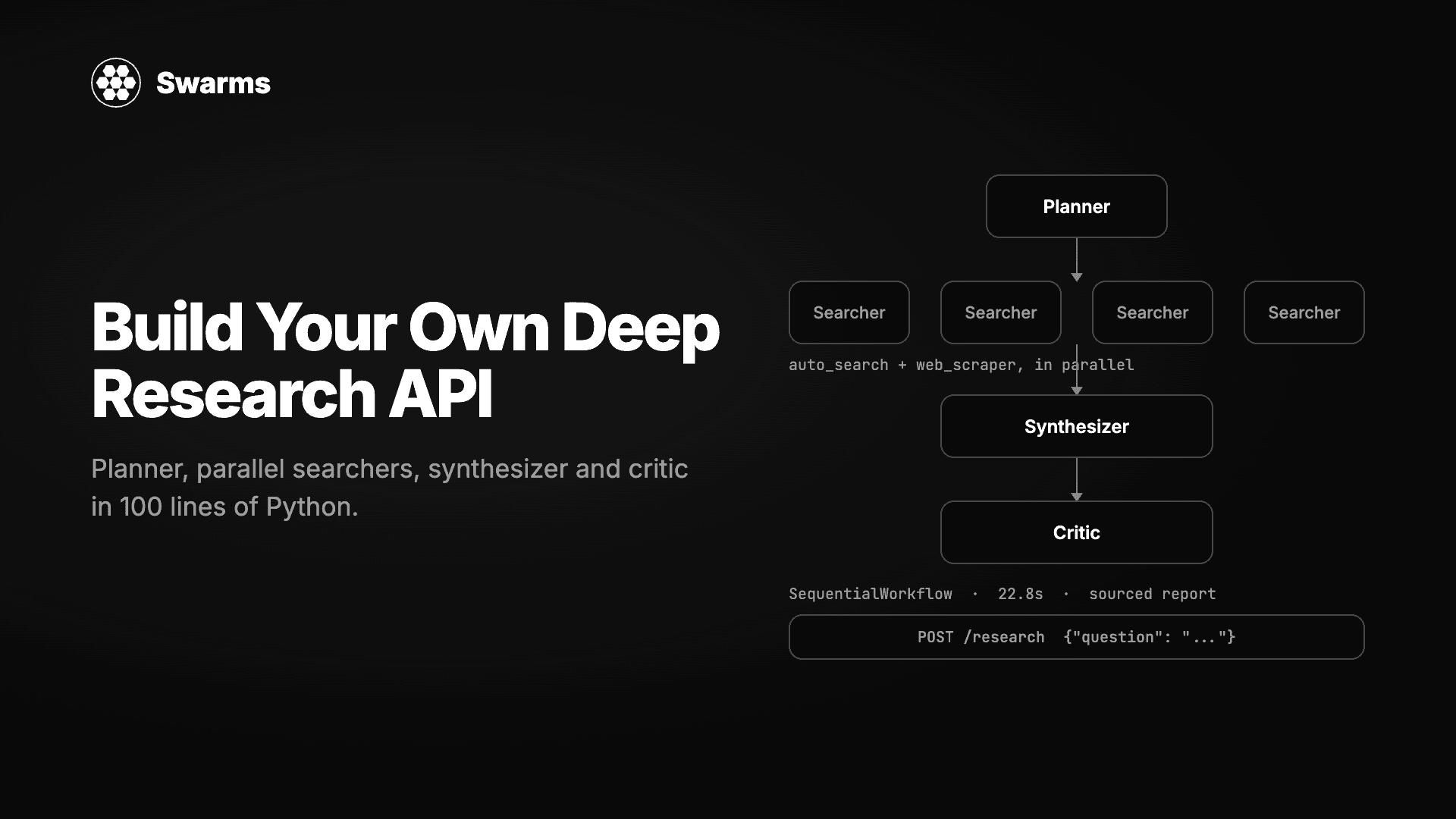
深度研究功能,即助手规划一组搜索、阅读结果并撰写一份带来源的报告,是今年最受欢迎的 AI 能力,也是大多数团队以为自己做不出来的能力。它背后的模式其实很小:拆分问题、并行搜索、综合、核查。其中每一步都是对 Swarms API 的一次调用,智能体、联网搜索工具和编排都由它处理。
本指南用两个文件构建一个深度研究 API。deep_research.py 运行流水线,research_api.py 用 FastAPI 把它包装起来,这样任何能发送 POST 的东西都能请求一份报告。过程中我们会展示一次真实运行产生了什么、花了多少钱,以及与向一个强模型直接提问相比如何。
四个阶段,每个阶段是一个承担不同职责的不同智能体:
/v1/agent/completions 的一次调用。auto_search 联网搜索和 web_scraper 工具。它们用带来源的事实作答并引用 URL。第 3 和第 4 阶段作为一个 SequentialWorkflow 集群运行在 /v1/swarm/completions 上,所以批评者会自动接收综合者的输出。第 2 阶段使用智能体端点,因为内置的联网工具就在那里,一个线程池让四个搜索者同时运行。
question
   │
   ▼
Planner (gpt-5.4-mini) ── 4 sub-questions
   │
   ├──▶ Searcher 1 (auto_search + web_scraper) ─┐
   ├──▶ Searcher 2                              ├─ findings [F1..F4]
   ├──▶ Searcher 3                              │
   └──▶ Searcher 4 ─────────────────────────────┘
                                                 │
                                                 ▼
                     SequentialWorkflow: Synthesizer (claude-sonnet-5-5) → Critic (gpt-5.4-mini)
                                                 │
                                                 ▼
                                          corrected report
# deep_research.py
# A deep research pipeline on the Swarms API: a planner writes sub-questions,
# searchers answer them in parallel with web search, then a synthesizer and a
# critic produce the report. Requires: pip install requests
import json
import os
import sys
import time
from concurrent.futures import ThreadPoolExecutor

import requests

API = "https://api.swarms.world"
HEADERS = {"x-api-key": os.environ["SWARMS_API_KEY"], "Content-Type": "application/json"}


def agent(name: str, system_prompt: str, task: str, model: str = "gpt-5.4-mini",
          tools: list[str] | None = None, max_tokens: int = 900) -> tuple[str, float]:
    """One call to /v1/agent/completions. Returns (text, cost_in_usd)."""
    body = {
        "agent_config": {
            "agent_name": name,
            "system_prompt": system_prompt,
            "model_name": model,
            "max_loops": 1,
            "max_tokens": max_tokens,
        },
        "task": task,
    }
    if tools:
        body["tools_enabled"] = tools
    r = requests.post(f"{API}/v1/agent/completions", headers=HEADERS, json=body, timeout=180)
    r.raise_for_status()
    data = r.json()
    # With tools on, outputs also contain tool-call entries whose content is a
    # list. The agent's own prose is the string content under its name.
    text = "\n".join(
        m["content"] for m in data["outputs"] if m["role"] == name and isinstance(m["content"], str)
    )
    return text.strip(), data["usage"]["total_cost"]


def plan(question: str) -> tuple[list[str], float]:
    text, cost = agent(
        "Research Planner",
        "You are a research planner. Given a research question, return exactly 4 focused "
        "sub-questions, one per line, with no numbering and no commentary. Each should be "
        "answerable with a web search and together they should cover the question.",
        question,
        max_tokens=400,
    )
    return [line.strip() for line in text.splitlines() if line.strip()], cost


def search(sub_question: str) -> tuple[str, float]:
    return agent(
        "Searcher",
        "You are a research assistant with web search and a page scraper. Answer the question "
        "with current, sourced facts in 150-250 words. Cite the URL of each source you rely on. "
        "If sources conflict, say so.",
        sub_question,
        tools=["auto_search", "web_scraper"],
    )


def synthesize(question: str, findings: list[str]) -> tuple[str, float, float]:
    """Synthesizer then critic, as one SequentialWorkflow swarm."""
    task = f"Research question: {question}\n\nFindings from the search stage:\n\n" + "\n\n".join(
        f"[F{i + 1}] {f}" for i, f in enumerate(findings)
    ) + "\n\nWrite the final report."
    body = {
        "name": "Deep Research Synthesis",
        "swarm_type": "SequentialWorkflow",
        "task": task,
        "max_loops": 1,
        "agents": [
            {
                "agent_name": "Synthesizer",
                "system_prompt": "You are a senior research writer. Turn the findings into a report with the sections: Summary, What changed, Who is affected, Deadlines, Recommended actions, Open questions. Tag every factual claim with the finding it comes from, like [F2]. Under 600 words.",
                "model_name": "claude-sonnet-5-5",
                "max_loops": 1,
                "max_tokens": 1400,
            },
            {
                "agent_name": "Critic",
                "system_prompt": "You are a fact-checking editor. Review the report you receive. List any claim not supported by the findings, any missing deadline, and any vague recommendation, then output the corrected report in full. Under 700 words.",
                "model_name": "gpt-5.4-mini",
                "max_loops": 1,
                "max_tokens": 1600,
            },
        ],
    }
    r = requests.post(f"{API}/v1/swarm/completions", headers=HEADERS, json=body, timeout=300)
    r.raise_for_status()
    data = r.json()
    return data["output"][-1]["content"], data["usage"]["total_cost"], data["execution_time"]


def deep_research(question: str) -> dict:
    started = time.perf_counter()
    sub_questions, plan_cost = plan(question)

    with ThreadPoolExecutor(max_workers=len(sub_questions)) as pool:
        results = list(pool.map(search, sub_questions))
    findings = [text for text, _ in results]
    search_cost = sum(cost for _, cost in results)

    report, synth_cost, synth_seconds = synthesize(question, findings)

    return {
        "question": question,
        "sub_questions": sub_questions,
        "report": report,
        "cost_usd": round(plan_cost + search_cost + synth_cost, 4),
        "seconds": round(time.perf_counter() - started, 1),
        "synthesis_seconds": round(synth_seconds, 1),
    }


if __name__ == "__main__":
    q = sys.argv[1] if len(sys.argv) > 1 else "What changed in EU AI Act obligations for general-purpose AI model providers during 2026, and what should a startup shipping an LLM-based product do before the next deadline?"
    print(json.dumps(deep_research(q), indent=2))
agent 辅助函数有一处值得解释。启用工具后,智能体端点会在 outputs 中返回完整轨迹:用户消息、智能体的工具调用(其 content 是一个列表)、工具结果,以及智能体的最终回答。只保留智能体自己名下的字符串内容,就得到了纯文本。
运行:
pip install requests
export SWARMS_API_KEY=your_key
python deep_research.py "What changed in EU AI Act obligations for general-purpose AI model providers during 2026?"# research_api.py
# Exposes the pipeline as an HTTP API. Run: uvicorn research_api:app --port 8000
from fastapi import FastAPI, HTTPException
from pydantic import BaseModel, Field
from deep_research import deep_research
app = FastAPI(title="Deep Research API")
class ResearchRequest(BaseModel):
question: str = Field(min_length=10, max_length=500)
@app.post("/research")
def research(req: ResearchRequest) -> dict:
try:
return deep_research(req.question)
except Exception as exc: # surfaces Swarms API errors as a 502 with the message
raise HTTPException(status_code=502, detail=str(exc)) from excpip install fastapi uvicorn
uvicorn research_api:app --port 8000
curl -X POST http://localhost:8000/research \
-H "Content-Type: application/json" \
-d '{"question": "What changed in EU AI Act obligations for general-purpose AI model providers during 2026, and what should a startup shipping an LLM-based product do before the next deadline?"}'响应就是 deep_research 返回的字典:规划者选出的子问题、修订后的报告、总费用和实际耗时。问题上的 max_length 既是校验规则也是成本控制,因为这个问题会进入六个提示词。
我们针对上面的欧盟 AI 法案问题运行了每个阶段。使用 gpt-5.4-mini 的规划者以 $0.0007 的费用返回了这四个子问题:
How did the EU AI Act's obligations for general-purpose AI model providers change across 2026, including any phased-in requirements or guidance updates? What specific compliance duties apply to providers of general-purpose AI models under the EU AI Act as of the next deadline, especially for transparency, documentation, and copyright policy? What exemptions, reduced obligations, or special rules apply to startups or smaller providers shipping LLM-based products under the EU AI Act? What practical steps should a startup with an LLM-based product take before the next EU AI Act deadline to assess, document, and mitigate compliance risk?
这比大多数人手写的拆分更好,而费用不到一美分的十分之一。
每个搜索者请求都带有固定的 $0.04 联网搜索费加上它的 token,所以四个子问题的搜索阶段大约花费 $0.17,与每个智能体运行多少次搜索无关。搜索者并行运行,所以这一阶段的耗时取决于最慢的那个,而不是总和。
综合集群是这个模式真正体现价值的地方。我们让综合者和批评者处理了一组关于该法案的六条发现。综合者产出了一份带标注的报告;批评者随后指出了两处发现中没有依据的论断,其中一处是:
Claim not supported by findings: "Art. 50 is the most relevant duty for them" for startups that only call a model API. The findings say Art. 50 transparency duties are scheduled for 2 Aug 2026, but do not say they are the most relevant for API-only startups.
它还认为“Classify your role”这条建议过于含糊,将其改写为具体步骤,并返回了带截止日期表格的修订报告。这一阶段耗时 22.8 秒,两个智能体共 4,835 个 token,费用 $0.0449。端到端来看,这条流水线产出一份报告大约花费 $0.22、耗时约一分钟,大部分时间在搜索和综合阶段。
我们还让一个不带工具的 claude-sonnet-5-5 智能体回答同一个问题。它一次性作答,费用 $0.0175,开头就写“my information may be out of date”,没有给出来源,并且在写完截止日期表格之前就被 1,500 token 的上限截断了。
| 单智能体 | 深度研究流水线 | |
|---|---|---|
| 费用 | $0.0175 | 约 $0.22 |
| 耗时 | 几秒 | 约一分钟 |
| 来源 | 无 | 每条发现一个 URL |
| 时效性 | 模型的训练数据 | 实时联网搜索 |
| 自我修正 | 无 | 批评者一轮审阅并列出异议 |
| 输出 | 截断、含糊 | 带截止日期表格的结构化报告 |
流水线的费用约为十二倍,耗时约为十倍。对于一个答案在今年发生了变化、写错日期会有后果的问题,这是一笔划算的交易。对于模型凭记忆就能回答的问题,用单智能体。有价值的产品决策是两者都提供,让用户选择深度。
402 表示账户购买的积分余额不足 1 美元;429 表示触及速率限制,免费账户是每分钟 100 次请求。流水线每份报告发出六次请求,所以免费账户大约支持每分钟 16 份报告。stream: true 会返回逐 token 事件,每个都带智能体名称,用户可以看着综合者撰写、批评者修订。job_id 和费用。 每个响应都包含两者,GET /v1/swarm/logs 让你之后可以回顾运行。搜索者阶段本身就是一个研究智能体。这一条请求在启用联网搜索的情况下提问,并返回带来源的答案:
curl -X POST https://api.swarms.world/v1/agent/completions \
  -H "x-api-key: $SWARMS_API_KEY" -H "Content-Type: application/json" \
-d '{"agent_config": {"agent_name": "Researcher", "system_prompt": "Answer with current, sourced facts and cite the URL of each source.", "model_name": "gpt-5.4-mini", "max_loops": 1, "max_tokens": 800}, "task": "What are the current EU AI Act deadlines for general-purpose AI model providers?", "tools_enabled": ["auto_search"]}'把工作拆成一个撰写子问题的规划者、多个带联网搜索的并行搜索智能体,以及一个综合者加一个批评者。在 Swarms API 上,规划者和搜索者是对 /v1/agent/completions 的调用,并设置 tools_enabled: ["auto_search", "web_scraper"];综合者和批评者作为一个 SequentialWorkflow 运行在 /v1/swarm/completions 上。本指南的完整流水线大约 100 行 Python。
四个子问题时每份报告约 $0.22:规划不到一美分,四个联网搜索智能体约 $0.17(每个固定 $0.04 搜索费加 token),综合者和批评者约 $0.045。每个响应都在 usage.total_cost 中报告准确费用。
因为第二个模型对照源发现阅读报告,能发现作者在自己的文字里看不到的问题。在我们的运行中,批评者指出了两处无依据的论断和一条含糊的建议并重写了它们。这一轮的费用约两美分。
可以。通过 mcp_url 给智能体接入一个 MCP 服务器,智能体就能调用你的搜索或检索工具;MCP 服务器除 token 外不收费。内置的 auto_search 是最快的起步方式,因为不需要任何配置。
在我们的运行中端到端约一分钟:规划几秒,搜索阶段并行,综合者和批评者 22.8 秒。对综合阶段做流式输出可以让等待在 UI 中可见。
在 swarms.world 获取密钥,运行上面那一行 cURL 看看带来源的答案,然后保存本指南的两个文件并用 uvicorn 启动 API。Swarms API 文档涵盖了智能体端点、内置工具和每种集群架构。想看用同样方式构建的其他模式,行业页面提供了金融、法律、生命科学等领域的研究台,每个都附带可运行代码。
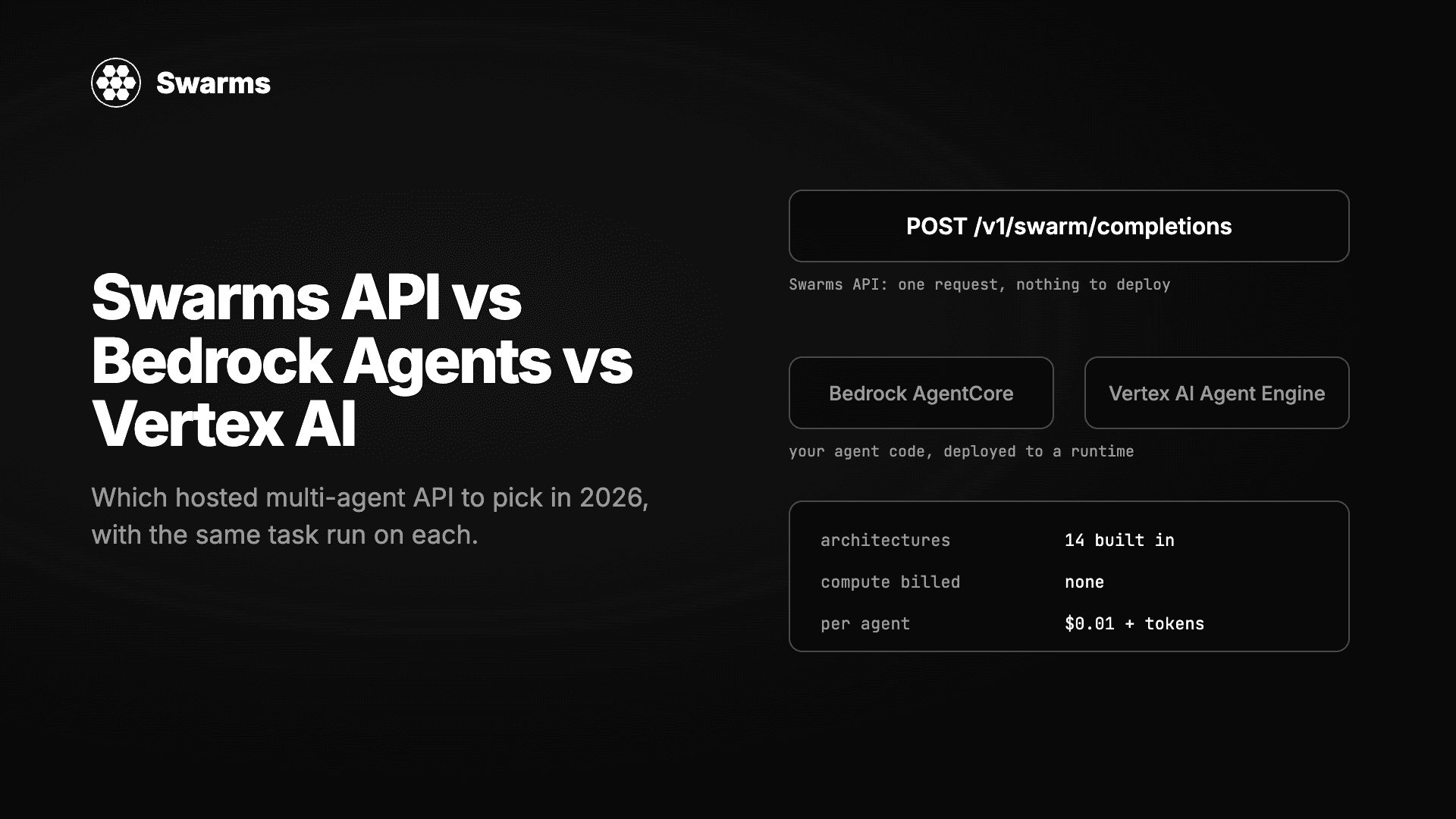
三种无需自建服务器即可运行多智能体系统的方式实测对比:Swarms API、Amazon Bedrock Agents 与 AgentCore、Google 的 Vertex AI Agent Builder 与 ADK。同一任务分别实现,逐项比较架构、模型选择、流式输出、批处理、定价以及拿到第一个结果所需的时间。
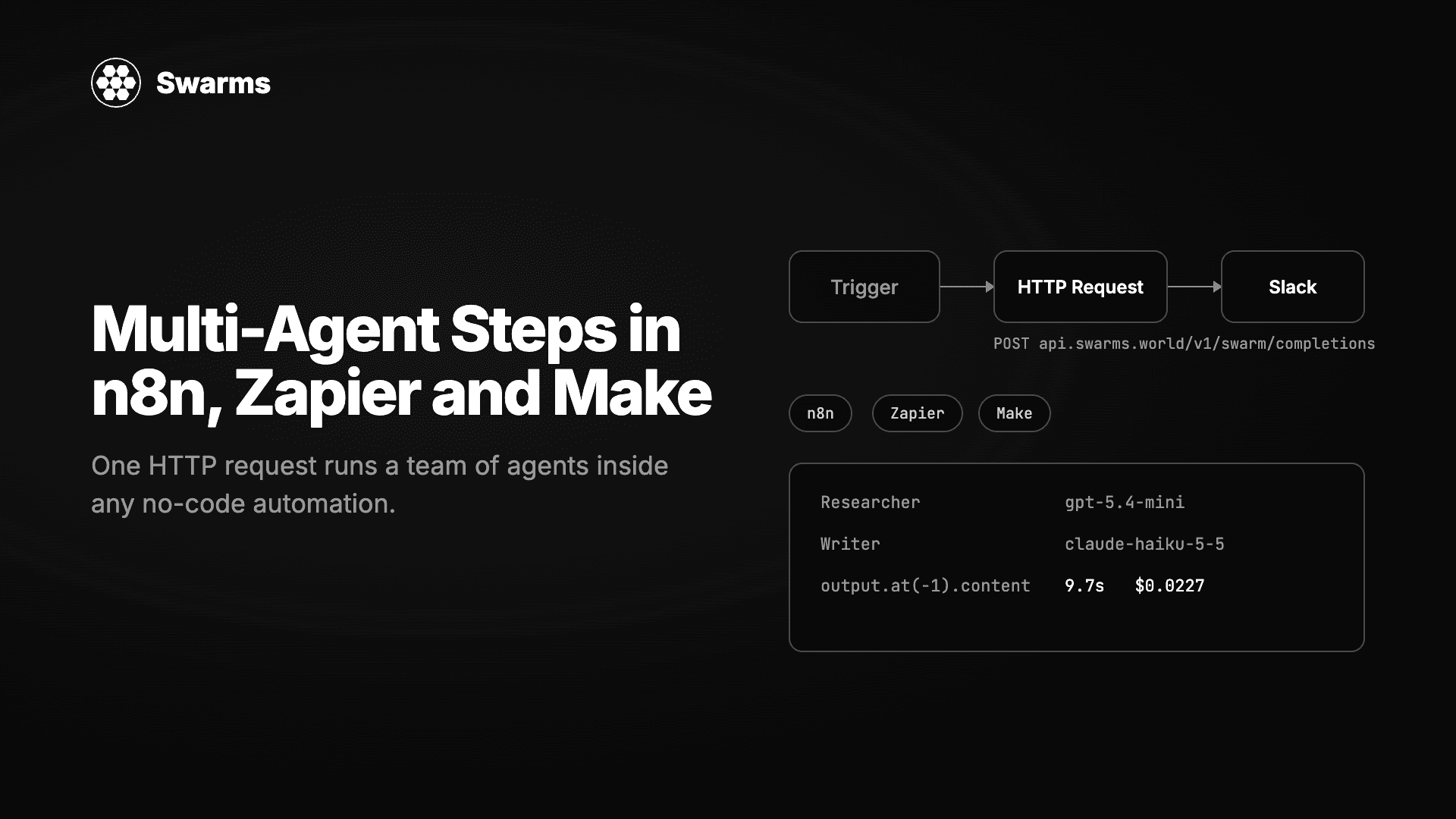
在任何无代码自动化工具中运行一支 AI 智能体团队。一个 HTTP Request 节点、一个 JSON 请求体,Swarms API 就会返回完成的工作。n8n、Zapier 和 Make 的逐步配置,外加三个可直接粘贴的配方:线索补全、工单分诊和每周报告。
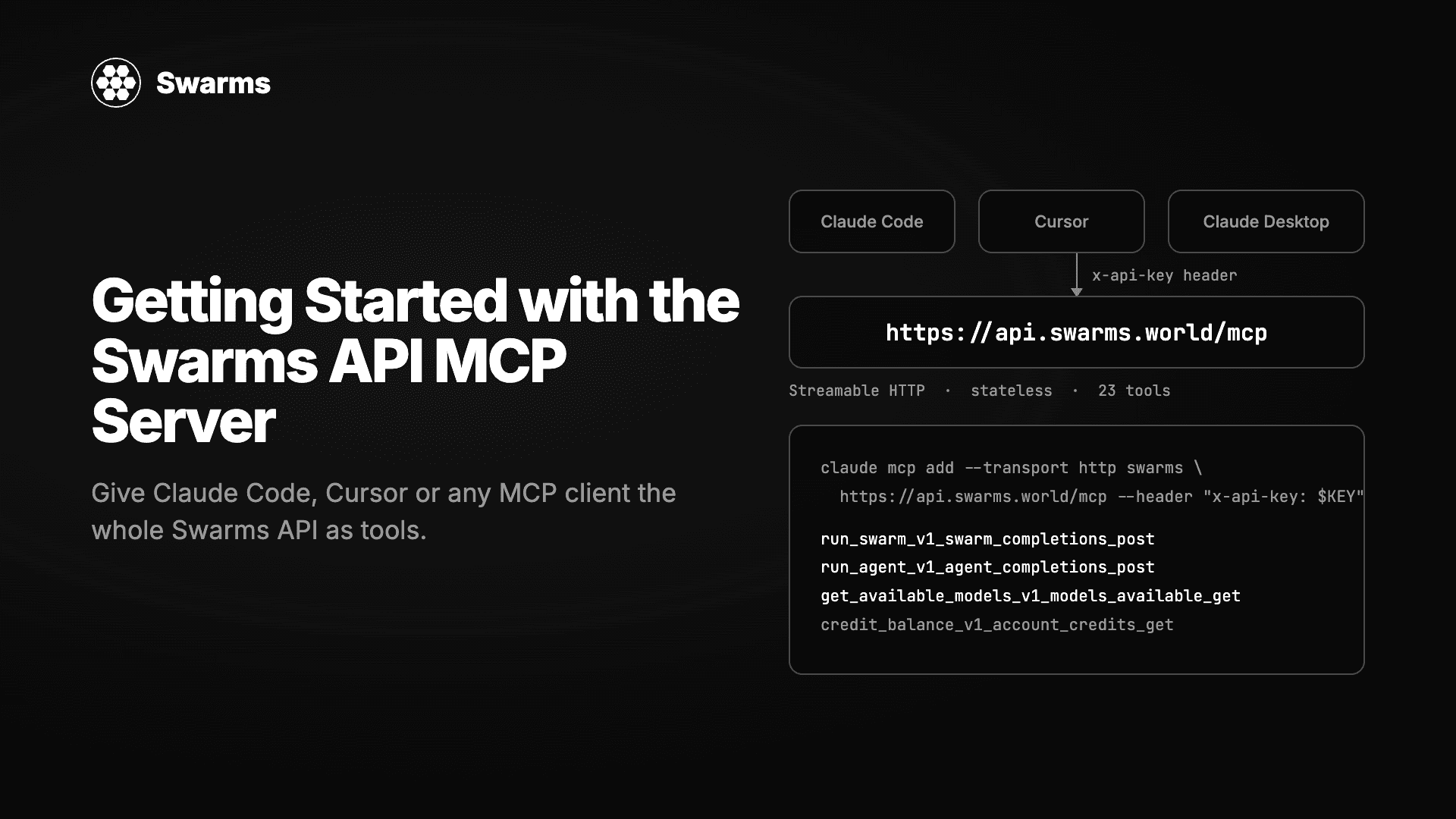
托管在 api.swarms.world/mcp 的 Swarms MCP 服务器完整教程。用两行配置连接 Claude Code、Claude Desktop、Cursor 或你自己的 Python 和 TypeScript 智能体,了解 23 个工具,从一句聊天提示运行你的第一个智能体和集群,读取结果和费用,并解决第一天会遇到的错误。