指南工程
如何在 Swarms 中使用 Gemini Decision 1:DecisionModel 分步教程
面向 Google gemini-decision-1 的分步教程:在开源 Swarms 框架中用 DecisionModel 提出是非、选择和评分问题,拿回经过校准的概率,检查图片,统计成本,并根据答案把请求路由给 Swarms 智能体。
Swarms 团队10 分钟阅读

面向 Google gemini-decision-1 的分步教程:在开源 Swarms 框架中用 DecisionModel 提出是非、选择和评分问题,拿回经过校准的概率,检查图片,统计成本,并根据答案把请求路由给 Swarms 智能体。
大多数智能体系统都把相当一部分 token 花在小判断上:这个请求该交给哪个智能体,它是否紧急,答案是否已经足够好可以停止。生成式模型用一段文字来回答这些问题,你的代码还得再去解析这段文字。Google 的 Gemini Decision 1(gemini-decision-1)正是为这类判断而设计的。你把输入和一组带类型的问题发给它,它返回经过校准的概率,输出 token 为零。
开源的 Swarms 框架现在通过 DecisionModel 支持它,这个类此前已经覆盖了 TypeSafe、Cloudflare 和 OpenAI 的决策模型。在本教程中,你将从一个是非问题开始,一步步做到一个路由器,由它决定哪个 Swarms 智能体来处理请求。每一步都是一个可以直接运行的短脚本。
完整的 API 见 DecisionModel 参考文档,更长的完整示例见 Gemini 决策模型示例页。
| 步骤 | 新增内容 |
|---|---|
| 1 到 2 | 安装 Swarms,设置一个密钥 |
| 3 到 6 | 三种问题类型:是非、选择、评分 |
| 7 到 8 | 一次请求问多个问题,然后在代码里设阈值 |
| 9 | 针对图片提问 |
| 10 到 11 | 用异步一次处理多条数据,并查看成本 |
| 12 | 一个把每条请求交给合适 Swarms 智能体的路由器 |
DecisionModel 对 Gemini 的支持目前在 Swarms 的 master 分支上,会随下一个版本发布。在那之前,请从 GitHub 安装:
pip install -U git+https://github.com/kyegomez/swarms.git不需要安装别的东西。DecisionModel 直接调用 Gemini 的 HTTP API,所以不需要 google-genai 包。
在 Google AI Studio 创建一个 Gemini API 密钥,把它放进环境变量或 .env 文件。Swarms 在被导入时会加载 .env。
export GEMINI_API_KEY="..."模型名称决定服务商。任何以 gemini-decision 开头的名称都会走 Gemini 的 Decisions API,并读取 GEMINI_API_KEY。
创建 yes_no.py:
from swarms import DecisionModel

model = DecisionModel(model_name="gemini-decision-1")

probability = model.noul(
    state="The blue mug I ordered on Monday arrived cracked on Wednesday.",
    instructions="Did the item arrive damaged?",
)

print(f"Damaged: {probability:.2f}")
noul() 返回一个浮点数:答案为“是”的概率。对这条消息,你应该看到一个接近 1 的值。
关于这个数字有两点要知道。它是经过校准的,也就是说 0.8 意味着大约 80% 的情况下是对的。另外,Gemini 把是非概率限制在 0.01 到 0.99 之间,所以 > 0.99 这样的判断永远不会成立。
简短的问题常常有歧义。顾客不喜欢颜色,算不算在报告产品缺陷?用 criteria 给两边各加一句描述:
from swarms import DecisionModel

model = DecisionModel(model_name="gemini-decision-1")

probability = model.noul(
    state="I returned the sweater because I prefer green over blue.",
    instructions="Is the customer reporting a product defect?",
    criteria={
        "true": "The product itself is broken or faulty.",
        "false": "A preference, sizing, shipping or pricing complaint.",
    },
)

print(f"Defect: {probability:.2f}")
DecisionModel 对所有服务商都使用 true 和 false 这两个键,并把它们转换成 Gemini 需要的名称,所以同一个问题不用修改就能用在其他决策模型上。
choice() 从一组固定选项中选出一个。criteria 把每个选项映射到一句说明,描述它在什么情况下适用:
from swarms import DecisionModel

model = DecisionModel(model_name="gemini-decision-1")

answer = model.choice(
    state="I was charged twice for my order.",
    instructions="Which department should handle this request?",
    criteria={
        "billing": "Payments, invoices and refunds.",
        "technical": "Problems using the product.",
        "shipping": "Delivery and tracking.",
        "other": "Anything outside these categories.",
    },
)

print(answer["choice"], answer["confidence"])
print(answer["probabilities"])
答案是一个如下结构的字典(你得到的数值会不同):
{
  "type": "choice",
  "choice": "billing",
  "probabilities": {"billing": 0.97, "technical": 0.01, "shipping": 0.01, "other": 0.01},
  "confidence": 0.97
}
选择题总会把概率分配到你给出的选项上,即使没有一个合适。请加入一个像 other 这样的兜底选项并写上真实的描述,在采取行动之前先检查 confidence。
score() 按从低到高排列的等级对输入评分:
from swarms import DecisionModel

model = DecisionModel(model_name="gemini-decision-1")

answer = model.score(
    state="Export fails in Safari but works in Chrome.",
    instructions="How severe is this issue for the user?",
    criteria=[
        "Cosmetic: appearance only, no lost functionality.",
        "Workaround available: a task fails, but another way works.",
        "Fully blocked: a task fails with no workaround.",
    ],
)

print(f"Severity: {answer['score']:.2f} on a 0-2 scale")
print(answer["probabilities"]){
"type": "score",
"score": 1.1,
"legend": {"0": "Cosmetic: ...", "1": "Workaround available: ...", "2": "Fully blocked: ..."},
"probabilities": {"0": 0.05, "1": 0.8, "2": 0.15},
"confidence": 0.8
}score 是按概率加权的等级,所以它可能落在两个等级之间。三个等级时,分值范围是 0 到 2。用它来排序或筛选;需要单一等级时,读取 probabilities。
辅助方法每次只发送一个问题。run() 可以在一次请求里针对同一份输入问任意多个问题。Gemini 会独立回答每个问题,所以增加一个问题不会改变其他答案,一次请求最多可以带 1,000 个问题。
创建 triage.py:
from swarms import DecisionModel

model = DecisionModel(model_name="gemini-decision-1")

ticket = {
    "message": "The blue mug I ordered on Monday arrived cracked on Wednesday.",
    "order": {"id": "8821", "age_days": 2},
}

result = model.run(
    state=ticket,
    questions={
        "queue": {
            "type": "choice",
            "instructions": "Which support queue should handle this message?",
            "criteria": {
                "billing": "Payment, invoice or refund questions.",
                "replacements": "Damaged, missing or wrong items.",
                "general": "Product questions and account updates.",
            },
        },
        "severity": {
            "type": "score",
            "instructions": "How severe is this issue for the customer?",
            "criteria": [
                "Minor: the item is usable as it is.",
                "Moderate: the item is usable with a workaround.",
                "Severe: the item cannot be used.",
            ],
        },
        "is_damaged": {
            "type": "noul",
            "instructions": "Did the item arrive damaged?",
        },
        "within_window": {
            "type": "noul",
            "instructions": "Is order.age_days 30 or less?",
        },
    },
)

answers = result["answers"]
queue = answers["queue"]

print(f"Queue: {queue['choice']} (confidence {queue['confidence']:.2f})")
print(f"Severity: {answers['severity']['score']:.2f} on a 0-2 scale")
print(f"Damaged: {answers['is_damaged']['noul']:.2f}")
print(f"Within window: {answers['within_window']['noul']:.2f}")
这里的 state 是一个字典。DecisionModel 会把它作为 JSON 文本发给 Gemini,所以 within_window 可以用键路径 order.age_days 来引用其中的字段。
模型给你的是数字。策略留在你的代码里,可以阅读,也可以测试。把下面这段加到 triage.py 的末尾:
approved = (
    queue["choice"] == "replacements"
    and queue["confidence"] >= 0.7
    and answers["is_damaged"]["noul"] >= 0.8
    and answers["within_window"]["noul"] >= 0.8
)

if approved:
    print("Action: send a replacement")
else:
    print("Action: send to a human")
问题要问得窄,再用普通的 if 语句把它们组合起来。阈值应当根据你自己流量中带标注的样本来设定,权衡一次错误批准和一次错误升级各自的代价。
Gemini Decision 1 是多模态的。把 state 写成内容块的列表,它会原样发送给 Gemini。在脚本旁边放一张 photo.jpg:
import base64
from pathlib import Path

from swarms import DecisionModel

model = DecisionModel(model_name="gemini-decision-1")

photo = base64.b64encode(Path("photo.jpg").read_bytes()).decode("ascii")

probability = model.noul(
    state=[
        {"type": "text", "text": "Customer photo for return request #8821."},
        {"type": "image", "data": photo, "mime_type": "image/jpeg"},
    ],
    instructions="Does the photo show physical damage to the item?",
)

print(f"Visible damage: {probability:.2f}")
同一个列表也接受 audio、video 和 document(PDF)内容块。mime_type 必须是文件的真实格式。问题的 instructions 只能是文本。
每次调用都是一个很小的 HTTP 请求,所以批量筛选适合用 arun() 和 asyncio.gather:
import asyncio

from swarms import DecisionModel

model = DecisionModel(model_name="gemini-decision-1")

reviews = [
    "Arrived on time and works perfectly.",
    "The lid does not close. I want my money back.",
    "Fine for the price, though the colour is duller than the photo.",
]

questions = {
    "sentiment": {
        "type": "choice",
        "instructions": "What is the overall sentiment of this review?",
        "criteria": {
            "positive": "The customer is satisfied.",
            "neutral": "Mixed or no clear feeling.",
            "negative": "The customer is dissatisfied.",
        },
    },
    "wants_refund": {
        "type": "noul",
        "instructions": "Is the customer asking for a refund?",
    },
}


async def main() -> None:
    results = await asyncio.gather(
        *(model.arun(review, questions) for review in reviews)
    )

    for review, result in zip(reviews, results):
        answers = result["answers"]
        print(
            f"{answers['sentiment']['choice']:<9}"
            f"refund {answers['wants_refund']['noul']:.2f}  {review}"
        )


asyncio.run(main())
处理几百条数据时,用 asyncio.Semaphore 包住这些调用,以免超出速率限制。遇到限流和过载,DecisionModel 会自动退避重试,最多 max_retries 次。
每个 DecisionModel 都会累计服务商报告的 token 数。把下面这段加到上面任意脚本的末尾:
print(model.usage)
print(model.get_price())
print(model.calculate_cost())
usage 是该实例所有请求的输入和输出 token 之和。get_price() 返回每百万 token 的美元价格,gemini-decision-1 的输入价格是 0.10,输出是 0:这个模型不产生输出 token,所以你只为输入付费。calculate_cost() 把两者相乘。
无论问多少个问题,共享的输入在每次请求中只计费一次,这也是把问题集中到一次 run() 调用里的另一个理由。
现在把它用到多智能体系统里。决策模型很适合做路由器:它速度快,成本只是一次生成式调用的一小部分,而且会告诉你它有多确定。下面的智能体同样运行在 Gemini 上,用的是同一个 GEMINI_API_KEY。
创建 route.py:
from swarms import Agent, DecisionModel

agents = [
    Agent(
        agent_name="Billing-Agent",
        agent_description="Refunds, invoices, failed payments and subscription changes.",
        system_prompt="You resolve billing questions clearly and briefly.",
        model_name="gemini/gemini-2.5-pro",
        max_loops=1,
    ),
    Agent(
        agent_name="Technical-Agent",
        agent_description="Bugs, API errors, integrations and outages.",
        system_prompt="You debug technical problems step by step.",
        model_name="gemini/gemini-2.5-pro",
        max_loops=1,
    ),
    Agent(
        agent_name="Sales-Agent",
        agent_description="Pricing, plan upgrades and new accounts.",
        system_prompt="You answer pricing and plan questions.",
        model_name="gemini/gemini-2.5-pro",
        max_loops=1,
    ),
]
agents_by_name = {agent.agent_name: agent for agent in agents}

router = DecisionModel(model_name="gemini-decision-1")


def route(task: str) -> str:
    answers = router.run(
        state=task,
        questions={
            "agent": {
                "type": "choice",
                "instructions": "Which agent should handle this request?",
                "criteria": {
                    agent.agent_name: agent.agent_description
                    for agent in agents
                },
            },
            "in_scope": {
                "type": "noul",
                "instructions": "Is this a request a software company's support team should handle?",
            },
        },
    )["answers"]

    if answers["in_scope"]["noul"] < 0.5:
        return "Declined: out of scope for support."

    decision = answers["agent"]
    if decision["confidence"] < 0.6:
        return "Escalated to a human: the router is unsure who owns this."

    print(f"Routing to {decision['choice']}")
    return agents_by_name[decision["choice"]].run(task)


print(route("I was charged twice for my March invoice, can you refund one?"))
选项是从智能体本身生成的:每个 agent_name 是一个选项,它的 agent_description 就是说明。往列表里加一个智能体,路由器就能选到它。第二个问题检查请求是否在处理范围内,置信度下限则把不明确的请求交给人工。在这之后才会运行生成式智能体。
同样的模式适用于集群在步骤之间需要做判断的任何地方:当一轮辩论没有新论点时提前结束,在群聊中每条回复发出之前先打分,或者在层级结构中选择下一个执行者。参考文档里各有一个示例。
所有服务商的问题和答案结构都相同,所以更换模型只需要改一行:
model = DecisionModel(model_name="gemini-decision-1")  # Google, GEMINI_API_KEY
model = DecisionModel(model_name="gpt-6-luna")         # OpenAI, OPENAI_API_KEY
model = DecisionModel(model_name="clef")               # Cloudflare Workers AI
model = DecisionModel()                                # TypeSafe jev-latest
媒体输入是例外。第 9 步中的内容块列表是 Gemini 的格式;参考文档的 Providers 一节说明了每个服务商如何接收图片。
DecisionModel 会把它作为 httpx.HTTPStatusError 抛出,原因写在错误信息里。queue、severity),所以要把完整的问题写进 instructions。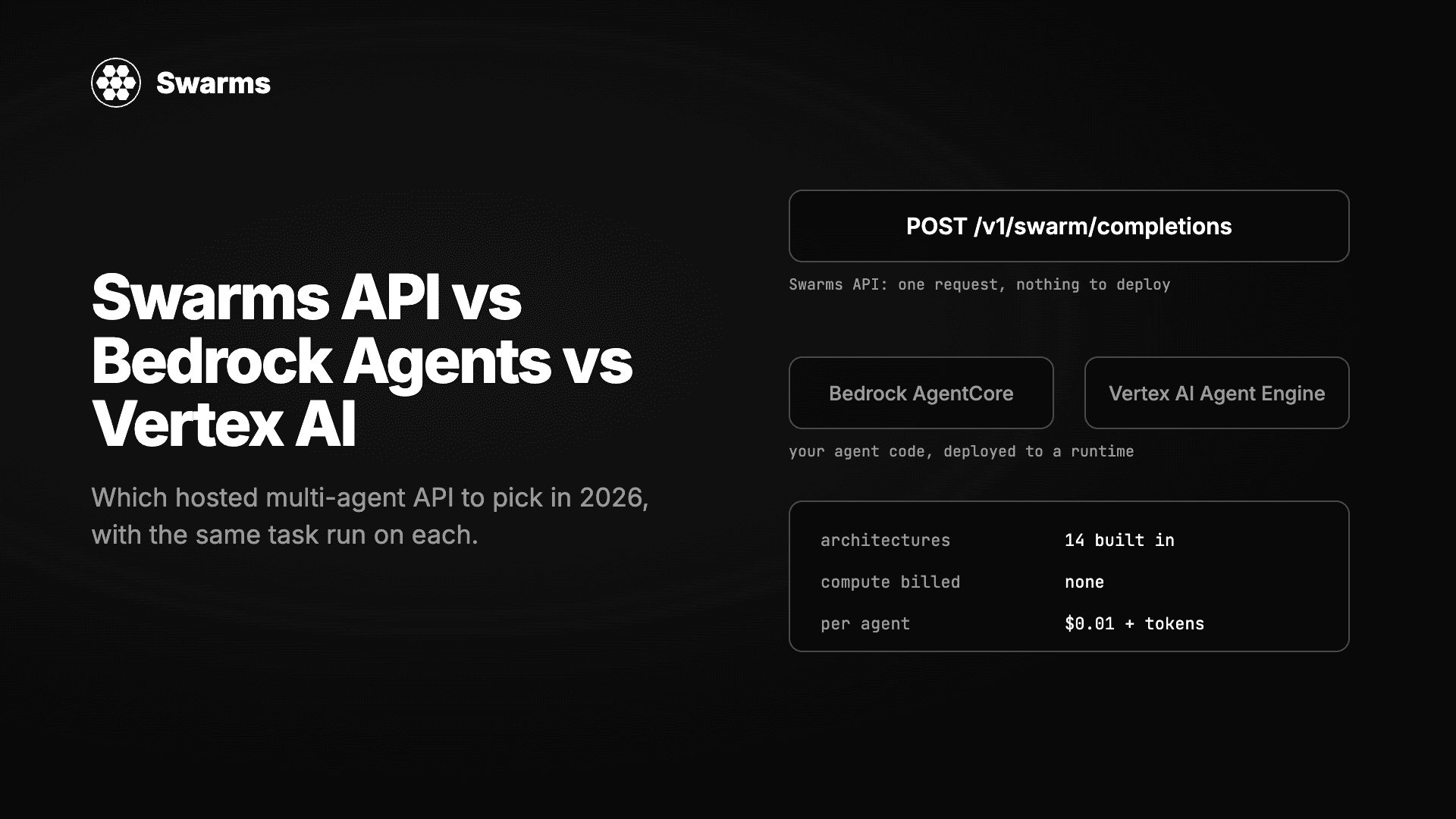
三种无需自建服务器即可运行多智能体系统的方式实测对比:Swarms API、Amazon Bedrock Agents 与 AgentCore、Google 的 Vertex AI Agent Builder 与 ADK。同一任务分别实现,逐项比较架构、模型选择、流式输出、批处理、定价以及拿到第一个结果所需的时间。
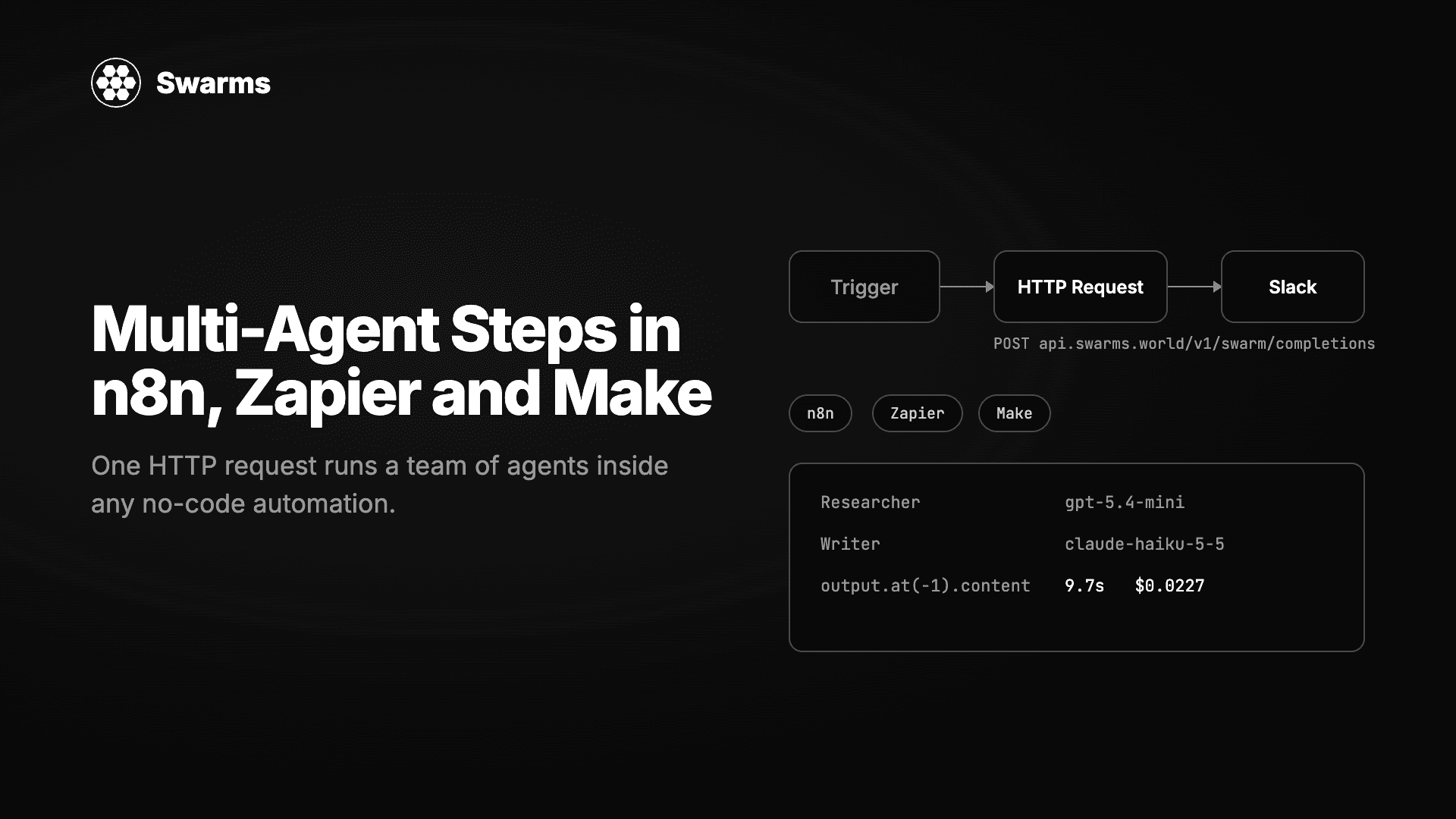
在任何无代码自动化工具中运行一支 AI 智能体团队。一个 HTTP Request 节点、一个 JSON 请求体,Swarms API 就会返回完成的工作。n8n、Zapier 和 Make 的逐步配置,外加三个可直接粘贴的配方:线索补全、工单分诊和每周报告。
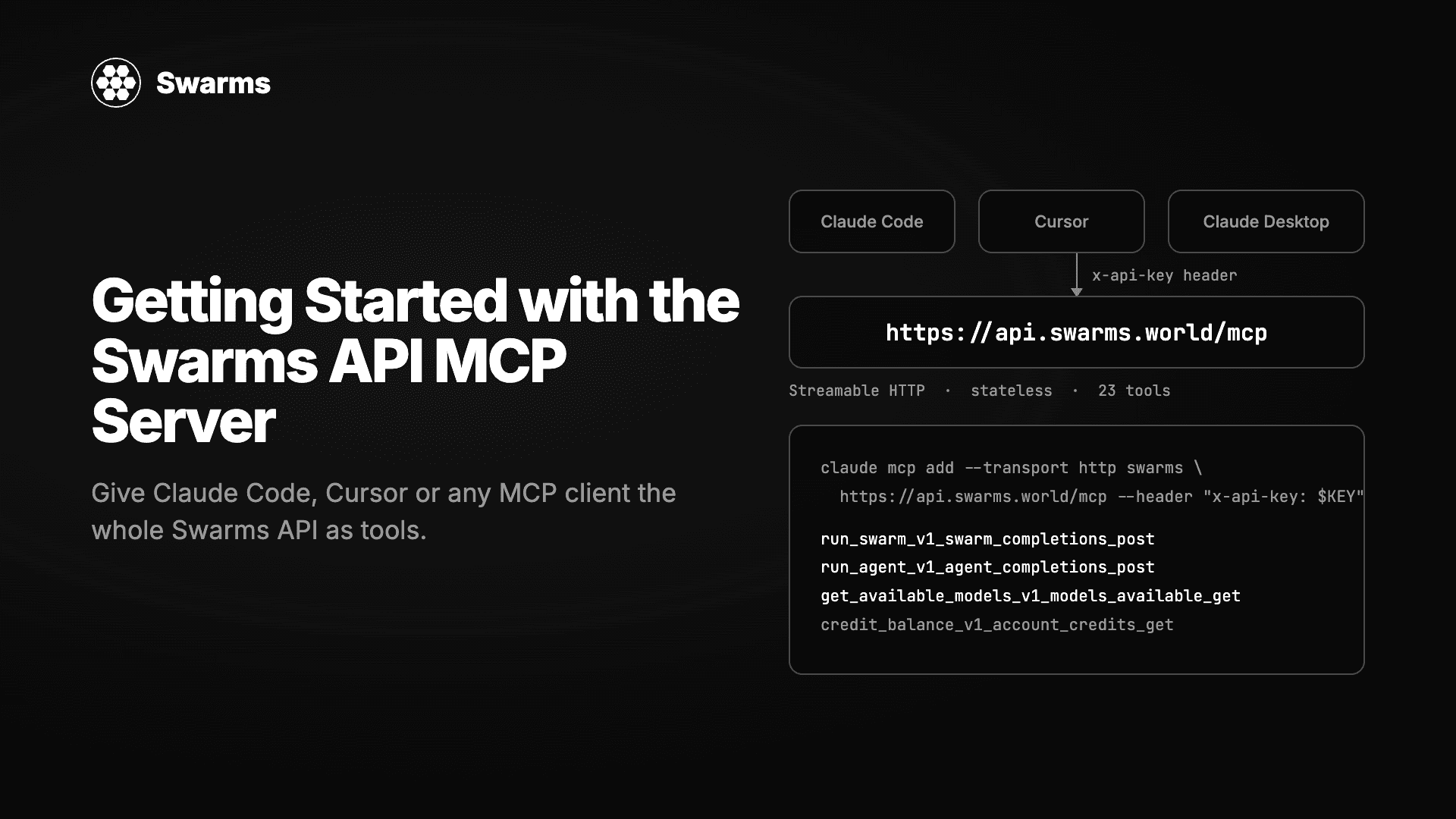
托管在 api.swarms.world/mcp 的 Swarms MCP 服务器完整教程。用两行配置连接 Claude Code、Claude Desktop、Cursor 或你自己的 Python 和 TypeScript 智能体,了解 23 个工具,从一句聊天提示运行你的第一个智能体和集群,读取结果和费用,并解决第一天会遇到的错误。