指南工程
什么是决策模型?Jev 和 Clef 与 LLM 有何不同
什么是决策模型?TypeSafe Jev 与 Cloudflare Clef 如何用经过校准的置信度回答带类型的问题,而不是生成文本,以及如何在 Swarms 中使用它们。
Swarms 团队11 分钟阅读

什么是决策模型?TypeSafe Jev 与 Cloudflare Clef 如何用经过校准的置信度回答带类型的问题,而不是生成文本,以及如何在 Swarms 中使用它们。
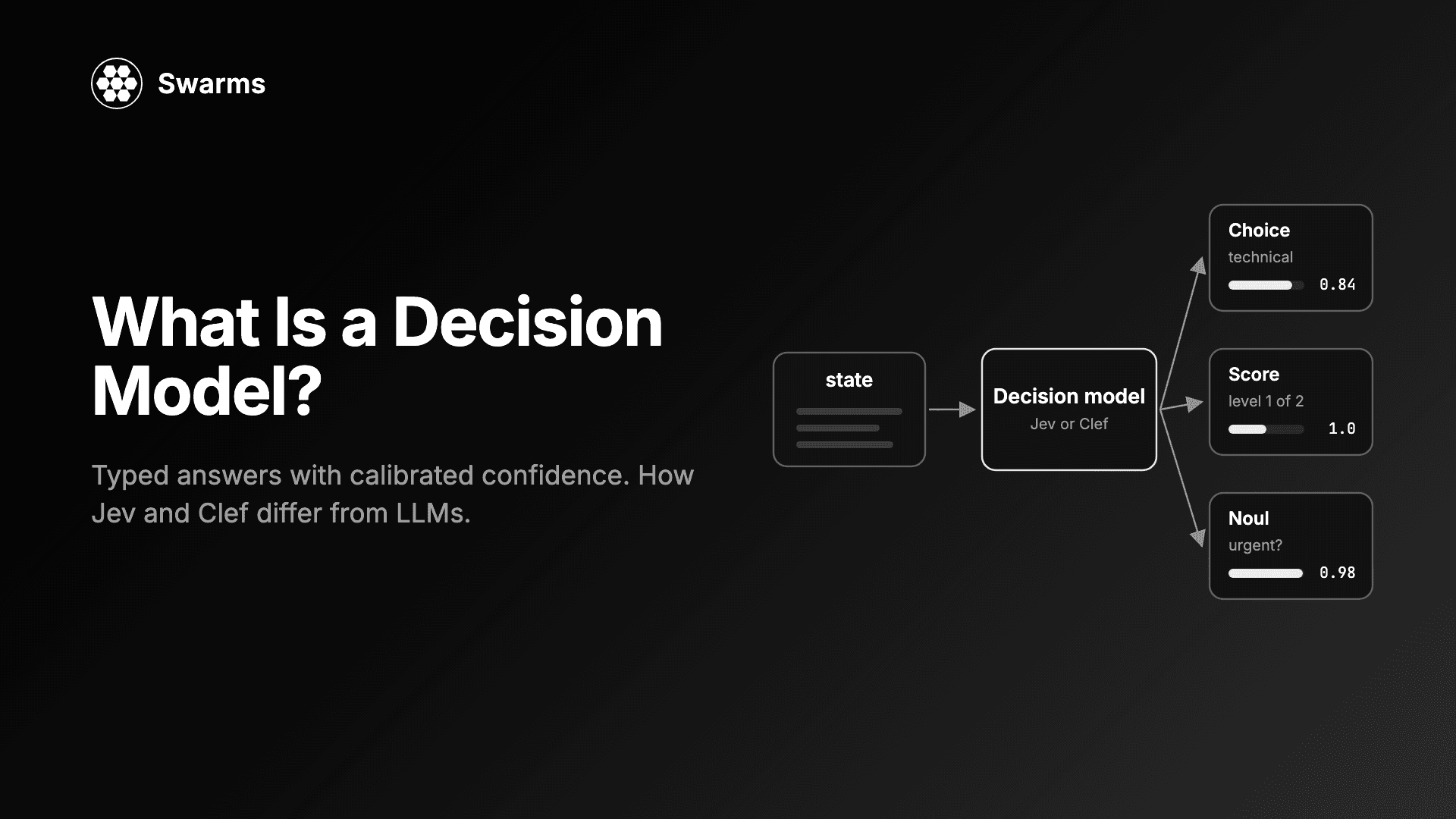
**决策模型(decision model)**是一种 AI 模型:它针对一段内容回答带类型的问题,返回的是概率,而不是文字。你给它一个 state(一张工单、一条记录、一段对话记录),再给它一组问题,并写明每个问题允许的答案。它会返回每个问题的答案、每个允许选项的概率,以及一个可供代码分支判断的置信度。它从不写句子。
目前有两个可用的决策模型:TypeSafe 的 Jev 和 Cloudflare 的 Clef。Swarms 16 为两者新增了 DecisionModel 客户端。本文先解释决策模型 AI 做什么、它和"让 LLM 返回 JSON"或训练一个分类器有什么区别、什么时候它是错误的工具,然后给出可运行的代码。
pip install -U swarms
# or
uv pip install -U swarms
DecisionModel 默认调用 TypeSafe 的 Jev,并读取 TYPESAFE_API_KEY。路由示例还会运行一个 LLM 智能体,所以需要 OPENAI_API_KEY。Clef 需要两个 Cloudflare 变量。导出你需要的变量,或者把它们写进工作目录下的 .env 文件,Swarms 会自动加载:
export TYPESAFE_API_KEY="..."
export OPENAI_API_KEY="sk-..."
# Only for Cloudflare Clef
export CLOUDFLARE_ACCOUNT_ID="..."
export CLOUDFLARE_AUTH_TOKEN="..."
检查版本:
python -c "import swarms; print(swarms.__version__)"本文的所有内容都需要 Swarms 16 或更高版本。
TypeSafe 把 Jev 称为"System One"模型,这个名字来自 Daniel Kahneman 描述的快速、直觉式思维。TypeSafe 的文档直白地说明了它不是什么:它不写回复、不写代码,也不解释自己的推理。它针对 state 评估带类型的问题,返回带类型的值和概率分布。
一个请求由两部分组成:
type、instructions,大多数类型还有列出允许答案的 criteria。同一个请求中的每个问题看到的是同一个 state,并且各自独立作答。一个答案永远不会成为另一个问题的隐藏上下文。正因如此,你可以把路由器、护栏和打分器放进同一次调用,仍然分别读取每个结果。
Clef 的请求和响应形状完全相同。Cloudflare 的模型页面把 Clef 描述为一个 27B 的多模态决策模型,把 Clef Flash 描述为更快的 9B 模型。两者都能以文本、JSON、图像或视频的形式读取 state。Jev 目前只支持文本。
| 类型 | 问的是 | 返回 |
|---|---|---|
| Choice | 这些选项中的哪一个? | choice、probabilities、confidence |
| Score | 在有序量表上处于哪一级? | score、legend、probabilities、confidence |
| Noul | 这个陈述是否为真? | noul,一个 0 到 1 之间的概率 |
Choice 从一组无序选项中选出一个,比如团队、文档类型或意图。criteria 把每个选项映射到一段描述;如果选项名本身已经说清楚,也可以映射到 None。如果你的列表可能覆盖不了所有输入,就加一个 other 选项。
Score 把 state 放到你定义的等级上,等级从低到高排列。score 按概率加权,所以可能落在两个等级之间:在 0 到 2 的沮丧程度量表上得到 1.4,意思是"介于沮丧和非常愤怒之间"。
Noul 是一个是/否问题。答案是"是"的概率。接近 0.5 表示模型无法判断。Noul 没有单独的 confidence 字段,因为概率本身已经说明了它有多确定。
根据 TypeSafe 的 API 参考,一个 Choice 最多可以有 255 个选项,一个 Score 可以有 2 到 10 个等级。Cloudflare 的 schema 允许每个 Clef 请求包含 1 到 64 个问题。由于每个答案都是你所提供选项上的概率分布,模型无法返回这些选项之外的值。
TypeSafe 训练 Jev 的目标是做出经过校准的决策。校准是对一组预测的描述:在所有被给出 0.8 概率的答案中,大约 80% 应当是正确的。它并不保证任何单个答案正确,但它让这些数字可以用作阈值。
confidence 把一个 Choice 或 Score 的分布浓缩成一个 0 到 1 之间的数。对于有 n 个选项的 Choice,它衡量最高概率比均匀分布高出多少:(p_max - 1/n) / (1 - 1/n)。全部概率集中在一个选项上得 1,均匀分布得 0。Score 的公式还会计算概率离最可能的等级有多远,所以在两个相邻等级之间摇摆,比在两端之间摇摆扣分更少。
置信度给了你第二个维度。答案告诉你"是什么",置信度告诉你"要不要行动"。TypeSafe 的文档建议划分三个区间:自动执行、确认后执行、或者转交他人,阈值随出错代价的升高而提高。以 0.6 的置信度给用户读出余额没有问题,批准一笔转账则不行。先从保守的阈值开始,再用你自己的数据去调。
你本来就可以从 LLM 拿到标签,或者训练一个分类器。区别在于返回什么,以及改动的代价。
| 让 LLM 返回 JSON | 训练好的分类器 | 决策模型 | |
|---|---|---|---|
| 输出 | 符合 schema 的生成文本 | 标签和分数 | 答案,以及每个选项的概率 |
| 不确定性 | "confidence"字段也是生成出来的文本 | 分数可能需要额外校准 | 经过校准的概率和 confidence |
| 新增标签 | 修改提示词 | 收集数据并重新训练 | 修改请求中的 criteria |
| 训练数据 | 不需要 | 需要 | 不需要 |
| 能写文字或代码 | 能 | 不能 | 不能 |
结构化输出模式会强制 LLM 的回复符合某个 schema,解决了解析问题。但它不会给你一个可用的概率:当模型写下 "confidence": 0.9 时,这个数字和其他每个 token 一样是采样出来的。分类器能给出真实的分数,但标签集在训练时就固定了。决策模型介于两者之间。你在每个请求里用自然语言定义选项,拿回的是恰好覆盖这些选项的概率分布。
当你的代码需要对非结构化内容做一个范围很窄的判断,并且会根据答案采取行动时,就用它:
当你需要文字时不要用它:回复、摘要、代码、计划或解释,这些是 LLM 的工作。决策模型也无法替你进行多步推理。TypeSafe 的建议是把一个宽泛的判断("给这份融资路演打分")拆成原子化的问题(市场规模、可行性、差异化),再在代码里加权组合。如果一个判断需要专家想几秒钟,就问它;如果需要一个下午,那就不是决策模型该回答的问题。Jev 目前只支持文本,并且英文的准确率最高,所以在依赖它处理非英文内容之前先做测试。
常见的设计是两者配合。决策模型负责廉价、高频、结构化的调用,LLM 智能体负责生成类的工作。用决策模型降低 LLM 成本一文介绍了这种漏斗及其成本。
不带参数的 DecisionModel() 使用 TypeSafe 的 jev-latest。run() 会把所有问题放进一个请求发送:
from swarms import DecisionModel

# Reads TYPESAFE_API_KEY and uses TypeSafe's jev-latest by default.
model = DecisionModel()

ticket = {
    "message": (
        "Checkout has been failing for every customer for an hour. "
        "We are losing orders. Please fix this now."
    ),
    "customer_plan": "enterprise",
}

result = model.run(
    state=ticket,
    questions={
        "team": {
            "type": "choice",
            "instructions": "Which team should handle `message`?",
            "criteria": {
                "billing": "Payments, invoices and refunds",
                "technical": "Outages, errors and integrations",
                "sales": "Pricing, plans and upgrades",
            },
        },
        "severity": {
            "type": "score",
            "instructions": "How severe is the customer impact in `message`?",
            "criteria": ["No impact", "Minor", "Major", "Critical"],
        },
        "urgent": {
            "type": "noul",
            "instructions": "Does `message` convey urgency or time pressure?",
        },
    },
)

answers = result["answers"]
print("Answered by:", result["model"])
print("team:", answers["team"])
print("severity:", answers["severity"])
print("urgent:", answers["urgent"])
print("usage:", result["usage"])
cost = model.calculate_cost(result["usage"])
print(f"cost: ${cost['total_cost']:.6f}")
我们实际运行的输出:
Answered by: jev-1.13.0
team: {'type': 'choice', 'choice': 'technical', 'confidence': 0.98, 'probabilities': {'billing': 0.02, 'technical': 0.98, 'sales': 0.0}}
severity: {'type': 'score', 'score': 3.0, 'confidence': 1.0, 'legend': {'0': 'No impact', '1': 'Minor', '2': 'Major', '3': 'Critical'}, 'probabilities': {'0': 0.0, '1': 0.0, '2': 0.0, '3': 1.0}}
urgent: {'type': 'noul', 'noul': 0.99}
usage: {'input_tokens': 438, 'output_tokens': 68}
cost: $0.000018
带反引号的 message 是指向 state 内部的路径,告诉模型应该判断哪个字段。result["model"] 报告实际作答的带版本号的模型(jev-latest 目前指向 jev-1.13.0),所以你可以把它记录下来;如果你针对某个版本调过阈值,也可以固定使用那个版本。请求发出之前,DecisionModel 会检查每个问题:类型必须有效,Choice 需要非空的 criteria 字典,Score 至少需要两个等级。请求返回之后,它会检查每个问题是否都得到了同类型的答案。
这里决策模型充当两个 LLM 智能体前面的路由器。阈值按风险设定:回复需要 0.6,退款需要 0.9,任何不属于客服范围的请求都会被拒绝。
from swarms import Agent, DecisionModel

router = DecisionModel()

agents = {
    "billing": Agent(
        agent_name="Billing-Agent",
        system_prompt="You are our billing support agent. Reply to the customer in two sentences.",
        model_name="gpt-5.4-mini",
        max_loops=1,
        output_type="final",
        print_on=False,
    ),
    "technical": Agent(
        agent_name="Technical-Agent",
        system_prompt="You are our technical support agent. Reply to the customer in two sentences.",
        model_name="gpt-5.4-mini",
        max_loops=1,
        output_type="final",
        print_on=False,
    ),
}


def handle(request: str) -> str:
    """
    Route a request to an agent, or to a person when the router is unsure.

    Args:
        request: The customer's message.

    Returns:
        The agent's reply or the reason the request went to a person.
    """
    answers = router.run(
        state=request,
        questions={
            "team": {
                "type": "choice",
                "instructions": "Which team should handle this request?",
                "criteria": {
                    "billing": "Charges, invoices, refunds and subscriptions",
                    "technical": "Bugs, API errors, outages and integrations",
                    "other": "Not a billing or technical support request",
                },
            },
            "refund": {
                "type": "noul",
                "instructions": "Does the request ask for money back?",
            },
        },
    )["answers"]

    team = answers["team"]
    print(
        f"  team={team['choice']} confidence={team['confidence']:.2f} "
        f"refund={answers['refund']['noul']:.2f}"
    )

    if team["choice"] == "other":
        return "Declined: not a support request."
    if team["confidence"] < 0.6:
        return "Sent to a person: the router is unsure who owns this."
    # Refunds move money, so they need a higher bar than a reply does.
    if answers["refund"]["noul"] > 0.5 and team["confidence"] < 0.9:
        return "Sent to a person: refund with moderate confidence."
    return agents[team["choice"]].run(request)


requests = [
    "Our webhook endpoint has returned 500 errors since your API update this morning.",
    "I was charged twice for my March invoice. Please refund one of the charges.",
    "Your sync bug duplicated 300 orders and we paid shipping on all of them. We want compensation.",
    "Something is wrong with my account.",
    "Can you write my history essay on the French Revolution?",
]

for request in requests:
    print(f"\n{request}")
    print(handle(request))
我们实际运行的输出,智能体的回复做了截断:
Our webhook endpoint has returned 500 errors since your API update this morning.
  team=technical confidence=1.00 refund=0.02
Sorry for the trouble—could you send the webhook endpoint URL, a sample failing request payload, ...

I was charged twice for my March invoice. Please refund one of the charges.
  team=billing confidence=1.00 refund=0.99
I’m sorry about the duplicate charge on your March invoice; I can help with that. ...

Your sync bug duplicated 300 orders and we paid shipping on all of them. We want compensation.
  team=billing confidence=0.68 refund=0.93
Sent to a person: refund with moderate confidence.

Something is wrong with my account.
  team=technical confidence=0.24 refund=0.05
Sent to a person: the router is unsure who owns this.

Can you write my history essay on the French Revolution?
  team=other confidence=1.00 refund=0.01
Declined: not a support request.
每个分支都被触发了。那条含糊的请求仍然得到了一个首选项 technical,但置信度只有 0.24,代码没有据此行动。如果让 LLM 选一个团队,它也会同样流畅地选出一个。同步缺陷那条索赔主要属于账单、部分属于技术,而且它在要钱,所以 0.68 不够。五个请求中只有两个到达了 LLM。不同运行之间会有小幅差异:在我们的几次运行中,那条含糊请求的得分在 0.24 到 0.36 之间,同步缺陷索赔在 0.65 到 0.72 之间。路由是多智能体系统悄无声息地出错的方式之一,所以值得同时阅读多智能体系统的失败模式。
get_decision_models() 列出每个 provider 提供的模型。当某个 provider 的凭据已设置时,它会把该 provider 的实时列表合并到内置名称中。自 #2431 起,Swarms 还会跟踪价格和 token 用量。get_decision_model_prices() 以每百万 token 的美元价格返回每个模型的价格。model.usage 累加该实例发出的每个请求的输入和输出 token。calculate_cost() 为一次响应的用量定价,不传参数时则为累计总量定价。
from swarms import DecisionModel, get_decision_model_prices, get_decision_models

print(get_decision_models())
for name, price in get_decision_model_prices().items():
    print(f"{name}: ${price['input']} input, ${price['output']} output per million tokens")

model = DecisionModel(model_name="jev-latest")
review = "The battery lasts two days, but the screen scratched within a week."

sentiment = model.score(
    state=review,
    instructions="How positive is this product review overall?",
    criteria=["Negative", "Mixed", "Positive"],
)
topic = model.choice(
    state=review,
    instructions="What does the review complain about?",
    criteria={"battery": None, "screen": None, "price": None, "shipping": None},
)
defect = model.noul(
    state=review,
    instructions="Does the review report damage or a defect?",
)

print("sentiment:", sentiment["score"], sentiment["confidence"])
print("topic:", topic["choice"], topic["probabilities"])
print("defect:", defect)
print("usage:", model.usage)
print(f"cost: ${model.calculate_cost()['total_cost']:.6f}")
我们实际运行的输出:
['jev-latest', 'jev-preview', 'jev-1.13.0', 'clef', 'clef-flash']
jev-latest: $0.042 input, $0.0 output per million tokens
jev-preview: $0.042 input, $0.0 output per million tokens
jev-1.13.0: $0.042 input, $0.0 output per million tokens
clef: $0.24 input, $0.0 output per million tokens
clef-flash: $0.09 input, $0.0 output per million tokens
sentiment: 0.95 0.93
topic: screen {'screen': 1.0, 'battery': 0.0, 'shipping': 0.0, 'price': 0.0}
defect: 0.97
usage: {'input_tokens': 916, 'output_tokens': 82}
cost: $0.000038
这些价格与各 provider 自己的页面一致。TypeSafe 列出的 Jev 1.13 价格是每百万输入 token 0.042 美元,输出 token 免费。Cloudflare 列出的 Clef 价格是每百万输入 token 0.24 美元,Clef Flash 是 0.09 美元。TypeSafe 没有价格接口,所以 Jev 的价格内置在 Swarms 中。设置了凭据时,Clef 的价格会从 Cloudflare 实时获取。
score()、choice() 和 noul() 是单个问题的快捷方式,每次调用都是一个独立的请求。上面三次调用用了 916 个输入 token。我们把同样三个问题、针对同一条评论放进一次 run() 时,只用了 370 个。当问题共享同一个 state 时,用 run()。TypeSafe 的文档也是这么说的:同一请求中多问一个问题,只需付这个问题本身的 token。要跟踪整个技术栈的用量,请参阅如何在 Python 中跟踪 LLM token 用量和成本。
切换 provider 就是换一个模型名。以 clef 开头的名称会发往 Cloudflare Workers AI。Swarms 读取 CLOUDFLARE_ACCOUNT_ID 和 CLOUDFLARE_AUTH_TOKEN,并拆开 Workers AI 的 result 外层封装,所以读取响应的代码保持不变:
from swarms import DecisionModel

# Needs CLOUDFLARE_ACCOUNT_ID and CLOUDFLARE_AUTH_TOKEN in your environment or .env.
clef = DecisionModel(model_name="clef")  # or "clef-flash"

result = clef.run(
    state="Checkout has been failing for every customer for the last hour.",
    questions={
        "team": {
            "type": "choice",
            "instructions": "Which team should handle this request?",
            "criteria": {
                "billing": "Payments, invoices and refunds",
                "technical": "Outages, errors and configuration",
            },
        },
        "urgent": {
            "type": "noul",
            "instructions": "Is this support request urgent?",
        },
    },
)

answers = result["answers"]
print(result["model"], answers["team"]["choice"], answers["urgent"]["noul"])
print(f"cost: ${clef.calculate_cost(result['usage'])['total_cost']:.6f}")
运行这段代码需要一个 Cloudflare 账户。没有 CLOUDFLARE_ACCOUNT_ID 时,构造函数会抛出 ValueError,并告诉你该设置哪个变量。我们没有在 Workers AI 上实际运行这个示例。我们把它原样运行在一个模拟的 HTTP 传输层上,确认了它会向 .../accounts/<id>/ai/run/@cf/cloudflare/clef 发起请求、把你的 token 作为 bearer 头发送、原样发送问题,并返回与 Jev 相同的 model、answers 和 usage 结构。v16 更新日志也是这么说的:Clef 路径由模拟测试覆盖,尚未在 Workers AI 上实际运行过。
await model.arun(state, questions) 的签名与 run() 相同。retry-after。max_retries 默认为 3,timeout 默认为 30 秒。base_url、endpoint 和 api_key_env,或者继承并重写 build_headers、build_payload 和 parse_response。extra_body 会把字段合并进每个请求体。httpx 直接调用 HTTP API。仓库中的 examples/decision_models/ 目录还有八个脚本,包括把决策模型用作 HierarchicalSwarm 的主管、一个简历筛选漏斗,以及 GroupChat 上的护栏。Swarms v16「Overclock」发布说明介绍了这次发布的其余内容。
一种针对 state 回答带类型问题的模型,它返回经过校准的概率,而不是生成的文本。你定义允许的答案,它返回答案、每个选项的概率和一个置信度。TypeSafe 的 Jev 和 Cloudflare 的 Clef 就是两个例子。
不是。LLM 的 JSON 是逐个 token 生成的,它报告的任何置信度也是生成出来的文本。决策模型经过训练,返回的是你所提供选项上的概率分布,所以它的置信度可以拿来设阈值。
它们接收相同的请求,返回相同的答案。Jev 是 TypeSafe 的纯文本模型,价格为每百万输入 token 0.042 美元。Clef(27B)和 Clef Flash(9B)运行在 Cloudflare Workers AI 上,还能接收图像和视频,价格分别为每百万输入 token 0.24 美元和 0.09 美元。在 Swarms 中,两者的区别只是一个模型名。
当你需要文字、代码、摘要或计划,或者需要经过多步推理的判断时。这些情况请用 LLM,或者把判断拆成范围很窄的问题,再在代码里组合答案。
你为输入 token 付费,输出 token 免费。在我们的运行中,一个包含三个问题的 Jev 请求用了 438 个输入 token,即 0.000018 美元。DecisionModel.calculate_cost() 会根据 provider 报告的用量给出这个数字。
| 资源 | 链接 |
|---|---|
| Swarms v16「Overclock」发布说明 | /blog/swarms-v16-overclock-release |
| 用决策模型降低 LLM 成本 | /blog/reduce-llm-costs-decision-model |
| 在 Python 中跟踪 LLM token 用量和成本 | /blog/track-llm-token-usage-cost-python |
| 什么是智能体? | /blog/what-is-an-agent |
| 什么是多智能体系统? | /blog/what-is-a-multi-agent-system |
| 决策模型示例 | examples/decision_models |
| TypeSafe 文档 | docs.typesafe.ai |
| Cloudflare Clef | developers.cloudflare.com/workers-ai/models/clef |
| Cloudflare Clef Flash | developers.cloudflare.com/workers-ai/models/clef-flash |
| Swarms GitHub 仓库 | github.com/kyegomez/swarms |
有问题或反馈?欢迎加入我们的 Discord 社区,或查阅文档。
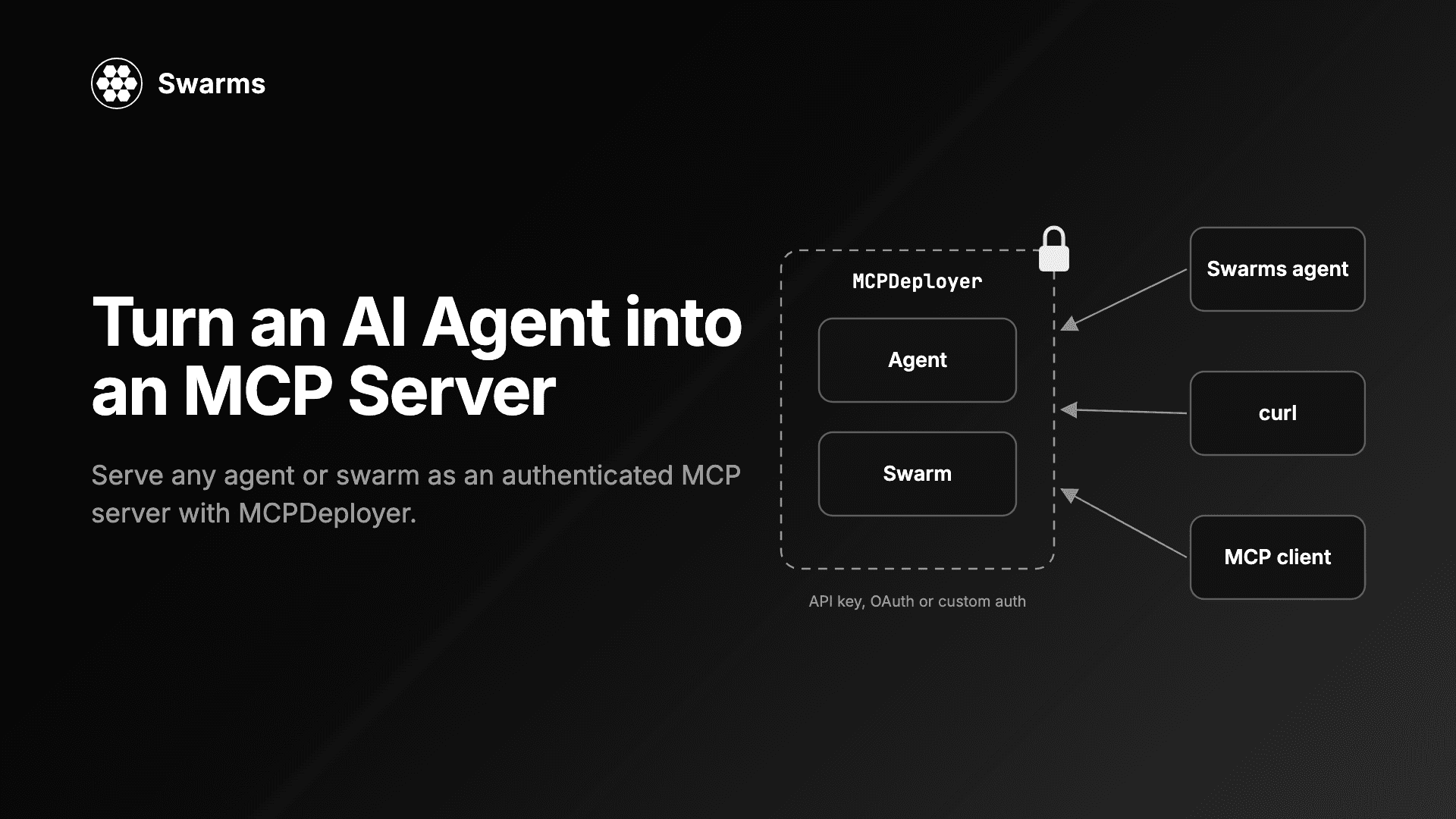
用 Swarms MCPDeployer 在 Python 中把 AI 智能体变成 MCP 服务器:API key、自定义认证、token 校验器、把 swarm 作为工具,以及一个调用它的客户端智能体。
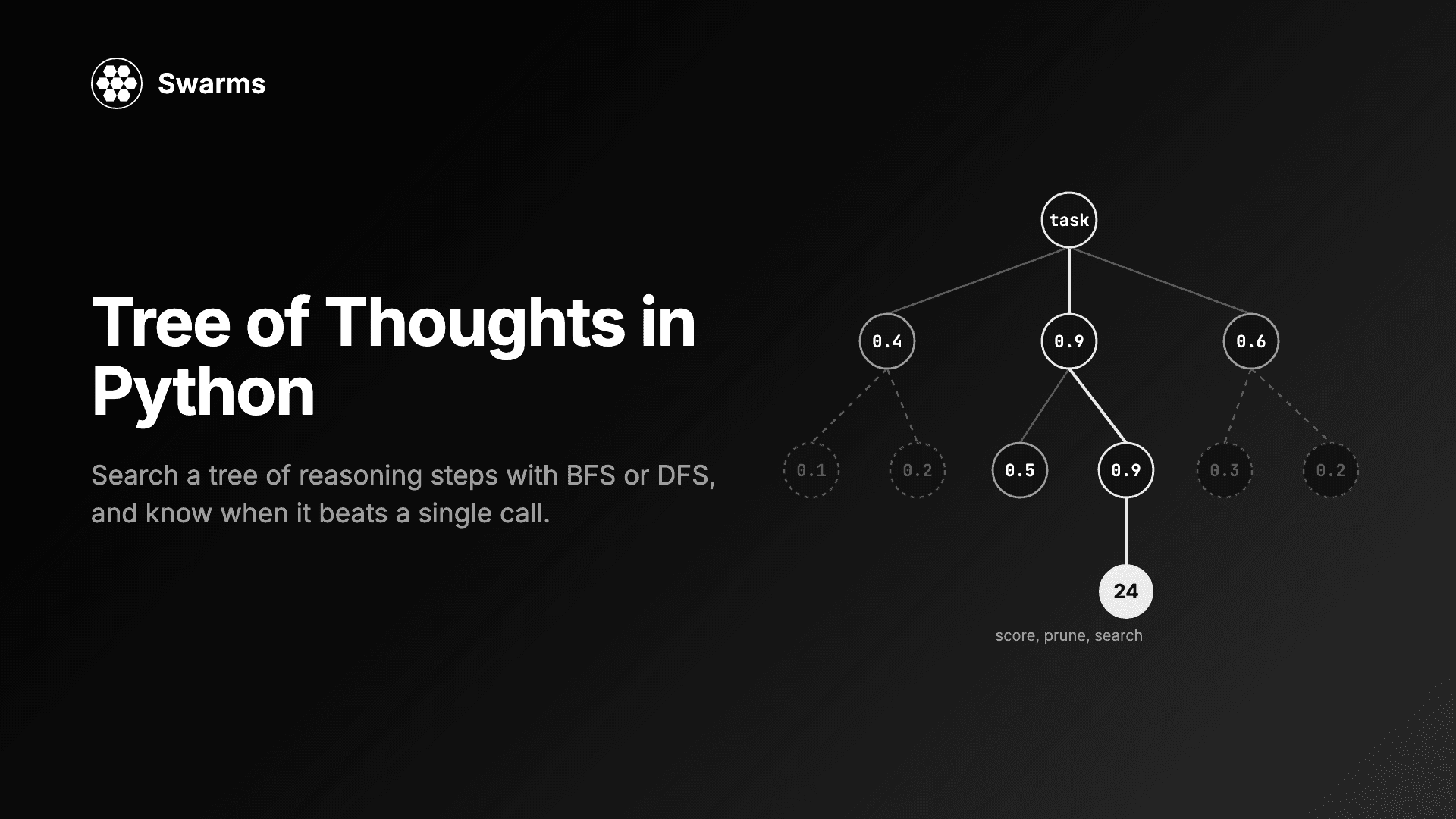
用 Swarms 在 Python 中实现 tree of thoughts:求解 24 点游戏,对比 BFS 与 DFS、propose 与 sample、value 与 vote,控制成本,并查看真实的调用次数。
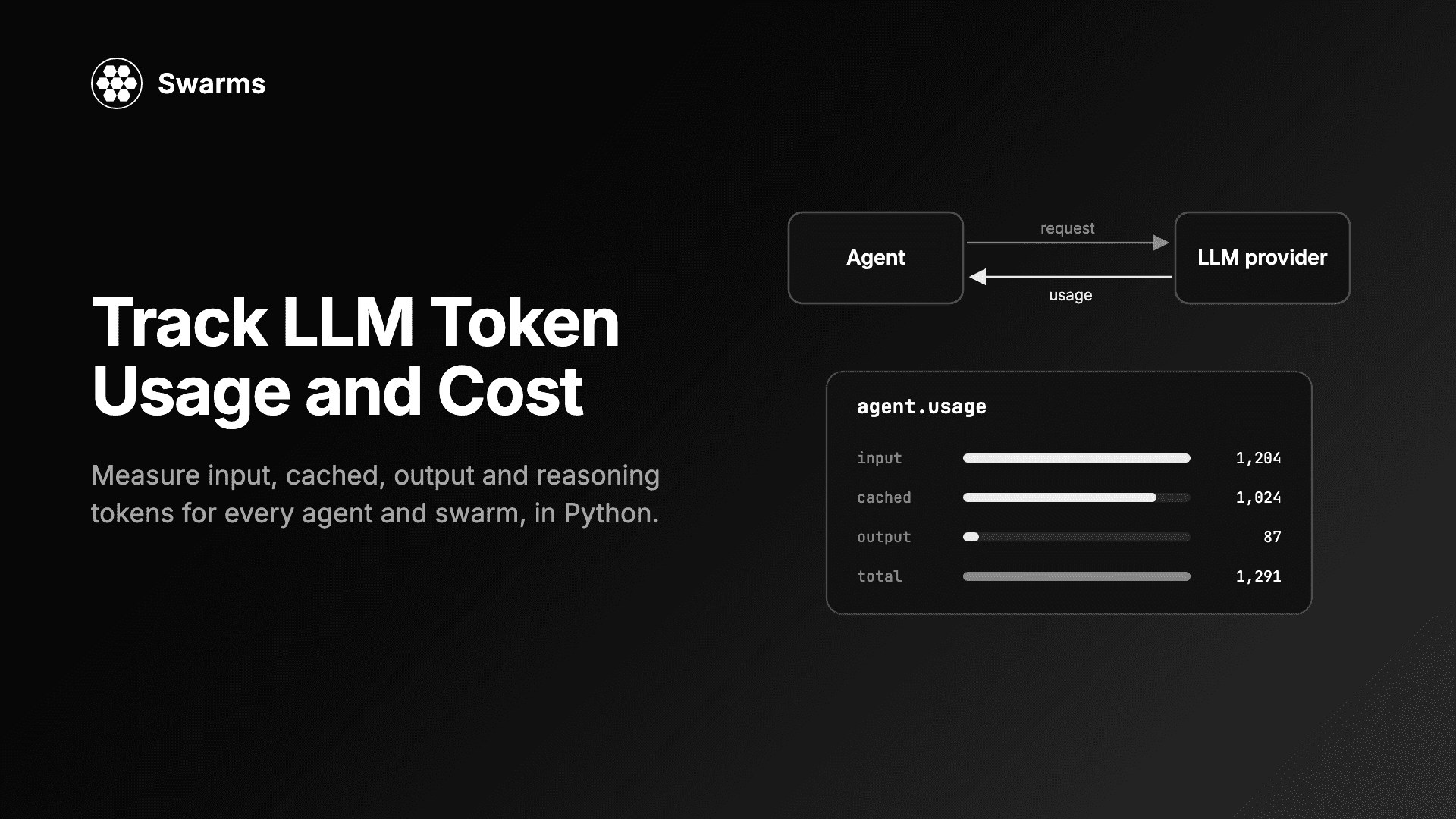
用 Python 追踪每个智能体的 LLM token 用量与成本:输入、输出、缓存与推理 token,单次运行快照,美元成本换算,以及 Swarms 中整个 swarm 的用量合计。