Every production agent eventually hits a 429, a timeout or a provider outage. Good LLM agent error handling decides what happens next: retry the same model, fall back to another model or provider, fall back to a different multi-agent structure, or stop and tell the caller. A fallback can only do its job if the failure is visible, though. A swarm that catches an exception and returns the error text as its "answer" gives every fallback above it nothing to react to.
This guide covers the failures you should plan for, why silent error strings are dangerous, and how fallbacks work in Swarms v17 "InterLink", where failed structures now raise so SwarmRouter(fallback_swarms=...) actually kicks in. You will set up retries and cross-provider fallback models on a single agent, a swarm-level fallback chain, a voting swarm that survives one provider going down, and a validation loop for bad output. Every code block was run against Swarms 17.0.0, with the provider calls simulated so we could make specific models fail on demand.
The LLM failures an agent system has to handle
Model calls fail in a handful of distinct ways, and they call for different responses:
- Rate limits (HTTP 429). The provider is up but your account is over its request or token budget. Retrying with backoff often works; at sustained load, a second provider works better.
- Timeouts. The request hangs or a long generation runs past your deadline. Retrying the same model may hang again, so a cap on time per request plus a fallback model is the usual fix.
- Provider outages (HTTP 5xx). The endpoint is down for everyone. Retries against the same provider waste time; a model on a different provider is what saves the run.
- Bad output. The call succeeds and returns text, but the text is wrong for your program: invalid JSON, missing fields, a refusal. No exception is raised, so no automatic fallback fires unless you check.
- Failures inside a structure. One worker in a fan-out, one voter, or one phase of a pipeline fails while the others succeed. The structure has to decide whether the whole run failed.
The first three surface as exceptions from the provider client. The last two are where silent errors come from.
Why silent error strings break fallbacks
A fallback is a reaction to an exception. If a component catches the exception and returns a string that looks like a result, the caller cannot tell success from failure, and every layer above keeps going on bad data.
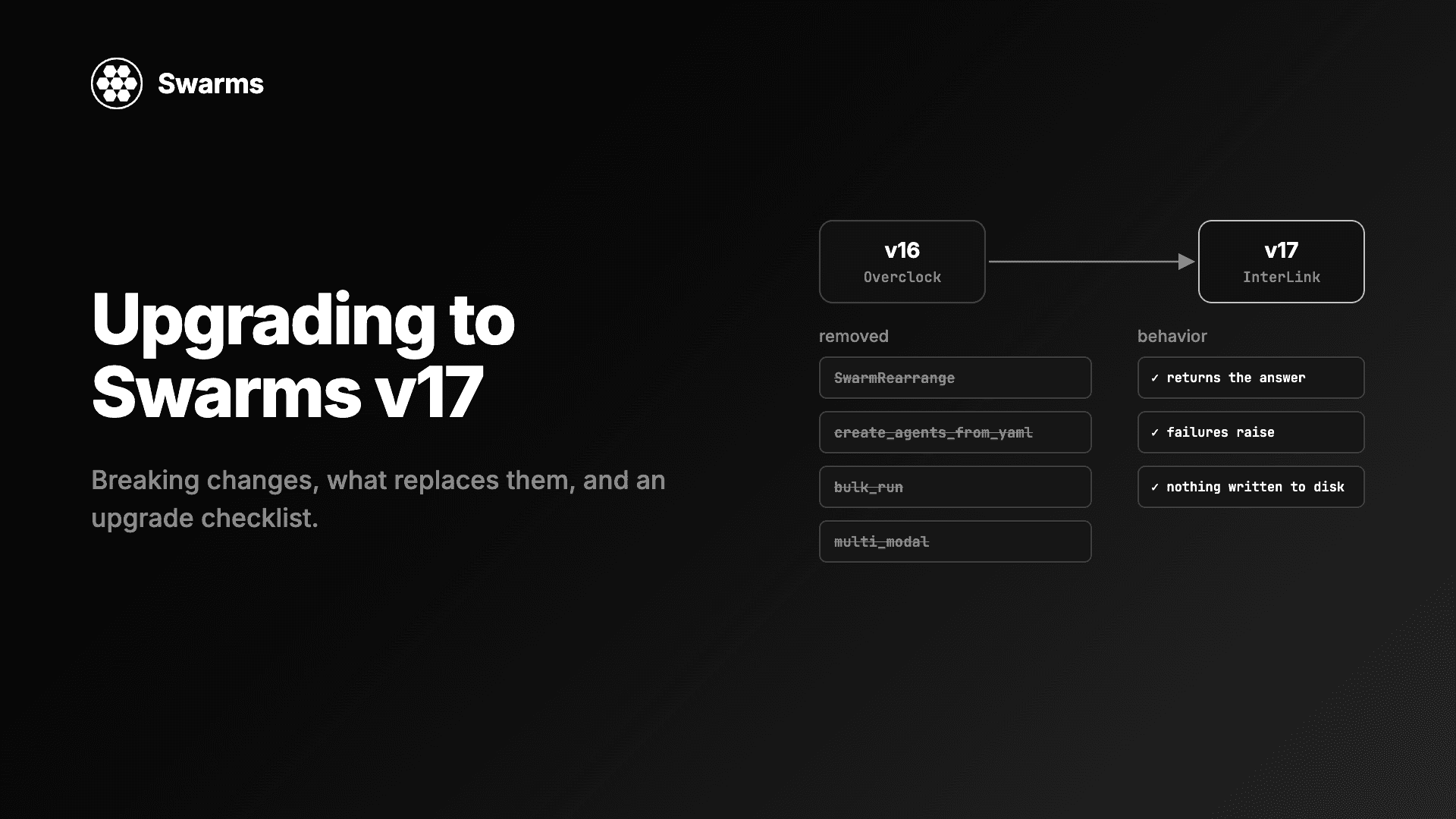
Swarms v16 already made a failed LLM call raise AgentLLMError. InterLink followed that error up through the structures and found several that caught it and returned something answer-shaped. Since SwarmRouter(fallback_swarms=...) only falls back when the swarm raises, the fallback never fired in any of these cases:
| Structure | What it did in v16 | v17 |
|---|
HeavySwarm | Returned "Failed to generate questions in loop 1: ..." as the answer and autosaved the run as "completed" | Raises; the router falls back (#2768) |
MixtureOfAgents | An aggregator failure returned "Error: ..." as the answer | Raises (#3063) |
MajorityVoting | Cast a failed voter's exception as its vote and handed it to the consensus agent | Raises; the consensus agent never runs (#3095) |
AuctionSwarm | With every winner failed, returned the bid table, "Bids: A=0.9000, B=0.4000" | Raises, chained to the top winner's error (#2493) |
AgentRearrange | Wrote a failing parallel agent's exception into the conversation as its answer, and the next step built on it | Raises, as a sequential step already did (#2456) |
The MajorityVoting case shows the damage clearly. An exception message became a vote, the consensus agent weighed it next to real answers, and the caller received a confident consensus built partly on an error string. Nothing in the logs said the run had degraded.
Two structures still record worker failures as data, on purpose, and you should know which: a failed worker inside a MixtureOfAgents layer becomes an "Error: ..." answer so that one worker outage does not kill the mixture, and ConcurrentWorkflow defaults to on_error="store", which records a failed agent under the role "<agent name> (failed)" and lets the others finish. Both are covered below.
Install
The examples mix providers, and each provider needs its key in the environment: OPENAI_API_KEY, ANTHROPIC_API_KEY, GEMINI_API_KEY, DEEPSEEK_API_KEY, MISTRAL_API_KEY and GROQ_API_KEY. You only need keys for the providers you actually use.
Retries and fallback models on one agent
The first line of defense is the agent itself. In v17 an Agent takes a fallback_models list: the first entry is the primary model, and run() walks down the list when a model fails. retry_attempts sets how many times the client retries each model before the agent moves on.
from swarms import Agent

analyst = Agent(
    agent_name="Analyst",
    system_prompt="You are a financial analyst. Answer in three short bullet points.",
    fallback_models=[
        "anthropic/claude-sonnet-5-5",  # primary
        "gpt-5.4",                      # different provider, similar strength
        "gemini/gemini-2.5-pro",        # third provider, last resort
    ],
    retry_attempts=2,  # litellm retries each model twice before the agent moves on
    max_loops=1,
    output_type="final",
    print_on=False,
)

answer = analyst.run("What are the main risks in a 60/40 portfolio right now?")
print("served by:", analyst.model_name)
print(answer)
output_type="final" makes run() return only the reply (the Agent default returns the conversation). We ran this with every Anthropic call returning a 429. The agent logged one warning and answered from the second model:
WARNING | swarms.structs.agent:run - Agent 'Analyst': 'anthropic/claude-sonnet-5-5' failed, trying 'gpt-5.4': Agent 'Analyst': model 'anthropic/claude-sonnet-5-5' failed: litellm.RateLimitError: ...
served by: gpt-5.4
After a run, agent.model_name names the model that served it, which is useful for logging and cost tracking. The next run() starts from the primary model again, so one bad minute at Anthropic does not leave the agent on the fallback for good.
How the flat model loop counts calls
Before v17, a failed call was retried in three stacked layers: litellm's own num_retries, an attempt loop in Agent._run, and a recursive fallback chain in LLMManager. With the default retry_attempts=3, one dead endpoint could cost up to 12 calls per model before the agent gave up (#2811).
Now there is one flat loop with clear rules:
- The client owns retries.
retry_attempts travels with every request as litellm's num_retries, and rate limits back off exponentially. With the default of 3, that is at most 4 calls per model.
Agent.run walks fallback_models once, in order. With three models and the default, the worst case is 12 calls for the whole run, where v16 could spend 12 on each model.- Only an
AgentLLMError (a failed model call) moves the loop to the next model. Any other error, such as a bug in one of your tools, raises at once and is never re-run on the next model.
- A failed attempt's turns are dropped from the agent's history, so the fallback model starts clean, and the caller's
messages reach the fallback model too (#2806).
- The older
fallback_model_name="..." still works; it is folded into fallback_models at construction.
Timeouts and the error you get when every model fails
When the last model in the list fails, run() raises AgentLLMError, chained to the provider's own exception. To cap how long a single request may take, pass litellm's timeout through llm_args, which the agent forwards to every completion call:
from swarms import Agent, AgentLLMError

summarizer = Agent(
    agent_name="Summarizer",
    system_prompt="Summarize the text in two sentences.",
    fallback_models=["gpt-5.4-mini", "anthropic/claude-haiku-5-5"],
    retry_attempts=1,
    llm_args={"timeout": 20},  # seconds per request, passed through to litellm
    max_loops=1,
    output_type="final",
    print_on=False,
)

try:
    print(summarizer.run("Summarize this incident report: ..."))
except AgentLLMError as error:
    # Raised only after the last model in fallback_models has failed.
    print("every model failed:", error)
    print("provider error:", type(error.__cause__).__name__)
Here both models are small and cheap, which suits a high-volume summarizer. In our test the OpenAI request timed out and Anthropic answered with a 500, so the run ended in the except branch:
every model failed: Agent 'Summarizer': model 'anthropic/claude-haiku-5-5' failed: litellm.InternalServerError: ...
provider error: InternalServerError
A timeout is reported immediately with the original error attached. Before v17 a network failure first waited 3 s probing 8.8.8.8:53 and then reported "No internet connection", which hid the real cause (#2729).
Cross-provider fallback: how to order the chain
A fallback model on the same provider protects you from a model-specific problem. It does nothing during a provider outage or an account-wide rate limit, because both models share the same endpoint and the same quota. For real coverage, put the next entry on a different provider:
- Match capability first. The fallback has to be able to do the job.
anthropic/claude-sonnet-5-5 falls back well to gpt-5.4 or gemini/gemini-2.5-pro; falling back from a frontier model to a small one may produce output that fails your checks downstream.
- Then spread providers. Three entries on three providers survive any single-provider incident.
- Keep prompts portable. The same system prompt goes to every model in the list. Avoid provider-specific features in prompts an agent might send to a fallback.
- Watch sampling parameters. Current Claude models reject
temperature and top_p, so leave them unset on agents whose list includes a Claude model.
Swarm-level fallback with SwarmRouter fallback_swarms
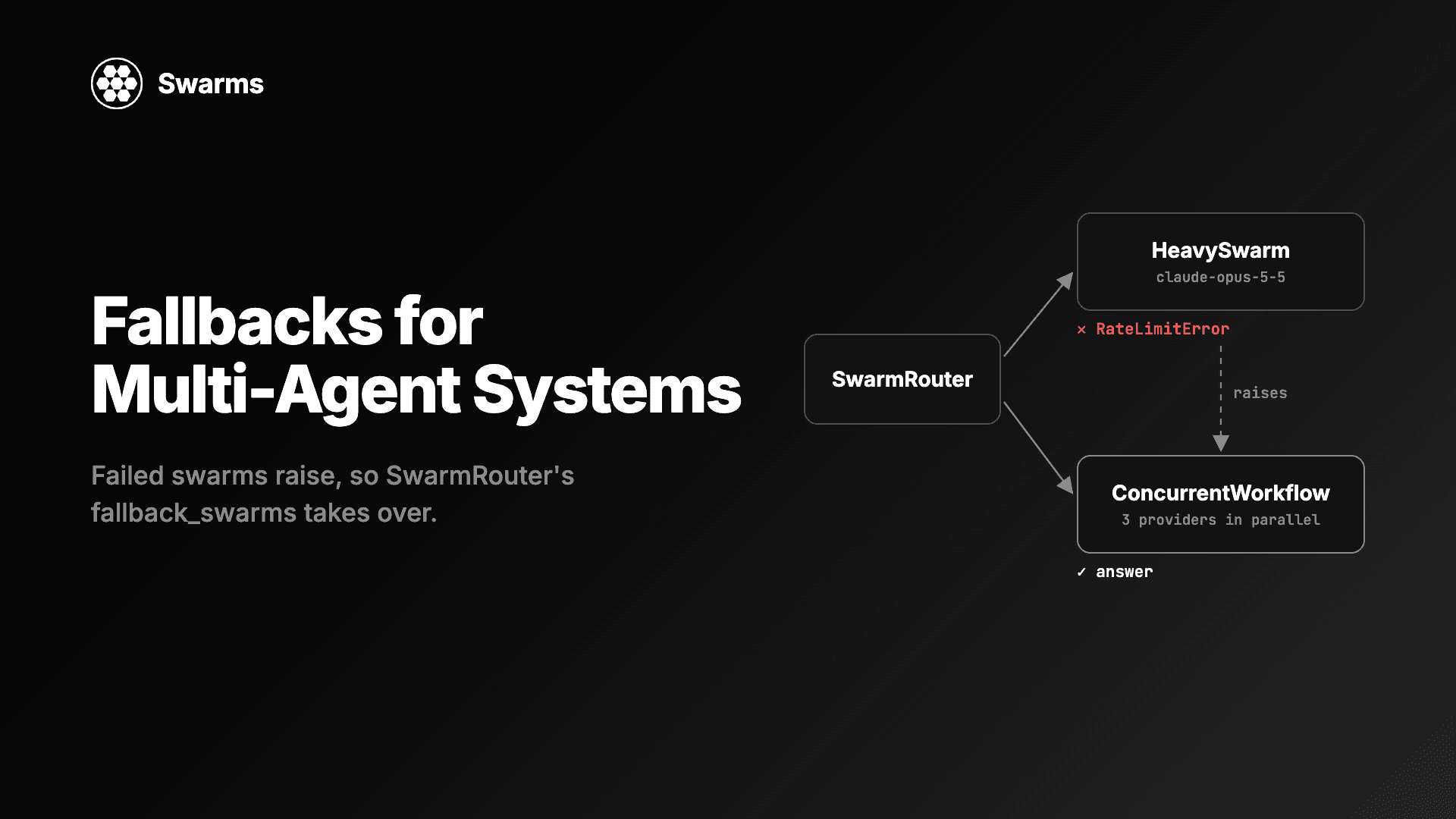
Agent-level fallbacks handle a failed model call. Sometimes the whole structure fails: a HeavySwarm whose internal models are all on one provider, or an architecture that cannot run with the inputs it got. SwarmRouter takes fallback_swarms, a list of swarm types to try in order when the primary raises. Each fallback is built from the same agents and configuration, and the first one to complete wins.
from swarms import Agent, SwarmRouter

# Your own agents, spread over three providers that are not Anthropic.
analysts = [
    Agent(
        agent_name="Macro-Analyst",
        system_prompt="Assess the macroeconomic picture in five bullet points.",
        model_name="gpt-5.4-mini",
        max_loops=1,
        print_on=False,
    ),
    Agent(
        agent_name="Sector-Analyst",
        system_prompt="Assess the sector and company-level picture in five bullet points.",
        model_name="gemini/gemini-2.5-pro",
        max_loops=1,
        print_on=False,
    ),
    Agent(
        agent_name="Risk-Analyst",
        system_prompt="List the five largest downside risks.",
        model_name="deepseek/deepseek-v4-pro",
        max_loops=1,
        print_on=False,
    ),
]

router = SwarmRouter(
    name="market-brief",
    agents=analysts,
    swarm_type="HeavySwarm",  # primary: HeavySwarm's built-in question agent and workers
    heavy_swarm_question_agent_model_name="anthropic/claude-opus-5-5",
    heavy_swarm_worker_model_name="anthropic/claude-sonnet-5-5",
    heavy_swarm_swarm_show_output=False,
    fallback_swarms=["ConcurrentWorkflow"],  # your agents, on other providers
    output_type="str-all-except-first",  # every analyst's answer
)

result = router.run("Write a one-page brief on the US semiconductor sector.")

print("served by:", router.active_swarm_type)
for attempt in router.fallback_attempts:
    print("failed:", attempt["swarm_type"], "->", type(attempt["error"]).__name__)
print(result)
The primary is a HeavySwarm with Claude Opus planning the questions and Claude Sonnet doing the research, the stronger option when Anthropic is healthy. The fallback is a plain ConcurrentWorkflow over your three analysts on OpenAI, Google and DeepSeek. With Anthropic returning 429s, HeavySwarm's question agent failed on its first call, the router logged SwarmRouter swarm 'HeavySwarm' failed: litellm.RateLimitError: ... Falling back to 'ConcurrentWorkflow'., and the run printed:
served by: ConcurrentWorkflow
failed: HeavySwarm -> RateLimitError
followed by the three analysts' answers. In v16 this same setup returned "Failed to generate questions in loop 1: ..." as the brief and the fallback never ran.
Two attributes tell you what happened: router.active_swarm_type is the swarm type that served the most recent run, and router.fallback_attempts holds one {"swarm_type", "error"} entry per swarm that failed. With autosave=True, the run's metadata records both. If you leave fallback_swarms unset, the primary swarm's error propagates unchanged.
Check the fallback's own failures
ConcurrentWorkflow keeps going when one of its agents fails: by default (on_error="store") it records the error as that agent's answer under the role "<agent name> (failed)". The router sees a completed run, so check the conversation if a partial result matters to you. This continues the example above:
# ConcurrentWorkflow records a failed agent as an "Error: ..." row instead of raising,
# so check the fallback's conversation for those rows.
failed = [
    message["role"]
    for message in router.conversation.conversation_history
    if message["role"].endswith("(failed)")
]
print("failed inside the fallback:", failed)
With Gemini also returning 500s in our test, this printed failed inside the fallback: ['Sector-Analyst (failed)']. When you use ConcurrentWorkflow directly you can pass on_error="raise" to fail the whole run instead. Inside a router, giving each analyst its own fallback_models is the simpler fix, because the agent recovers before the workflow ever sees an error.
When every swarm fails
If the primary and every fallback raise, run() raises SwarmRouterRunError (import it from swarms.structs.swarm_router), chained to the last attempt's error, and router.fallback_attempts still lists every attempt. That is the signal to page someone or return an explicit error to your user.
Fallbacks inside a vote: MajorityVoting
Voting and consensus structures are where silent errors hurt most, so they are a good place to see the v17 behavior. Three voters on three providers triage a support ticket:
from swarms import Agent, AgentLLMError, MajorityVoting

question = "Should this support ticket be escalated? Answer YES or NO with one reason."

voters = [
    Agent(
        agent_name="Voter-Groq",
        system_prompt="You triage support tickets.",
        model_name="groq/openai/gpt-oss-120b",
        max_loops=1,
        print_on=False,
    ),
    Agent(
        agent_name="Voter-Mistral",
        system_prompt="You triage support tickets.",
        model_name="mistral/mistral-large-latest",
        max_loops=1,
        print_on=False,
    ),
    Agent(
        agent_name="Voter-OpenAI",
        system_prompt="You triage support tickets.",
        model_name="gpt-5.4-mini",
        max_loops=1,
        print_on=False,
    ),
]

vote = MajorityVoting(
    agents=voters,
    consensus_agent_model_name="gemini/gemini-2.5-pro",
    additional_consensus_agent_kwargs={"print_on": False},
    output_type="final",
)

try:
    print(vote.run(question))
except AgentLLMError as error:
    print("vote failed:", type(error).__name__, error)
The voters are fast, inexpensive models, since a vote multiplies calls, and the consensus agent is Gemini 2.5 Pro, a stronger judge. (Leave Claude out of the consensus seat here: MajorityVoting's built-in consensus agent turns on dynamic temperature and sends a random temperature with its requests, which current Claude models reject.)
With Groq returning 500s, the run printed vote failed: AgentLLMError Agent 'Voter-Groq': model 'groq/openai/gpt-oss-120b' failed: ..., and the consensus model was never called. That is the correct outcome when a voter has no way to recover. In v16 the error text would have been counted as Groq's vote.
To let the vote survive the outage, give the vulnerable voter a fallback on another provider. This continues the previous block:
voters[0] = Agent(
    agent_name="Voter-Groq",
    system_prompt="You triage support tickets.",
    fallback_models=["groq/openai/gpt-oss-120b", "deepseek/deepseek-v4-pro"],
    max_loops=1,
    print_on=False,
)

vote = MajorityVoting(
    agents=voters,
    consensus_agent_model_name="gemini/gemini-2.5-pro",
    additional_consensus_agent_kwargs={"print_on": False},
    output_type="final",
)
print(vote.run(question))
print("Voter-Groq answered with:", voters[0].model_name)
Now the vote completes, the consensus agent runs on three real votes, and the last line printed Voter-Groq answered with: deepseek/deepseek-v4-pro. The two layers work together: agent fallbacks absorb a provider failure, and the structure raises only when an agent truly cannot answer.
Handling bad output: validate, then fall back
A model that returns malformed output does not raise, so fallback_models will not help. Treat "the output failed validation" as a failure in your own code and walk a model list yourself:
import json

from swarms import Agent, AgentLLMError

REQUIRED = {"vendor", "total", "currency"}
MODELS = ["gpt-5.4-mini", "anthropic/claude-haiku-5-5"]  # cheap first, then another provider


def extract_invoice(text: str) -> dict:
    problems = []
    for model in MODELS:
        agent = Agent(
            agent_name="Invoice-Extractor",
            system_prompt=(
                "Extract vendor, total and currency from the invoice. "
                "Reply with one JSON object and nothing else."
            ),
            model_name=model,
            max_loops=1,
            output_type="final",
            print_on=False,
        )
        try:
            data = json.loads(agent.run(text))
            if not isinstance(data, dict):
                raise ValueError("expected a JSON object")
            missing = REQUIRED - data.keys()
            if missing:
                raise ValueError(f"missing fields {sorted(missing)}")
            return data
        except (AgentLLMError, ValueError) as error:  # json.JSONDecodeError is a ValueError
            problems.append(f"{model}: {error}")
    raise RuntimeError("no model produced a valid invoice:\n" + "\n".join(problems))


print(extract_invoice("ACME Corp. Invoice 1043. Total due: 1,250.00 EUR."))
In our test the first model wrapped its JSON in a chatty sentence, json.loads failed, and the second model's valid object was returned: {'vendor': 'ACME Corp.', 'total': 1250.0, 'currency': 'EUR'}. When both models fail, the RuntimeError lists each model's problem; in our failure test that was a missing-fields error from the first model and a rate-limit error from the second. The function builds a fresh agent per attempt, which keeps the second model from seeing the first model's bad answer.
A production checklist for LLM agent error handling
- Give every agent on a critical path a
fallback_models list that spans at least two providers. It is the cheapest protection against 429s and outages.
- Budget retries on purpose. Calls per model are
retry_attempts + 1; multiply by the number of models for the worst case. Lower retry_attempts for latency-sensitive paths and lean on the fallback instead.
- Set a request timeout with
llm_args={"timeout": ...} so a hung request fails over instead of blocking.
- Use
fallback_swarms for structure-level failures, and read router.active_swarm_type and router.fallback_attempts after each run to log which path served it.
- Check structures that record failures as data:
"(failed)" rows in ConcurrentWorkflow and "Error: ..." worker answers in MixtureOfAgents.
- Validate output you parse. Bad output never raises on its own.
- Catch
AgentLLMError and SwarmRouterRunError at the edge of your app and return an explicit failure. Avoid returning a placeholder string, which recreates the silent-error problem one layer up.
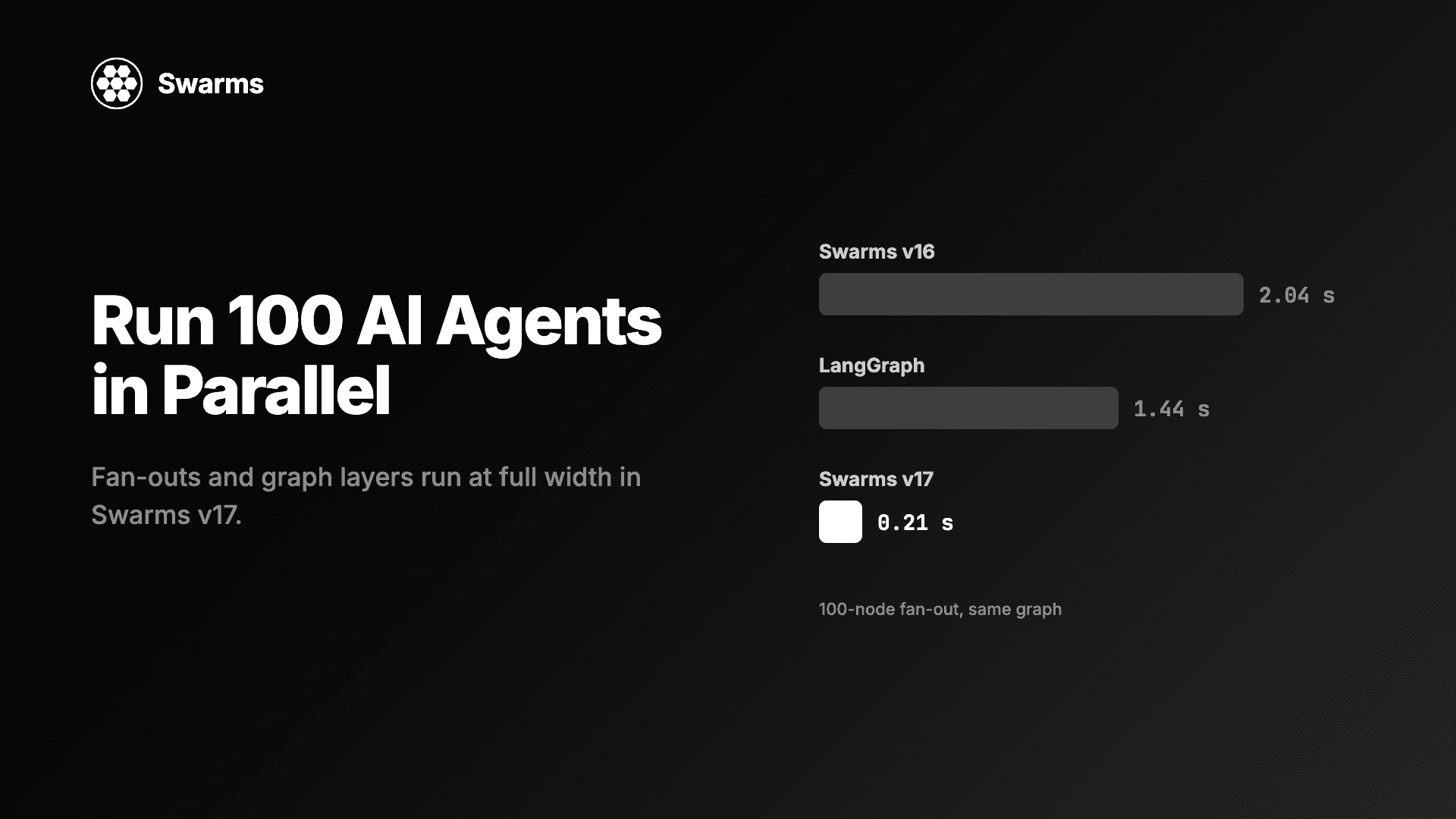
- Watch concurrency against rate limits. v17 sizes
GroupChat's thread pool to the number of agents; with a large roster, set max_workers or max_parallel_nodes if you start seeing 429s.
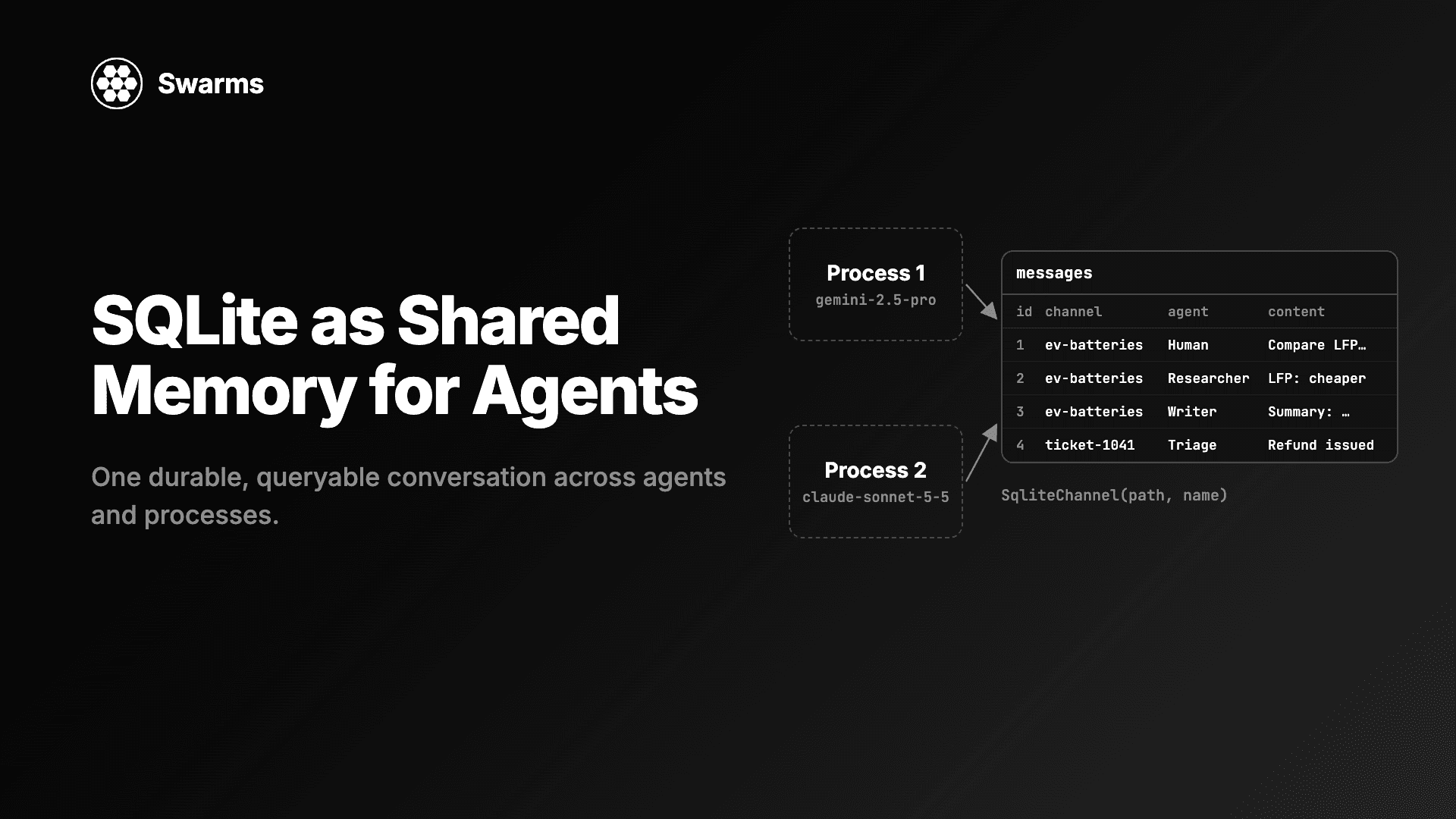
The broader pattern behind these bugs, structures that return plausible output instead of an error, is the subject of Multi-Agent System Failure Modes. If you want a durable record of what each agent said in a run (a failed run posts nothing), see Using SQLite as Shared Memory for AI Agents.
FAQ
How do I add a fallback model to an LLM agent in Swarms?
Pass fallback_models to Agent, with the primary model first: Agent(fallback_models=["anthropic/claude-sonnet-5-5", "gpt-5.4", "gemini/gemini-2.5-pro"]). When a model call fails, run() tries the next model in the list, and every new run starts from the first model again.
What is the difference between retry_attempts and fallback_models?
retry_attempts is how many times the client retries the same model (it is sent to litellm as num_retries, with exponential backoff on rate limits). fallback_models is the ordered list of models the agent moves through once a model has failed all its retries.
Why didn't SwarmRouter fallback_swarms trigger before v17?
fallback_swarms only runs when the primary swarm raises. In v16, HeavySwarm, MixtureOfAgents, MajorityVoting, AuctionSwarm and AgentRearrange caught some failures and returned error text or a bid table as if it were an answer, so the router saw a success. In v17 they raise, and the router falls back.
What happens when every model and every swarm fails?
An agent raises AgentLLMError, chained to the last provider error. A SwarmRouter with fallback_swarms raises SwarmRouterRunError, and router.fallback_attempts lists the error from each swarm type it tried.
Should the fallback model be on a different provider?
Usually, yes. Rate limits and outages tend to affect a whole provider or account, so a fallback on the same provider often fails for the same reason. Pick a model of similar capability on another provider.
Get started
Read the full list of v17 changes, including every fix behind this guide, in the Swarms v17 "InterLink" changelog. The API reference is at docs.swarms.world, and the source is on GitHub.