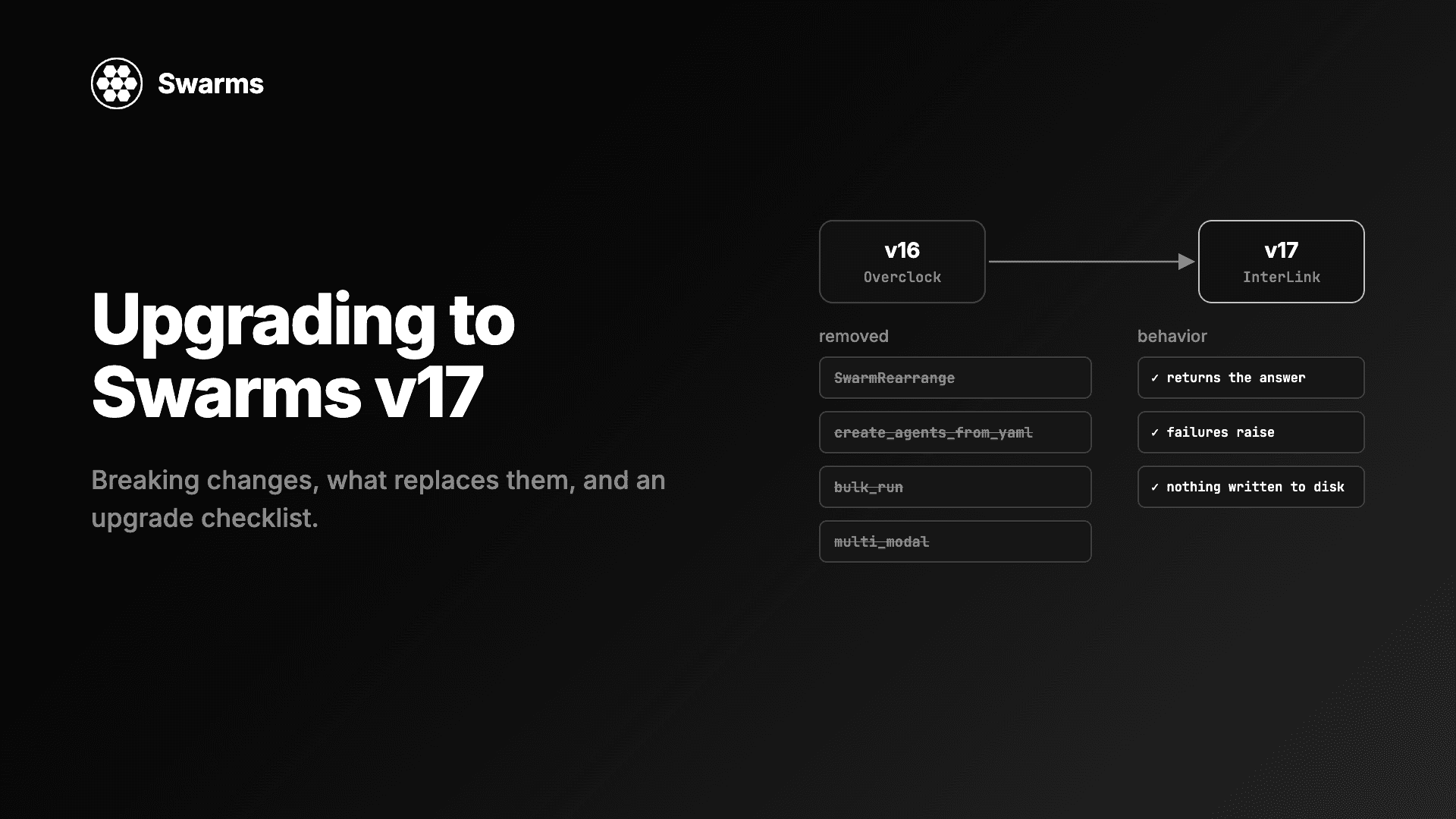
Swarms v17 "InterLink" removes more code than it adds. More than forty parameters, methods, modules and classes that did nothing, or did the wrong thing, are gone, and several defaults changed: Agent() sends no system prompt unless you give it one, workflows no longer autosave, and failed swarms raise where they used to return an error string. This guide is the Swarms v17 upgrade and migration path, organized by what you will actually run into, with the v16 code you probably have and the v17 code to replace it with.
The most important thing to know before you start: many removed keyword arguments are absorbed by **kwargs and silently ignored. Your code will often keep running after the upgrade and quietly stop doing what that argument used to do. Search for the names in this guide rather than waiting for a TypeError.
Every v17 code block below was run against Swarms 17.0.0. Blocks marked v16 (old) show the code you are migrating away from and do not run on v17.
Before you upgrade: pin, branch and search
Pin the version you are on now, so you can compare behavior side by side and roll back if you need to:
# see what you have
python -c "import swarms; print(swarms.__version__)"

# stay on v16 while you migrate (16.0.4 was the last v16 point release)
pip install "swarms==16.0.4"

# then, on a branch, move to v17
pip install -U "swarms==17.0.0"
# or with RouteHub and rustworkx, the optional speedups
pip install -U "swarms[fast]==17.0.0"
In requirements.txt or pyproject.toml, pin a major version so a future release cannot change behavior under you: swarms>=17,<18.
Then search your code for the removed names. This catches most of what the rest of this guide covers:
grep -rnE "SwarmRearrange|swarm_arrange|create_agents_from_yaml|CSVAgentLoader|MarkdownAgentLoader|MarkdownAgentConfig|AgentConfigDict|AgentValidator|ModelName|image_batch_processor|ImageAgentBatchProcessor|hierarchical_structured_communication_framework|Transcript|log_agent_data|generate_conversation_id|MAX_CONCURRENT_AGENTS|bulk_run|check_available_tokens|get_available_models|get_current_model|switch_to_next_model|reset_model_index|is_fallback_available|multi_modal=|sop=|sop_list=|output_cleaner|agents_config=|memory_system=|shared_memory=|idle_timeout=|auto_generate_prompts=|metadata_output_path=|output_metadata=|correct_answer=|basemodel|mcp_url=" --include="*.py" .
Expect some false positives (Transcript and ModelName are common words, and mcp_url= is still valid for HTTP servers). Calls to agent.run(task, n=...) are too generic to grep reliably; look for them by hand.
Removed classes and modules
The changelog lists twelve removed modules. These are the ones with real callers and a direct replacement.
SwarmRearrange becomes AgentRearrange with swarms as steps
AgentRearrange now accepts whole swarms in agents=, next to ordinary agents. Anything with a name and a run(task) method can appear in a flow, so SwarmRearrange and swarm_arrange() are deleted.
v16 (old):
from swarms import SwarmRearrange

pipeline = SwarmRearrange(swarms=[research_team, review_team], flow="Research-Team -> Review-Team")
v17:
from swarms import Agent, AgentRearrange, ConcurrentWorkflow

def make(name, model, prompt):
    return Agent(agent_name=name, model_name=model, system_prompt=prompt, max_loops=1, print_on=False)

planner = make("Planner", "anthropic/claude-sonnet-5-5", "Break the question into two research angles.")
analyst_a = make("Supply-Analyst", "groq/openai/gpt-oss-120b", "Research the supply side.")
analyst_b = make("Demand-Analyst", "gpt-5.4-mini", "Research the demand side.")
editor = make("Editor", "anthropic/claude-sonnet-5-5", "Merge the research into a five-line brief.")

# A whole swarm can be one step. This output_type returns each analyst's answer, without the task.
research_team = ConcurrentWorkflow(
    name="Research-Team", agents=[analyst_a, analyst_b], output_type="str-all-except-first",
)

pipeline = AgentRearrange(
    agents=[planner, research_team, editor],
    flow="Planner -> Research-Team -> Editor",
    output_type="final",
)
print(pipeline.run("What is the HBM memory supply outlook for 2027?"))
The planner and editor run on Claude Sonnet 5.5, because planning and merging reward a stronger model, while the two analysts run on cheaper, faster models (gpt-oss-120b on Groq and gpt-5.4-mini) since there are several of them. Each provider reads its own key: ANTHROPIC_API_KEY, GROQ_API_KEY, OPENAI_API_KEY, and likewise GEMINI_API_KEY, DEEPSEEK_API_KEY and MISTRAL_API_KEY for the other examples in this guide.
A nested swarm receives the whole shared conversation so far as its task, and whatever it returns is written into the outer conversation. So give the inner swarm an output type that returns only what it produced. For a ConcurrentWorkflow, "str-all-except-first" returns every agent's answer without repeating the task it was handed. ("final" would keep only the last agent to finish, and drop the other analyst.) For an inner sequential team, "final" is the right choice. The original object stays reachable as pipeline.agents[i].swarm.
create_agents_from_yaml, CSVAgentLoader and MarkdownAgentLoader become AgentLoader
Agent loading was spread across four entry points with overlapping schemas. v17 has one class, AgentLoader, with one pydantic schema whose field names are Agent parameters. Removed: swarms.create_agents_from_yaml (and its return_type="tasks"), CSVAgentLoader, MarkdownAgentLoader, MarkdownAgentConfig, AgentConfigDict, AgentValidator, AgentValidationError and ModelName. Validation errors are now pydantic.ValidationError.
v16 (old):
from swarms import create_agents_from_yaml
from swarms.structs.agent_loader import CSVAgentLoader

agents = create_agents_from_yaml("team.yaml", return_type="agents")
csv_agents = CSVAgentLoader("team.csv").load_agents()
v17:
from pathlib import Path

from swarms import AgentLoader, load_agent_from_markdown

Path("team.yaml").write_text("""
agents:
  - agent_name: Researcher
    model_name: gemini/gemini-2.5-pro
    system_prompt: You research the question and list the key facts.
    max_loops: 1
  - agent_name: Writer
    model_name: anthropic/claude-haiku-5-5
    system_prompt: You turn research notes into a short, plain answer.
    max_loops: 1
swarm_architecture:
  name: Research-Pipeline
  swarm_type: SequentialWorkflow
  output_type: final
  task: Why do bond prices fall when interest rates rise?
""")

Path("reviewer.md").write_text("""---
name: Reviewer
model_name: gpt-5.4
max_loops: 1
---
You review an answer for factual errors and reply with a corrected version.
""")

loader = AgentLoader()

agents = loader.load_agents_from_yaml("team.yaml", return_type="agents")
print([a.agent_name for a in agents])

answer = loader.load_agents_from_yaml("team.yaml", return_type="run_swarm")  # builds the SwarmRouter and runs its task
print(answer)

reviewer = load_agent_from_markdown("reviewer.md")
print(reviewer.agent_name, reviewer.model_name)
For CSV and JSON, use loader.load_agents_from_csv("team.csv"), and loader.auto(path) picks the loader from the extension (.md, .yaml, .yml, .csv, .json). Two differences to check in existing files: unset fields now fall back to the Agent defaults (the v16 CSV loader turned autosave on, and the Markdown loader set context_length=100000), and any model name is accepted. The aliases name, description, model, dynamic_temperature and streaming keep older files loading.
Other removed modules and what replaces them
| Removed | Use instead |
|---|
swarms/structs/transcript.py (Transcript) | Conversation.record_assistant, flush_tool_results, to_messages |
swarms/structs/hierarchical_structured_communication_framework.py | HierarchicalSwarm |
swarms.structs.image_batch_processor (ImageAgentBatchProcessor) | Moved to examples/single_agent/capabilities/vision/ in the repo |
log_agent_data, swarms.state spans | swarms.conversation on run spans |
agent_id(), generate_conversation_id() | swarms.utils.generate_id.generate_id |
MAX_CONCURRENT_AGENTS | ConcurrentWorkflow(max_workers=...) |
output_type="basemodel" | output_type="json" |
swarms/prompts/debate.py, collaborative_utils.talk_to_agent, swarms/tools/function_util.py, MULTI_MODAL_AUTO_AGENT_SYSTEM_PROMPT* and a few helpers | Nothing called them |
output_type="basemodel" deserves a note: it was never a working output type, and in 17.0.0 it still raises ValueError: Invalid type: basemodel, after the model call has been made and paid for. Switch to "json".
Half of BaseTool is gone: 26 methods that nothing called, 18 of them public, including execute_tool, dynamic_run, execute_tool_from_text, execute_function_with_dict, dict_to_openai_schema_str, get_docs_from_callable, detect_api_response_format and convert_schema_between_providers. What remains covers the real uses: func_to_dict to build a schema from a function, execute_tool_by_name to run one tool, and execute_function_calls_from_api_response to run the tool calls in a model response.
Removed parameters and methods
This is the table to search against. "Ignored" means the argument lands in **kwargs and does nothing, with no warning.
| Removed | What happens on 17.0.0 | Use instead |
|---|
Agent(multi_modal=...) | Ignored | Nothing: vision is detected from model_name |
Agent(sop=..., sop_list=...) | Ignored | Skills: Agent(skills_dir=...) |
Agent(output_cleaner=...), output_cleaner_op | Ignored | Post-process the value run() returns |
Agent.run(n=...) | No longer runs the task n times; lands in **kwargs and is passed on to the model request | Run the task in a loop |
Agent.run(correct_answer=...) | Lands in **kwargs; it was the 4th positional parameter, so pass streaming_callback and later arguments by keyword | Drop it |
Agent.bulk_run | AttributeError | agent.run_batched(tasks) |
Agent.check_available_tokens | AttributeError | agent.input_tokens |
get_available_models, get_current_model, switch_to_next_model, reset_model_index, is_fallback_available, current_model_index | AttributeError | fallback_models |
LiteLLM(audio=...), constructor max_completion_tokens, modalities, audio_processing, reasoning_check, get_media_base64, check_internet_connection | Forwarded to the provider as ordinary kwargs, or AttributeError | max_tokens; explicit messages for audio |
Conversation(output_metadata=...) | TypeError | Drop it |
GroupChat(idle_timeout=...) | TypeError | max_loops, threshold |
AgentRearrange(memory_system=...) | TypeError | Query your store and pass the records in the task |
SequentialWorkflow(shared_memory_system=...), MultiAgentRouter(shared_memory_system=...) | Ignored | Drop it |
ForestSwarm(shared_memory=...) | Ignored; rules and verbose move up one position | Drop it, pass later arguments by keyword |
SwarmRouter(agents_config=...), SwarmRouter.fetch_message_history_as_string | Ignored, or AttributeError | router.swarm.conversation |
ConcurrentWorkflow(auto_generate_prompts=...), metadata_output_path | TypeError | Drop them |
mcp_url="python server.py" as a stdio server | Raises AgentMCPConnectionError | mcp_config=MCPConnection(command=..., args=[...]) |
bulk_run, n and check_available_tokens
v16 (old):
tags = agent.bulk_run([{"task": h} for h in headlines])
samples = agent.run("Fed holds rates steady", n=3)
agent.check_available_tokens()
v17:
from swarms import Agent

agent = Agent(
    agent_name="Tagger",
    model_name="gpt-5.4-mini",
    system_prompt="Reply with one topic tag for the headline.",
    max_loops=1,
    output_type="final",
    print_on=False,
)

headlines = ["Fed holds rates steady", "Chipmaker beats on datacenter revenue"]

# was agent.bulk_run(...)
tags = agent.run_batched(headlines)
print(tags)

# was agent.run(task, n=3): run it three times yourself, on a fresh conversation each time
samples = []
for _ in range(3):
    agent.reset()
    samples.append(agent.run("Fed holds rates steady"))
print(len(samples), "samples")

# was agent.check_available_tokens()
print("next request would carry about", agent.input_tokens, "input tokens")
run_batched runs the tasks one after another on the same agent, so later tasks see the earlier ones in the conversation. When the runs must be independent, call agent.reset() between them, as the sampling loop does. reset() rebuilds the conversation the way the constructor does (system prompt, seeded messages, tool schemas) and keeps agent.usage. input_tokens counts what the next request would carry: system prompt, conversation and tool schemas.
The fallback-chain methods become fallback_models
v16 retried a failed call in three stacked layers and exposed methods for stepping through models by hand. v17 has one flat loop: retry_attempts is passed to the client as retries per model, and Agent.run walks fallback_models in order. Only an AgentLLMError moves it to the next model; any other error raises at once. Every run starts again from the first model.
from swarms import Agent
from swarms.structs.agent import AgentLLMError

agent = Agent(
    agent_name="Analyst",
    model_name="anthropic/claude-sonnet-5-5",
    fallback_models=["anthropic/claude-sonnet-5-5", "gpt-5.4", "gemini/gemini-2.5-pro"],
    retry_attempts=2,   # client retries per model, then the next model in the list
    max_loops=1,
    output_type="final",
    print_on=False,
)

try:
    print(agent.run("Summarise the risks of buying an ETF on margin in two sentences."))
    print("answered by:", agent.model_name)
except AgentLLMError as error:
    # Every model failed. The provider's own exception is chained underneath.
    print("every model failed:", type(error.__cause__).__name__, error.__cause__)
One detail that is easy to miss: fallback_models is the whole chain, primary first. When it is set, the agent's model_name is replaced by fallback_models[0]. If you list only the backups, the first backup becomes the primary and your model_name is never called. fallback_model_name="..." still works and is folded into the list as [model_name, fallback_model_name].
Provider errors arrive as AgentLLMError, with the provider's exception as __cause__. If you caught provider exception types (RateLimitError, APIConnectionError and so on) around agent.run, catch AgentLLMError instead.
Stdio MCP servers need MCPConnection(command=...)
A scheme-less mcp_url used to be split on spaces and launched as a command with your full environment, which meant anyone who controlled an agent's mcp_url could run a command. v17 starts stdio servers only from an explicit MCPConnection, and gives them the MCP SDK's minimal default environment plus the env you pass.
v16 (old):
agent = Agent(model_name="gpt-5.4", mcp_url="python server.py")
A small stdio server to test against (server.py, built with the mcp 2.x SDK that Swarms installs):
import os

from mcp.server.mcpserver import MCPServer

mcp = MCPServer("rates")


@mcp.tool()
def policy_rate(central_bank: str) -> str:
    """Return the current policy rate for a central bank."""
    # A stdio server in v17 sees only the env you pass it, plus a minimal default.
    source = os.environ.get("RATES_API_KEY", "missing")
    return f"{central_bank}: 4.25% (key {'set' if source != 'missing' else 'missing'})"


if __name__ == "__main__":
    mcp.run("stdio")
v17, run from the same directory:
import sys

from swarms import Agent, MCPConnection

agent = Agent(
    agent_name="Rates-Desk",
    model_name="gpt-5.4",
    system_prompt="Use the policy_rate tool to answer questions about interest rates.",
    max_loops=1,
    output_type="final",
    print_on=False,
    mcp_config=MCPConnection(
        command=sys.executable,           # was mcp_url="python server.py"
        args=["server.py"],
        env={"RATES_API_KEY": "env:RATES_API_KEY"},  # pass what the server needs, explicitly
    ),
)
print(agent.run("What is the ECB's policy rate?"))
The 4.25% is a placeholder the toy server returns. The env: prefix reads the value from your environment when the connection starts. Leave the env line out and the tool reports key missing, which is exactly what will happen to a v16 server that relied on inheriting your shell's variables.
Behavior changes that do not raise
These are the changes most likely to alter results without any error.
Agent() sends no system prompt unless you give one
v16 sent a built-in 1,111-character persona, with the current minute stamped into it, whenever you passed no system_prompt. It changed what every agent said, and because it changed every minute it also broke provider prompt caching. In v17, an agent with no system_prompt and max_loops=1 sends no system message at all.
system_prompt | max_loops=1 | integer max_loops >= 2 | max_loops="auto" |
|---|
| not passed | no system message | the loop prompt | the autonomous prompt |
| your text | your text | your text, then the loop prompt | your text, then the autonomous prompt |
from swarms import Agent
from swarms.prompts.agent_system_prompts import build_agent_system_prompt

# v17: no system_prompt means no system message at all
plain = Agent(agent_name="Plain", model_name="gpt-5.4-mini", max_loops=1, output_type="final")

# Your own prompt is sent as written
analyst = Agent(
    agent_name="Analyst",
    model_name="anthropic/claude-sonnet-5-5",
    system_prompt="You are a credit analyst. Answer in three bullet points.",
    max_loops=1,
    output_type="final",
)

# The v16 built-in persona, if your agents depended on it
legacy = Agent(
    agent_name="Legacy",
    model_name="gemini/gemini-2.5-pro",
    system_prompt=build_agent_system_prompt(),
    max_loops=1,
    output_type="final",
)

for agent in (plain, analyst, legacy):
    print(agent.agent_name, "->", agent.run("What drives a company's interest coverage ratio?"))
If an agent's answers changed tone after the upgrade, this is the first thing to check. Writing a real system prompt for each agent is better than restoring the generic persona, but build_agent_system_prompt() is there if you need identical behavior while you migrate.
output_type: the reply or the conversation
Agent.run returns according to output_type, and the default, "str-all-except-first", is the conversation after the first input. On a fresh single-loop agent that looks like the reply. On the second call to the same agent, or with tools and multiple loops, it carries everything since the first task:
from swarms import Agent

default_agent = Agent(agent_name="Explainer", model_name="gpt-5.4-mini", max_loops=1, print_on=False)
final_agent = Agent(
    agent_name="Explainer", model_name="gpt-5.4-mini", max_loops=1, print_on=False,
    output_type="final",  # only the newest reply
)

for agent in (default_agent, final_agent):
    agent.run("In one sentence, what is a write-ahead log?")
    second = agent.run("And in one sentence, what is a checkpoint?")
    print(f"output_type={agent.output_type!r}:")
    print(second)
    print("---")
The default agent's second result contains the first answer, the second question and the second answer; the "final" agent's contains only the second answer. Seven structures and helpers in v16 recorded that raw return value as an agent's contribution, so their output grew with every step. In v17 HeavySwarm, ReflexionAgent, IterativeReflectiveExpansion, handoff_task, ExpertPanelDiscussion, GKPAgent and SequentialWorkflow's drift detection record the answer. If you parsed transcripts out of any of them, handoff_task in particular, you now get the delegate's answer directly.
Two related changes: "str", "string" and "all" now return the whole conversation (they returned a view trimmed to 8,192 tokens and cut mid-word), and a SwarmRouter running RoundRobin returns the router's output_type, which defaults to "dict". Pass output_type="final" for the old RoundRobin string.
Failed swarms raise, so fallback_swarms works
HeavySwarm, MixtureOfAgents, MajorityVoting, AuctionSwarm and parallel steps in AgentRearrange used to catch a failed model call and return something that looked like an answer: an error string, a bid table, or an exception cast as a vote. SwarmRouter(fallback_swarms=...) only falls back when the swarm raises, so the fallback never fired. In v17 they raise.
from swarms import Agent, SwarmRouter

def make(name, model, prompt):
    return Agent(agent_name=name, model_name=model, system_prompt=prompt, max_loops=1, print_on=False)

agents = [
    make("Bull", "deepseek/deepseek-v4-pro", "Argue the bull case in two sentences."),
    make("Bear", "mistral/mistral-large-latest", "Argue the bear case in two sentences."),
    # MixtureOfAgents uses the last agent as its aggregator
    make("Judge", "anthropic/claude-opus-5-5", "Weigh both cases and give a one-line verdict."),
]

router = SwarmRouter(
    name="Equity-Debate",
    agents=agents,
    swarm_type="MixtureOfAgents",
    fallback_swarms=["SequentialWorkflow"],  # tried only if the primary swarm raises
    output_type="final",
)

result = router.run("Should a long-term investor buy Nvidia at 40x earnings?")
print("ran as:", router.active_swarm_type)
for attempt in router.fallback_attempts:
    print("failed first:", attempt["swarm_type"], "->", type(attempt["error"]).__name__)
print(result)
The two debaters use DeepSeek and Mistral, so the two sides come from different model families, and the judge uses Claude Opus 5.5, the strongest model here, because its one call decides the output. If the judge's call fails inside MixtureOfAgents, the swarm now raises AgentLLMError, the router logs it in fallback_attempts, and the same agents run again as a SequentialWorkflow. With every swarm type failed, the router raises SwarmRouterRunError, chained to the last error. Without fallback_swarms, you get the original exception.
What to change: anywhere you checked a swarm's return value for "Error" or "Failed", wrap the call in try/except instead, or put the swarm under a router with fallback_swarms. Worker failures inside a MixtureOfAgents layer are still recorded as "Error: ..." answers on purpose, so one worker outage does not kill the mixture; only the aggregator raises. For fallback design in more depth, see Fallbacks for Multi-Agent Systems.
Nothing is written to disk unless you ask
A v16 process that imported Swarms and ran a SequentialWorkflow left an agent_workspace/ directory, an error.txt, log files and a conversation_history.json behind. v17 writes none of them by default:
| What | v16 | v17 |
|---|
agent_workspace/ and error.txt | Created by import swarms | Created on the first real write |
Log files under WORKSPACE_DIR/logs | Always | Only with SWARMS_LOG_FILES=True |
SequentialWorkflow, ConcurrentWorkflow, AgentRearrange autosave | On | Off |
SpreadSheetSwarm CSV and JSON | On | Off |
Setting WORKSPACE_DIR after import | Ignored | Read on every call |
If a downstream job reads those files, turn them back on explicitly:
import os
from pathlib import Path

os.environ["WORKSPACE_DIR"] = str(Path("runs").resolve())  # read on every write in v17

from swarms import Agent, SequentialWorkflow

def make(name, model, prompt):
    return Agent(agent_name=name, model_name=model, system_prompt=prompt, max_loops=1, print_on=False)

workflow = SequentialWorkflow(
    name="Release-Notes",
    agents=[
        make("Drafter", "deepseek/deepseek-v4-pro", "Draft release notes from the change list."),
        make("Copyeditor", "anthropic/claude-haiku-5-5", "Tighten the draft. Keep every fact."),
    ],
    autosave=True,  # v17 default is False: nothing is written unless you ask
    output_type="final",
)
workflow.run("Changes: faster import, channels, uncapped worker pools.")

for path in sorted(Path("runs").rglob("*.json")):
    print(path)
It prints one path, runs/swarms/SequentialWorkflow/Release-Notes-<timestamp>/conversation_history.json. In SwarmRouter, autosave=False now actually reaches the swarm it builds, and AgentRearrange(autosave=True) now actually saves.
Worker pools are uncapped
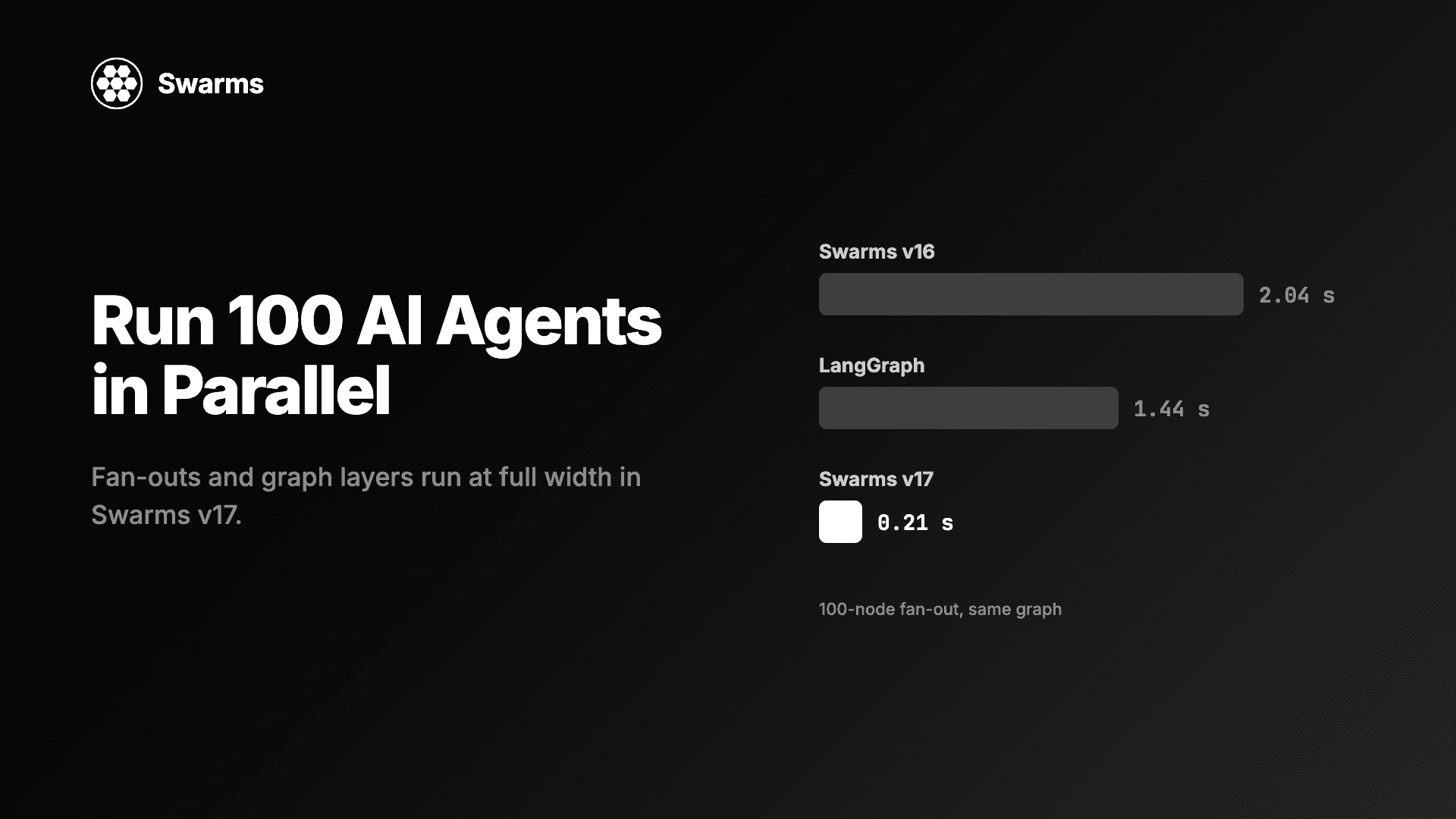
ConcurrentWorkflow used to cap its pool at 32 agents and GraphWorkflow sized its pool to CPU cores, so a 100-node layer on a 12-core machine ran in waves of 11. v17 runs every agent, and every node in a layer, at once. That is much faster for network-bound model calls, and it can also hit provider rate limits that the old cap happened to protect you from. If you see 429s or connection-pool warnings, set a cap:
from swarms import Agent, ConcurrentWorkflow

tickers = ["AAPL", "MSFT", "NVDA", "AMZN", "GOOGL", "META", "TSLA", "AVGO", "JPM", "V", "XOM", "LLY"]

screeners = [
    Agent(
        agent_name=f"Screener-{ticker}",
        model_name="groq/openai/gpt-oss-120b",  # a cheap, fast model for many parallel workers
        system_prompt=f"You screen {ticker}. Reply with one line: buy, hold or sell, and why.",
        max_loops=1,
        print_on=False,
    )
    for ticker in tickers
]

# v17 runs all 12 at once by default. Cap it if your provider rate-limits you.
workflow = ConcurrentWorkflow(name="Screen", agents=screeners, max_workers=4, output_type="dict")
results = workflow.run("Screen this stock for a 12-month horizon.")
print(len(results), "messages recorded")
It prints 13 messages recorded: the task plus one answer per screener. MAX_CONCURRENT_AGENTS is gone; max_workers replaces it. For graphs, the equivalent is GraphWorkflow(max_parallel_nodes=16). How to Run 100 AI Agents in Parallel in Python covers when and how to cap them.
Telemetry records more, and off means off
Telemetry is on by default, as in v16, but it records much more: every traced call's arguments, the full conversation of the structure that made it, token usage, and each model request and response. Dict keys that name credentials (ending in key or token, or containing secret, password, authorization or oauth, plus headers and env) are replaced with <redacted>. Message text and argument values are not scrubbed, so a secret pasted into a prompt is sent as written.
To opt out:
export SWARMS_TELEMETRY_ON=False
With telemetry off, no OpenTelemetry module is imported and traced methods run undecorated. The switch is read when Swarms is imported, so set it in the environment or a .env file, before the import.
Smaller default changes
tool_call_summary defaults to False. v16 made a second model call after every tool call to summarize its output. Pass tool_call_summary=True to restore it.stopping_token defaults to None, and when set it is now sent to the provider as a stop sequence.- Model catalog warnings (unknown model,
max_tokens above the limit, no function calling) appear only with SWARMS_STRICT_MODEL_CHECK=true. Set it in development if you relied on them.
- Streaming callbacks receive tool-call and thinking text, behind
[tool call] and [thinking] headers. Return values are unchanged. Filter on the headers or on token_info["type"].
- Model defaults moved to current models.
ModelRouter routes with gpt-5.4; AgentJudge, ReflexionAgent and GKPAgent default to gpt-5.4 (they defaulted to the retired openai/o1); ReasoningDuo's reasoning agent follows model_name; top_p and every built-in temperature are None, because current Claude models reject them.
SwarmRouter with MixtureOfAgents uses the last agent only as the aggregator (it also ran as a worker and judged its own answer), and GroupChat's max_loops counts agent turns.- Dependencies:
asyncio and setuptools are no longer installed. Install setuptools yourself if your own code needs pkg_resources.
Swarms v17 upgrade checklist
- Pin your current version, branch, and install
swarms==17.0.0 (or swarms[fast]==17.0.0).
- Run the grep from the top of this guide and fix every hit using the tables above.
- Give every agent a system prompt. Use
build_agent_system_prompt() only if you need the old persona.
- Set
output_type="final" wherever you treat run()'s return value as the agent's answer, and give nested swarms an output type that returns only their own output.
- Replace error-string checks with exception handling. Catch
AgentLLMError around agents, and use SwarmRouter(fallback_swarms=[...]) where you want a fallback structure.
- Check
fallback_models: the list must start with the primary model.
- Turn file output back on where something downstream reads it:
autosave=True and SWARMS_LOG_FILES=True.
- Set
max_workers or max_parallel_nodes for large rosters on rate-limited providers.
- Move stdio MCP servers to
MCPConnection(command=..., args=[...], env={...}).
- Review telemetry, and set
SWARMS_TELEMETRY_ON=False if your prompts carry data that must not leave your network.
- Check streaming consumers for the new
[tool call] and [thinking] text.
- Install
swarms[fast] once everything passes. RouteHub and rustworkx are drop-in, and SWARMS_LLM_BACKEND=litellm switches model calls back to litellm.
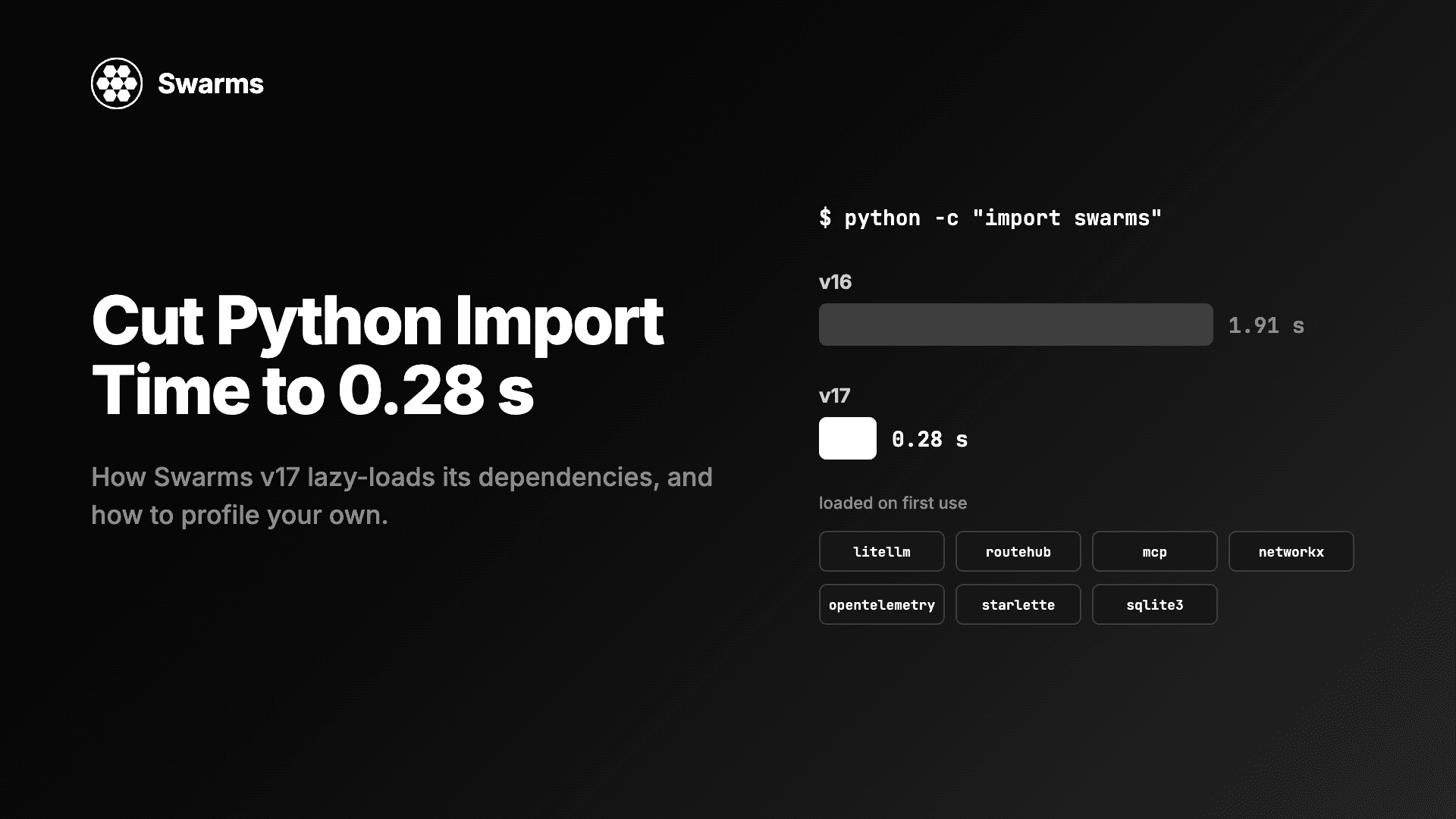
Upgrading also makes start-up much cheaper: import swarms went from 1.91 s to 0.28 s. If cold starts matter to you, Why Your Python Agent Framework Takes 2 Seconds to Import covers how to measure that in your own deployment.
FAQ
Will my v16 code break when I upgrade to Swarms v17?
Some of it will raise (removed classes, bulk_run, a few constructor arguments like idle_timeout and auto_generate_prompts), and that part is easy to find. The riskier part keeps running: removed keyword arguments such as multi_modal, sop and agents_config are silently ignored, Agent() stops sending a default system prompt, and swarms that returned error strings now raise. Run the grep in this guide and read the behavior changes before you deploy.
What replaces SwarmRearrange in Swarms v17?
AgentRearrange. Pass swarms in agents= next to ordinary agents and name them in flow, for example flow="Planner -> Research-Team -> Editor". Give each nested swarm an output_type that returns only its own output.
Why did my agent's answers change after upgrading?
Most likely the system prompt. v17 sends none unless you pass system_prompt, where v16 sent a generic built-in persona. Pass your own prompt, or build_agent_system_prompt() from swarms.prompts.agent_system_prompts to get the old one back.
How do I stop Swarms v17 from sending telemetry?
Set SWARMS_TELEMETRY_ON=False in the environment or in a .env file before Swarms is imported. With it off, no OpenTelemetry module is loaded at all.
How do I roll back to Swarms v16?
pip install "swarms==16.0.4". Pin swarms>=17,<18 once you have migrated, so the next major version is an explicit choice.
Get started
pip install -U swarms

# RouteHub for model calls and rustworkx for graphs
pip install -U "swarms[fast]"